







Jódar Castle
Monument
, Jódar
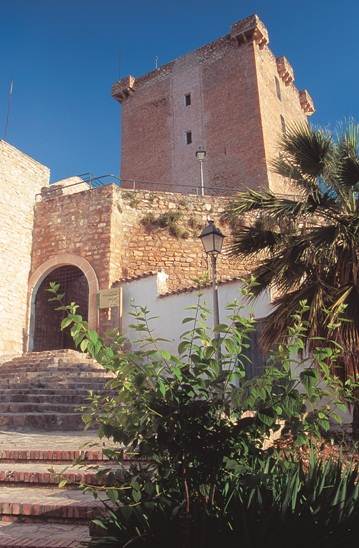
Jódar Castle, built during the Muslim period and renovated by the Christians, boasts two lines of defence: an outer enclosure, and an alcázar, or inner fortress comprising two large towers located at either end of the site, flanking the bailey. In the 17th century the castle was abandoned and its walls and towers deteriorated considerably; however, over the course of the 20th and 21st centuries a number of restoration projects have been carried out. The castle now houses the visitor centre for the Sierra Mágina Natural Park.
Jódar Castle has its origins in a small fortified hamlet from the time of the emirate. According to the documentary sources, it specialised in the production and exportation of olive oil and enjoyed significant growth until, by the 10th century, it had become one of the leading towns in the kura (region) of Jaén. In 1090, Jódar was conquered by the Almoravids and in 1161 it became part of the Almohad empire. The castle’s surviving rammed-earth walls may date to this period. Jódar fell into Castilian hands between 1227 and 1229, and became one of the most important settlements on the border with Granada. It also became the seat of a large feudal estate, which gave rise to constant clashes and changes of ownership. The two towers of the alcázar were built during this period. Jódar also played a part in other conflicts, such as the Carlist Wars and the Peninsular War, which had an impact on the castle’s defences.
Jódar Castle sits on a flat-topped rocky promontory 665 metres above sea level, overlooking the Bedmar, Jandulilla and Guadalquivir valleys.
Its origins have been traced back to a Muslim alcazaba, or citadel, which was constructed from irregular masonry and ashlars. After the Christian conquest the site underwent major alterations, with a particular focus on the two keeps that still stand in its interior. The castle boasts two lines of defence: an enclosure that is broadly oval in shape, and an inner fortress consisting of two large towers standing separately at either end of the site, flanking the bailey.
The north tower, also known as the Old Tower, is quadrangular in shape with dimensions of 15.30 x 12.60 metres. It was built during the 13th century. The tower’s entrance was probably located on the south façade and would have been positioned at the height of the first floor, leaving the ground floor unconnected to the rest of the tower. The north façade has two sets of arrow slits, which are longer on the second floor than on the first and have been partially blocked off.
The south tower, or New Tower, is also quadrangular in shape and measures 13.50 x 12.40 metres. It contains a cistern and a central wall and stands 41 metres from the north tower, guarding the double gateway providing access to the castle. This is accessed via the north façade. The south tower’s arrow slits are similar to those of its northern counterpart, while the interior boasts 16th century sail-vaulted ceilings and the remains of Mudéjar stucco.
The castle is also equipped with other defensive elements. At the south end there is a detached tower, hidden from view behind a residential building on Plaza del Castillo and abutting the section of wall housing the gateway known as the Puerta del Aire, above which runs a parapet connecting the two structures. At the opposite end, where the old castle entrance used to stand, the remains of a rammed-earth wall can be seen, which may have formed part of a tower that flanked the entrance.
Although the castle has been incorporated into the fabric of the town and is now surrounded by houses, at the end of the 19th century it stood entirely alone. Only parts of the north and east walls remain visible, as the houses stand apart from the main rampart and these sections of wall now form part of a courtyard area. The two towers are in better condition, although they have lost part of their perimeter wall.
The outer wall originally encircled both the alcázar and the old town. The west side of the wall followed the same line as the wall now surrounding the alcázar, while the north wall followed the line of Calle Alcázar. The layout of the east wall is not known. We do know that in 1905, permission was granted to demolish one of the towers forming part of the wall on Calle Isabel la Católica, and that the sources mention another tower located around 150 metres further on along the same street. In 1511, the wall housed a number of gates; however, the only one that has survived is the Puerta del Aire, which stands next to the current entrance to the castle.
Archaeological excavations have shown that this area has been occupied since prehistoric times, although it would appear that the greatest concentration of activity occurred during the Iberian period. The Sierra Mágina mountains are renowned for their rock art, and in particular the paintings found at La Graja de Jimena, Cueva de Morrón, and the rocky overhangs of La Golondrina and La Lancha in Jódar.
Numerous Ibero-Roman settlements have also been found, such as the oppidum of Loma del Perro. Many of these settlements, such as La Coscoja, El Castillejo and La Atalaya, survived into the Roman or medieval eras. During the time of the Roman empire, the fortified settlement on Cerro del Castillejo, which covered an area of 5 ha, stood out from many others. A large number of these settlements continued to thrive over the centuries that followed.
The settlement of Jódar (referred to as Šawdar in the Arabic sources) was a small quarya or hamlet that formed part of the emirate, and was subsequently equipped with fortifications that converted it into a hisn or walled town. Šawdar continued to grow until by the 10th century it had become one of the leading towns in the kura of Yayyan (Jaén). This growth was accompanied by the construction of new walls surrounding the town, along with important urban developments such as a drainage network and a mosque.
In 1090, Jódar was conquered by the Almoravids and in 1161 it became part of the extensive Almohad empire. It is likely that the castle’s rammed-earth walls date back to this period.
Šawdar came under Christian control between 1227 and 1229, as the result of a pact between King Ferdinand III and Abu l’-Ala, and went on to become one of the most important settlements on the border with Granada. It was during this time that the town became known as Xodar. Ferdinand III awarded the town to Sancho Martínez, who incorporated the toponym Xodar into his name, founded a sizeable feudal estate and went on to serve as the 2nd Governor of the Border from 1253 to 1258. For several years Xodar was the most important location on the border, which prompted Martínez de Xodar to strengthen its defences and build the Old Tower.
As part of the ongoing struggle to control the region, Fray Domingo, the Bishop of Baeza, and Rodrigo Ximénez de Rada, the Archbishop of Toledo, fought over Jódar and Garcíez until the former eventually came under the control of Baeza in 1243. However, the area remained unstable until the middle of the 14th century, which prompted the royal issuance of the fuero (charter) of Jódar in an attempt to prevent the town from losing its population. While it was part of the estate, the castle was subjected to major alterations. The parts of the castle wall and alcázar that had been damaged during the constant raids and attacks were rebuilt, and the New Tower was added to the complex.
Between the 14th and 15th centuries, the Jódar estate changed hands on various occasions. In 1521, during the conflict that broke out between the Benavides and Carvajal families in the Baeza region, Alonso de la Cueva attacked the town of Jódar (which at that time was controlled by the Carvajal family) and set fire to the castle, part of which was damaged. In 1618, Philip III raised the estate to the status of a marquessate, under the control of Gonzalo de Carvajal y Messia. In 1646, the marquessate passed into the hands of the Frías family, who left the area 25 years later and moved into the fortified palace at Tobaruela, leaving Jódar Castle in the hands of a castellan and administrator.
By the start of the 18th century the castle was in very poor condition, and a number of its structures had fallen down. In 1732 the town prison was moved into the New Tower, and a new entrance was opened up in the west façade for this purpose.
During the Peninsular War the castle appears to have been occupied by French troops, which resulted in fresh damage and alterations. In 1837, the Carlist Wars prompted further renovations in order to protect the castle’s weakest points, including blocking gates and other entrances. In 1885, following years of abandonment, Jódar was converted into a hospital for cholera patients. The castle eventually underwent a series of restorations over the course of the 20th century.
It is currently listed in Andalusia’s General Catalogue of Historical Heritage as a Site of Cultural Interest (under the category of Site of Historical Interest).
Follow us #JaénParaísoInterior


