






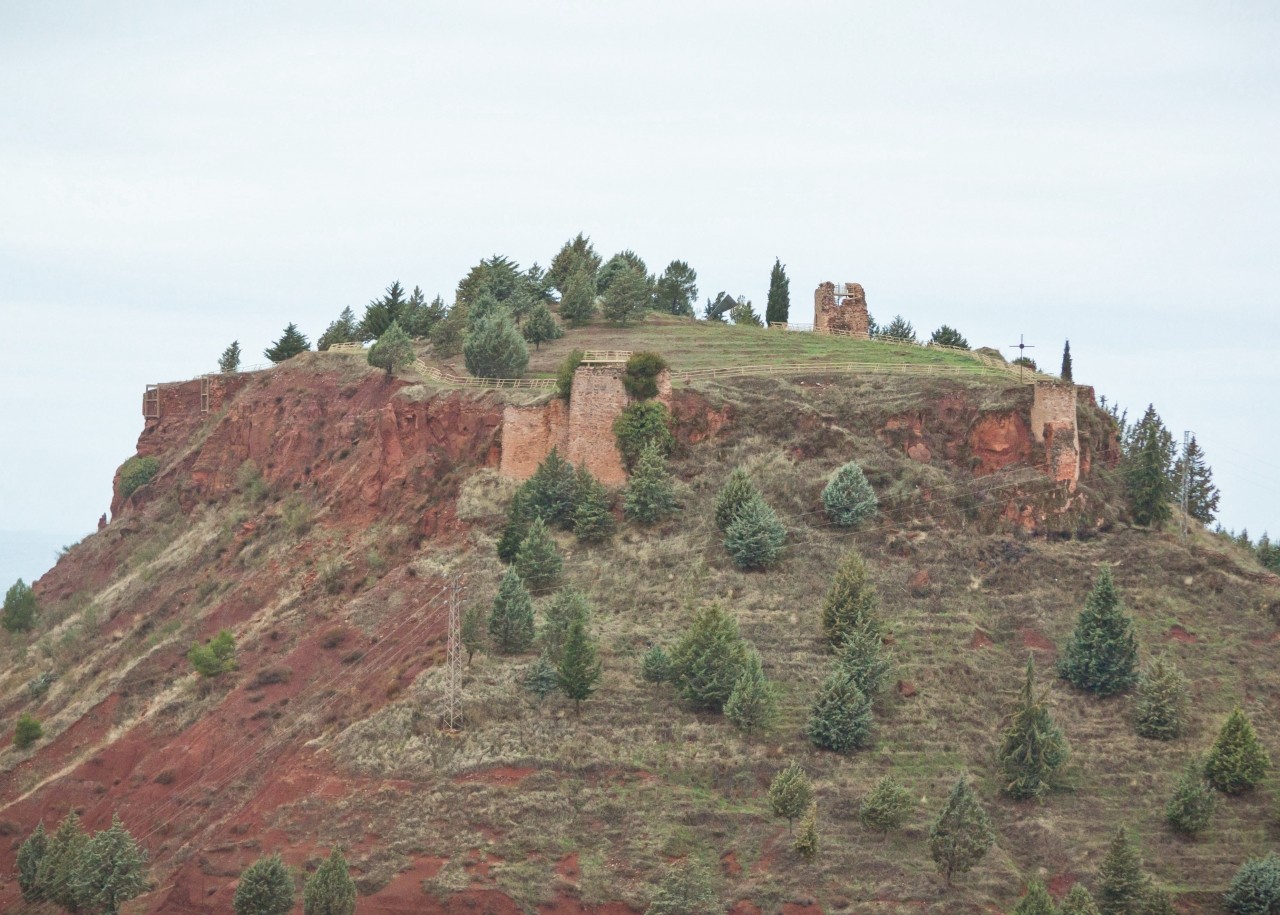

Castillo de San Esteban
Monument
, Santisteban del Puerto
Santisteban del Puerto and its term are located between the left bank of the Guadalimar and the southern edges of the Meseta. Its forms are gently hilly and it accumulates a great diversity of ecosystems.
The Castle was located on a flat hill, with an almost rectangular walled perimeter, 820 meters high and about two hundred meters in diameter. Its defensive system reached part of the population. From the fortress the castles of Vilches, Torre Alver, Iznatoraf and Chiclana were connected.
Historical facts
As is usual in the Alto Guadalquivir, the origin of Santisteban dates back to an old Iberian settlement, thus, in the time of Emperor Hadrian there was an oppidum known by the name of Ilugo, located near the current town.
Romanization entered a crisis in the second and third centuries of our era and, during the Visigothic period, the original name of Ilugo was changed to that of San Esteban.
In Muslim times the municipality was known by the name Sant Estiban, being the head of an Iqlim or district, according to different Arab chronicles. Since the beginning of the Arab invasion, this area will be subjugated on different occasions as a strategic place of passage towards Toledo. The route through the region of important Roman roads (Augusta or Camino de Aníbal) caused it to be a common route during the Arab occupation.
Being an artery of communications and a stronghold due to its orography, it was also worth being the protagonists of the struggles between the Banu Habil against the central power of the Umayyad.
In 914, Santisteban castle was occupied by the four Banu Habil brothers. One of them, Habil, was attacked by a Cordovan army. The rebel reached an agreement with Abd al-Rahman, by means of which he promised to serve the emir and participate with his people in the expeditions that he carried out, but on the condition that he was allowed to continue living in Sant Astiban.
In 924 Abd el-Rahman III for twenty-five days closely surrounded the castle of San Esteban and had up to six forts built in its surroundings to tighten the siege and, not being able to continue it personally, he ordered his generals to surrender the fortress. The siege rescued this square for the Umayyads.
Its defensive system, when the Caliphate of Córdoba collapsed, became more complex and effective. The fortification was restructured by providing it with walls with mortar wall, the suburb was widened, the channeling of water was improved, the population was provided with fountains and cisterns and a strong citadel was built on the top of the hill.
This castle was besieged in 1225 by Ferdinand III the Holy, to whom the Muslims surrendered in 1226. Santisteban gave himself in exchange for a sum of money and mules.
With this, a serious deficiency was rectified: until then, the Andalusian conquests of Castile had been linked to it by a narrow umbilical cord (the territory between the basins of Jándula and Guarrizas). With the acquisition of Iznatoraf and Santisteban, the roads to Úbeda and Baeza were secured.
Although, in principle, the king gave it the rank of royal land, from 1254, Alfonso X donated it to Úbeda, although by mandate of Sancho IV, in 1285, it regained its status as a royal village, assigning it custody of the port of Montizón. This situation persisted until Fernando IV, in 1300, granted it a lordship to the Order of Calatrava, although only three years later it regained its status as a royal land.
The preponderant role of the county capital, in the late Middle Ages, led to the castle being equipped with a rectangular tower, currently very deteriorated, which opened with a Gothic arched door, covered inside with a pointed half-barrel vault and, In 1337, Alfonso XI consolidated the fortification complex, by building a new and solid wall that ran through what would later become the palace of the Dukes of Medinaceli, with accesses such as the gates named Ojo de la Villa, los Tiradores del Salteadero , the Baeza and the Nueva or the Holy Spirit.
Starting in 1371, Enrique II made Santisteban a lordship in favor of Men Rodríguez de Benavides, also including Navas and Castellar. In 1473 Enrique IV granted Díaz Sánchez de Benavides the title and privilege of County of Santisteban and this was confirmed by the Catholic Monarchs.
It was declared an Asset of Cultural Interest in the BOE on June 29, 1985.
Description
Around the escarpment of the plateau the oppidum and the high medieval castle were successively organized. On this settlement the Berbers built a very cobbled calicanto enclosure that crowned the hill in lathes in the 11th and 12th centuries. To settle it, they had to partially excavate the edge of the escarpment and then, once the wall was completed, they filled in the interior space, thereby contributing to the leveling of the natural plateau.
This work was completed with another Christian work in the thirteenth century in which more than two thousand people could comfortably fit.
The castle, measuring 62 by 140 meters, had both solid and hollow towers. The only tower that remains today, whose basic function was to protect and monitor access to the castle, is rectangular in shape, and measures 6.10 by 5.30 m on a side.
The entrance to the tower was through a door topped by a pointed arch. On one of the door jambs, close to the ground, a masonry features a roughly carved potent cross. The inner chamber was covered with a pointed barrel vault.
Apart from the castle, there were walls built in 1337 of which there are still vestiges in the town, thus, on the north side you can see remains of a wall that went down the slope to another small hill known as La Torrecilla, in which there was a tower that completely disappeared and that closed the town to the west; or you can also highlight a rectangular albarrana tower that is today the bell tower of the church of Santa María.
The inhabitants of the castle communicated with the town by means of mines that started from the center of the plateau and measured about seven hundred meters.
From its Iberian-Roman past, countless archaeological remains have been found: Iberian bronze and clay votive offerings, polychrome necklace beads, pre-Roman and Roman ceramics, and coins from these times.
Follow us #JaénParaísoInterior


