






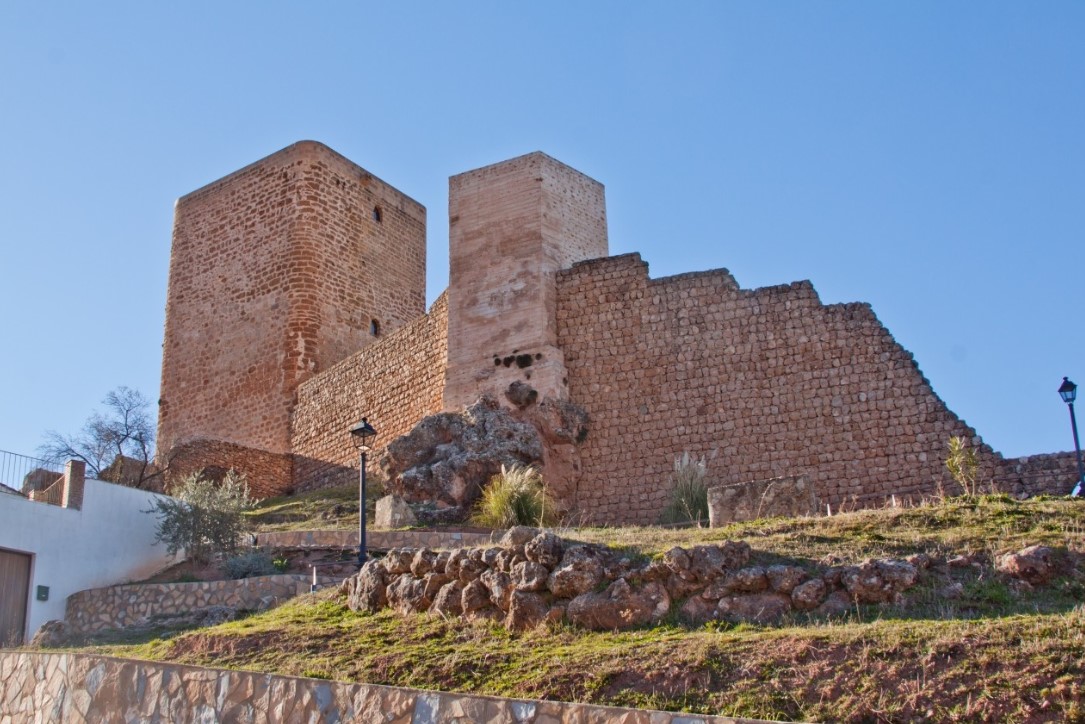

Hornos Castle
Monument
, Hornos de Segura
How to get
Hornos Castle stands atop a limestone promontory 890 m above the plain of the River Hornos, in a wide valley that separates the mountain ranges of Segura and Las Villas. The structure we see today was built by the Order of Santiago in the 13th century on top of a Muslim fortification, of which the remains of three square-shaped towers and a cistern have survived. The Christian-era castle comprises a trapezoidal enclosure, the longest side of which incorporates a large keep and another smaller tower. There are also remains of the enclosure that surrounded the town centre, including the original gateway, known as the Puerta de la Villa. This masonry tower is two storeys tall and has an L-shaped entryway. Nowadays, the castle is home to an astronomy centre called the Cosmolarium.
Like Segura de la Sierra, the origins of Hornos probably date back to the 10th century. The town’s location high above the valley afforded complete control over the surrounding territory, in conjunction with its neighbours Segura and Catena (La Espinareda). Originally known as Hisn Fornus, between the 11th and 13th centuries the settlement must have attained a certain size and defensive capacity, as it was one of the few towns in the region to be worthy of mention. After it was conquered by the Castilians in 1239, King Ferdinand III handed Hornos over to the Order of Santiago, which built the castle on the remains of the Muslim fortress. The town was granted the status of villa during the first half of the 13th century.
Written records refer to Hornos as a hisn, or fortified settlement. The structure which has survived to date is Castilian and dates to the late medieval period, although a number of elements imitating the Muslim style still remain. It is slightly trapezoid in shape, with both a large keep and a smaller tower standing on the longest side of the enclosure against the south-east wall. The main cistern, of Muslim origin, is inside the enclosure, between the two towers. The south side of the castle makes use of the rocky terrain of the promontory, which provides a natural shield. Defensive walls were added in the more vulnerable sections.
The keep is square in shape and built of masonry, with rounded corners. Internally, it is divided into three floors. The lower floor contains a rocky platform housing a cistern, which is accessed via the middle floor. Access to the keep was also via this floor, through an entrance raised several metres off te round. A staircase built into the wall leads up to the top floor, which (like the middle floor) has rooms covered by half-barrel vaulted ceilings.
Although the keep and part of the castle complex have been restored, on the unaltered sections of wall and on the smaller towers we can still make out the original blocks of irregular masonry, cemented together and clad with mortar.
Originally, the castle wall was extended to form an enclosure surrounding the town centre. Nowadays, two of the square-shaped defensive towers remain, one of which forms part of a more modern building. The Puerta de la Villa has also survived. This is an L-shaped gateway located inside a two-storey masonry tower crowned by a connecting parapet housing a number of arrow slits, which formed part of the original Almohad enclosure.
Hornos Castle underwent extensive restoration in 1973, while the town was declared a Site of Historical and Artistic Interest in 1985. Today, the castle is home to the Cosmolarium, an astronomy centre and planetarium where audio-visual content is projected onto a full-sized dome.
A number of prehistoric settlements have been discovered in the mountains around Hornos; however, at the end of the Bronze Age and the start of the Roman period, only the valleys and the most open areas were inhabited.
During the Roman occupation the valleys contained small, scattered settlements, but between the 2nd and 3rd centuries, land ownership appears to have undergone a process of becoming more concentrated. From the 6th century onwards, under pressure from the landowners, the peasant population fled from the large estates into the more inaccessible parts of the mountains, where they remained for several centuries. The large settlement of Segura La Vieja is one example of this process.
Between the 8th and 10th centuries the mountain communities likely returned to the valleys of the Segura region, which was at that time controlled by the Muladís. The sites for their settlements would have been chosen on the basis of their strategic position and access to plentiful water sources. Hornos was probably founded in line with these criteria around the 10th century (as was Segura de la Sierra), however, it is not mentioned in Arabic sources prior to the 12th century, or even during the Castilian conquest. Its location above the valley afforded Hornos, in conjunction with its neighbours Segura and Catena (La Espinareda), comprehensive control over the surrounding area, which was an important centre of irrigation farming. Named in the sources as Hisn Fornus, the town began life as a fortified hamlet protected by its precipitous location and encircling walls. It formed part of the territory controlled by the Muladí rebel Ibn al-Saliya during the fitna (civil war) that took place towards the end of the 9th century.
Although very few settlements in the area were mentioned between the 11th and 13th centuries, Segura and Hornos are clearly referenced in Arabic sources. During this period they became more important, especially Segura, to which there are many surviving references. Hornos is also mentioned repeatedly, although it appears to have been somewhat smaller and with lesser defensive capacities.
The town was abandoned shortly after the Castilian conquest, which suggests that it must have been of little importance at the time. However, the population eventually returned and gradually increased. Following its conquest in 1239 by Pedro Pérez Pelayo Correa, Master of the Order of Santiago, Ferdinand III (popularly known as El Santo, or “the Saint”) granted Hornos the status of villa and gave it to the Order, which built a castle on the remains of the Muslim fortress.
Along with Segura de la Sierra, during the 15th century Hornos was one of the focal points for the political activities of the Manrique family, which opposed John II and Henry IV of Castile. As the Manriques controlled a large part of the Order of Santiago’s resources, Rodrigo Manrique, the Commander of Segura, proclaimed himself Grand Master of the Order, resisting and defeating the troops of Juan II and Álvaro de Luna at Hornos.
The town remained part of the Order’s feudal estate of Segura de la Sierra throughout the early modern period, and was part of the kingdom of Murcia between 1507 and 1748.
Follow us #JaénParaísoInterior


