





- Winter, October to May: Tuesday to Sunday (closed on Monday), 10:00 to 13:00. Guided tour of the Cerrillo Blanco archaeological site at 13:00.
- Summer, June to September: Tuesday to Sunday (closed on Monday), 11:00 to 14:00. Guided tour of the Cerrillo Blanco archaeological site at 09:00.
- For groups outside of these visiting times, please contact the telephone numbers: 953 544 004 / 666 445 513.
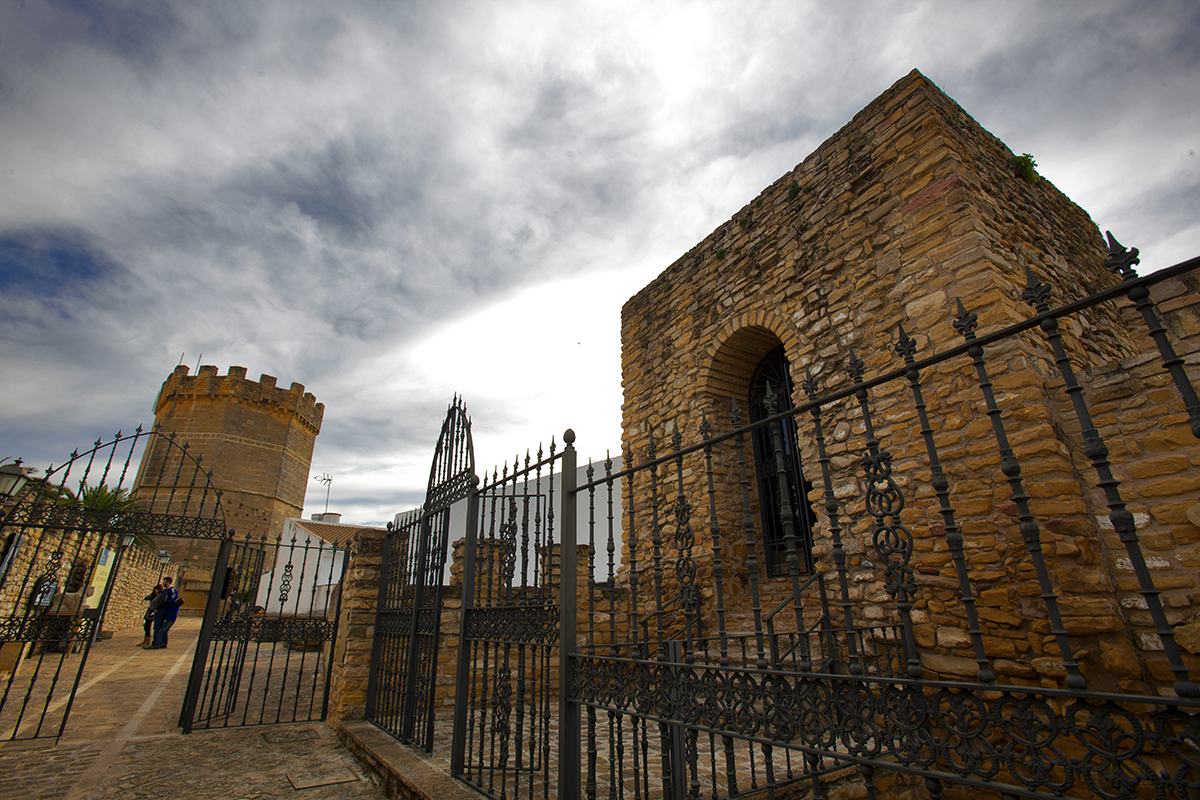
Walls and Tower of Boabdil
Monument
Calle Jose Moreno Torres, s/n. 23790, Porcuna
From the Islamic era onwards, Porcuna was defended by two walled enclosures built of sandstone. The first and largest enclosure surrounded the town, while the second comprised a political and military complex located at the east end of the town. As the town grew during the Late Middle Ages it expanded beyond its walls, which resulted in the creation of fortified arrabals or suburbs. These have since disappeared as a result of gradual abandonment, the impact of the Lisbon earthquake of 1755 and the urban redevelopment of the 19th and 20th centuries. Nonetheless, archaeological excavations have brought Porcuna’s medieval defences to light once more among the residential buildings of the modern-day town. The most iconic remnant of the old fortified complex is the octagonal New Tower, which was built in the Gothic-Mudéjar style by the Order of Calatrava in 1335. Today, it is home to the Porcuna Museum of Archaeology.
The site occupied by modern-day Porcuna stands out for its height, commanding views and abundant water sources, and it is due to these qualities that the site has been inhabited from the 3rd millennium BC to the present day. The Muslim settlement known as Hisn Bulkuna was built on the site of the Roman settlement of Obulco, of which numerous traces remain, including the amphitheatre, the cistern of La Calderona, the fortified enclosures of El Comendador and Jabonero, and the noble residences in the San Benito district. Its strategic location within the Campiña sector of the Upper Guadalquivir region made Hisn Bulkuna the seat of an iqlim (administrative district), responsible for collecting the taxes for the entire region. The Muslim settlement reached its zenith during the 12th and 13th centuries. Subsequently, it was conquered by Ferdinand III in 1240, who granted it to the Order of Calatrava, and Porcuna thus became an important commandery within the large feudal estate that the Order amassed in the south-west of the kingdom of Jaén. Around that time, the town’s defences were strengthened in view of its proximity to the border with the Nasrid kingdom of Granada. Towards the end of the 15th century, King Boabdil of Granada was temporarily imprisoned in the alcázar (fortress) of Porcuna after he was defeated and captured at the Battle of Lucena in 1483.
Information

Schedule

Although the Roman settlement of Obulco was still important during the Visigothic era, it seems to have undergone significant decline. The town that the Muslims encountered was smaller than the Roman settlement and required defences that were better suited to its reduced size. Thus, Hisn Bulkuna, as they named it, was given a new wall and the highest point of the town, housing the majority of its civic, residential and religious buildings, was strengthened, to which end some of the old defences were repurposed. Recent archaeological excavations have provided the first hypothesis of the outline of the town’s Muslim wall, beyond which there were also extensive arrabals. The walled enclosure was crowned by 17 towers, of which eight are still standing. The population reached its height around the 12th and 13th centuries, while the town’s defences remained in place until they disappeared between the 17th and 18th centuries.
After the Castilians gained control of Porcuna, probably around 1240, the Order of Calatrava proceeded to strengthen the town’s defensive capabilities, which involved organising the settlement into three distinct areas. There was the alcázar, which served as a fortress and residence of the commander; the town centre, which stood on the site formerly occupied by the Islamic alcazaba, or citadel; and the walled residential areas adjoining the town centre, whose fortifications were known as the “lower walls”. We also know, from descriptions in the documentary sources, that a palace complex was built between the 14th and 15th centuries. In turn, the upper enclosure or alcázar had eight towers, of which the remains of five – some dating back to the Muslim era – have survived. There would also have been a keep, which has since disappeared and may have stood in the centre of the alcázar, and the imposing New Tower.
The interior of the enclosure was divided into two sections: a military area to the north, which housed the keep and its service areas (bread ovens, a kitchen, stables etc.); and a more palatial area to the south, which housed a number of important buildings including the Church of Santa Catalina, the armoury, and various residential and administrative spaces used by the Master of the Order.
Three of the town’s gateways have been identified: the old Puerta de la Villa, of which the Arco de los Remedios, an arch standing next to the Town Hall, may have formed part; the Puerta de Martos, which is near the New Tower; and the Puerta Meridional, which now forms part of a residential building on Calle Aguilera. A detached tower has also been identified, which stood in front of the wall and was connected to it by a central passageway covered by half-barrel vaulting at the front and lowered vaulting at the back.
The south end of the alcázar was protected by the New Tower, popularly known as Boabdil’s Tower as according to the sources, Boabdil was imprisoned there after being captured at the Battle of Lucena. This Gothic-Mudéjar tower has an octagonal layout, adjoins the alcázar walls and stands at a height of 28 metres. Its entrance is defended by a machiolation at the top of the structure, and just like the tower’s inner doors it is framed by a pointed arch. The windows on the first floor are set within multi-lobed double arches, which can also be found on other fortifications within the Order’s feudal estate in the Upper Guadalquivir region. The parapets on the tower’s terrace are raised on corbels, giving the appearance of a continuous machiolation. On the south façade there is a panel bearing the cross of the Order of Calatrava flanked on both sides by the coat of arms of the Guzmán family. We can also make out the following inscription: THE CONSTRUCTION OF THIS TOWER WAS ORDERED BY THE MOST VALIANT AND NOBLE KNIGHT LUIS DE GUZMAN, BY DIVINE PROVIDENCE THE MASTER OF CALATRAVA, IN THE YEAR OF OUR LORD ONE THOUSAND AND CCCXXXV.
Internally, the tower has a solid ground floor, above which are two upper floors and a terrace, all of which are linked by stairs built into the north wall of the structure. The rooms are covered by rib-vaulted ceilings supported by corbels decorated with plant motifs, with keystones incorporating the heraldic emblem of the Order. Today, the tower houses the Porcuna Museum of Archaeology.
In the 17th century, the loss of its military function led to the gradual deterioration of the alcázar; a process that culminated with the Lisbon earthquake of 1755, which had a major impact on this area and caused extensive damage and destruction to the walls and towers. The bombardments inflicted during the Spanish Civil War also caused a great deal of damage to the remaining fortifications. Changes in the layout of the town ultimately concealed the defensive enclosures from view, and while some parts of the walls and towers survived by being put to use as dividing walls for residential buildings, sadly others were demolished. Additionally, since the middle of the 20th century the New Tower has undergone a number of aggressive interventions, which have altered its original appearance.
Cerro del Castillo is one of a series of flat-topped hills, and the town of Porcuna is spread out across several of these. The earliest occupation of Porcuna occurred between the Neolithic and Chalcolithic eras, in the 3rd millennium BC, when a community was established on the hills of Cerro de los Alcores and Cerro Albalate. This settlement survived into the Bronze Age and on into the Iberian period, when it became a polis known as Ipolca. Around the 7th century BC the settlement was transferred onto Cerro del Castillo, which is taller than the others.
Archaeological excavations appear to indicate that during the time of the Roman Republic, a substantial wall was built around the settlement (which at that time was known as Obulco). This wall survived until the end of the High Roman Empire, when some parts of the town began to be abandoned. Although the town remained important within the local area, it appears to have undergone significant decline during the Visigothic period.
In 1232, Muhammad ibn Yusuf ibn Nasr ibn al-Ahmar (popularly known as Alhamar, and also as Muhammad I), who was born in Arjona, proclaimed himself sultan in Jaén and one year later extended his rule to encompass Porcuna and Córdoba. In 1234, he declared fealty to Ibn Hud (who had been appointed governor of Andalusia by the Abbasid caliph) in exchange for Ibn Hud’s recognition of his status as king of Jaén, Arjona and Porcuna. Between 1240 and March 1241, King Ferdinand III managed to capture this area and immediately granted it to the Order of Calatrava. The Order then made it one of the main commanderies in the feudal estate it had amassed in the Upper Guadalquivir region.
The 13th and 14th centuries were marked by instability as a result of continuous Muslim incursions into the area. The Battle of Lucena in 1483 resulted in the defeat and capture of King Boabdil of Granada, who was imprisoned for a time in Porcuna. Consequently, the town’s New Tower became popularly known as “Boabdil’s Tower”.
At the end of the 17th century the Crown withdrew its funding for the maintenance of the Order of Calatrava’s fortifications, thereby kick-starting a process of abandonment and ruination. The Lisbon earthquake of 1755 had a major impact on Porcuna and caused serious damage to its defensive structures, which had already suffered significant deterioration.
Other services
For groups outside these hours, contact the phones: 953544004/666445513.
? ![]()
Follow us #JaénParaísoInterior


