





- Thursdays and Wednesdays: from 11.00 to 14.00 h.
- Saturdays: from 11.00 to 14.00 h. and from 19.00 to 21.00 h.
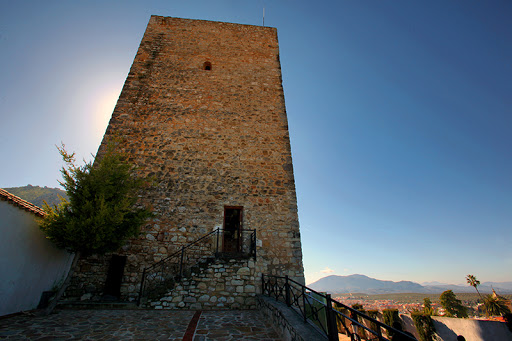
Castles of La Villa and La Peña
Monument
Calle Primero de Mayo, 34. 0, Martos How to get
Martos sits at the foot of a rocky promontory known as La Peña, a strategic location within Jaén’s southern Campiña region that stands out for its impressive height (1,003 metres). Within the town there is a rocky spur that has been occupied since prehistoric times; over the centuries it has been home to fortifications built during the Iberian, Roman, Islamic and late medieval Christian eras. In the centre of modern-day Martos we can still see the remains of a 13th century castle, including a keep and the imposing Almedina Tower. Above Martos, perched on the summit of La Peña, are the remains of an alcázar, or fortress, built by the Order of Calatrava. The alcázar has an irregular layout and stands within a walled enclosure, from where it presides over the entire region.
The origins of these fortifications go back to prehistoric times and the establishment of a Copper and Bronze Age settlement. Known as Tucci in the Iberian and Roman eras, it was located in the area occupied by modern-day Martos and continued to be important into the Visigothic era, when it became a bishopric and had its own mint. The town remained prominent throughout the Middle Ages owing to its great strategic value, and was fought over by rival factions during the fitna (civil war) of the late 9th century, during the time of the taifa kingdoms, and during the advance of the Christian armies in the 13th century. Martos was the seat of the extensive commandery created by the Order of Calatrava after the Christian conquest, and was strengthened with the addition of two fortified complexes in view of its border location and its involvement in a number of historic conflicts. These included the territorial expansion of the Castilian armies during the 13th and 14th centuries, and the struggles between noble families that broke out in the second half of the 15th century.
Information

Schedule

Information and bookings
In the Islamic era Martos had an alcazaba, or citadel, which occupied the site of the old Ibero-Roman fortification and was built between the 11th and 13th centuries. It also had a hisn, or fortified refuge, on the summit of La Peña. Both fortifications were constructed from rammed earth and mortar on a masonry base. There is little evidence of these structures today, save for a few sections of wall in the town centre.
It was after the area was granted to the Order of Calatrava by Ferdinand III in 1228 that the defensive complexes we see today took shape. They were built on two separate sites: one on the towering rocky massif known as La Peña, and the other on a broad rocky spur known as Cerro de la Villa, which stood on the massif’s north-west slope and was the location of the original urban settlement. In the Late Middle Ages these two complexes were linked via several stretches of wall, as part of the major modification of the town’s defences carried out by the Order.
The alterations made to the Muslim fortifications included cladding (or in some cases replacing) the old walls with masonry, and adding new defensive elements such as solid towers (both circular and square-shaped), outer walls, barbicans, and more.
At the highest point on Cerro de la Villa the Order constructed the alcazaba, a walled complex demarcated by a streambed and built on the remains of the Muslim fortification. This complex is popularly known as the lower fortress or La Villa Castle, and comprises three enclosures.
In the centre of the complex, and at the highest point of Cerro de la Villa, a fortress with a quadrangular layout was constructed during the first half of the 13th century. A key feature of this fortress is the square-shaped keep, which is located at the west end of the site and has four storeys, the lowest of which houses a cistern. The main entrance was located opposite the keep on the east wall and was protected by the Almedina Tower. This square-shaped tower has several floors and houses a cistern, which was dug out of the rocky foundation and covered with a barrel-vaulted ceiling made of brick. There is a quadrangular opening in the ceiling that serves as a wellhead for the extraction of water.
Adjoining this fortification to the west is another large enclosure that served as the castle bailey, and during the second half of the 13th century a third defensive enclosure was added at the east end of Cerro de la Villa in order to serve as an outer fortification. This complex was equipped with a variety of service areas, such as stables, storage rooms, bread ovens, wine presses and cellars.
The castle on the summit of La Peña, from where most of the Order’s possessions could be seen, sits on a large plateau that slopes sharply from south to north and is accessed via a narrow trail that winds its way up the south slope. The irregularly shaped enclosure, which takes full advantage of the natural defensive features of the steep slopes and rugged terrain, encircles the entire plateau and is reinforced by a series of circular and square-shaped defensive towers.
The interior of the site was accessed via a gate tower, which opened out onto a large space containing a number of buildings and two large water tanks, one of which was left as an open pool while the other was covered with a brick groin-vaulted ceiling. At the highest point of the plateau an alcázar was built, with an irregular layout incorporating a large rectangular keep standing four storeys tall. The ground floor of the keep probably housed a cistern.
The alcázar was separated from the rest of the plateau by a large moat dug into the rock, which was protected by an outer wall equipped with a drawbridge leading to the fortress’ entrance.
Following the conquest of the Nasrid kingdom of Granada these fortifications were left largely unchanged, particularly La Peña Castle. This only served to accelerate the process of abandonment and deterioration it suffered over the course of the 16th century.
In Martos town centre and the surrounding area evidence has been found of Neolithic occupation related to the process of sedentism. The subsequent development of a production economy from the end of the 4th millennium BC onwards led to the establishment of a Copper Age settlement; a number of dwellings and storage silos forming part of this settlement were discovered during excavations in the area around Martos’ municipal sports centre.
The Iberian period saw significant structural changes in the distribution of settlements in the area, and the years between the 5th and 4th centuries BC witnessed the proliferation of oppida or fortified settlements scattered throughout the ancient territory known as Tucci. The largest of these settlements was located on Cerro de la Villa (the site of modern-day Martos), the highest part of which was used as an acropolis.
During the Roman era, Augustus founded the Colonia Augusta Gemella between 15 and 14 BC, possibly near the settlement of Martos (hence the inclusion of the term gemella, “twin”, in the Roman name). Archaeological findings from Martos reveal the monumental nature and great importance of this settlement during the time of the Roman Empire; its forum, for example, was located in the area now occupied by the Church of Santa Marta.
Between the 5th and 7th centuries Tucci was part of the province of Baetica, and minted coins from the end of the 6th century and throughout the 7th century. It also became a bishopric. The remains of a Visigothic basilica and associated burials from this period have been found in the area around the municipal sports centre, along with traces of a road that led from this area towards the town. Artefacts discovered in the town centre include a spectacular Early Christian sarcophagus from the 4th century, which is now on display at the Museum of the Province of Jaén.
Throughout the Early Middle Ages, Martos’ privileged location overlooking the routes of communication with Córdoba and Granada gave it great strategic value, which in turn meant that the town was fought over during the fitna of the late 9th century. Over the course of that century, Martos underwent significant development and was incorporated into the kura (region) of Yayyan (Jaén), becoming one of its main administrative districts (referred to as the iqlim of Martus). The crisis that engulfed the caliphate, followed by the advance of the Christian armies, turned the Upper Guadalquivir region into an endless battlefield with both sides carrying out attritional incursions. As a result, the border regions were extensively fortified.
Jaén’s Campiña region was conquered by Ferdinand III during the first half of the 13th century (1224-1240). The various territories he granted to the Order of Calatrava in gratitude for its collaboration during the military campaigns led to the creation of the Grand Commandery of Martos, which occupied a border region of vital importance owing to its proximity to the territories controlled by Granada and Córdoba and the main routes of communication. The Order embarked on an intense programme of fortification in order to maintain military and administrative control over this extensive border territory, creating a network of strongholds that provided a solid defensive barrier and offensive platform.
Martos’ castles played an important role as border bastions during the process of territorial expansion carried out by the Castilian armies in the 13th and 14th centuries. Subsequently, during the second half of the 15th century they became embroiled in conflict once more within the context of the clashes between noble families that broke out during the reign of Henry IV of Castile, in which those loyal to the king fought the supporters of a coalition of noblemen led by Juan de Pacheco, the Marquess of Villena, and Pedro Girón, the Master of the Order of Calatrava.
LEGENDS
“The Legend of the Carvajal Brothers”. Brothers Pedro and Juan de Carvajal were accused of murdering a member of a rival family, Juan de Benavides. When King Ferdinand IV came to Jaén he presided over their trial and barely gave them time to plead their case before ordering that they be locked inside a cage lined with spiked rivets and flung from the top of La Peña. Moments before the death sentence was to be carried out, the brothers rebuked him: “Remember these words. As God is our witness, we are innocent; and you will be summoned to face His divine justice within one month. We will be waiting for you there, to see you tried for your crime.” A few days later, the king fell ill; but not long afterwards, and quite inexplicably, he woke up one day feeling completely cured and convinced that his illness had just been a coincidence. That same day, after eating and drinking copiously, he laid down for a nap from which he never woke up. It was 7 September, the very day on which the deadline set by the Carvajal brothers was due to run out; and from that day on, Ferdinand IV became known as “the Summoned”.
“The Legend of Lady Mencía de Haro”. Alvar Pérez de Castro, the Governor of Martos, had to go away for a while, so he left his estate in the hands of his young nephew, Tello. However, Tello took this opportunity to ride out with the majority of the governor’s men and make an incursion into Arab-controlled territory. Al-Ahmar, the Emir of Arjona, took advantage of their absence to attack Martos, as he believed it to be unguarded.
Countess Mencía de Haro, the wife of Alvar Pérez, took charge of the situation by ordering the soldiers’ wives to don military uniforms and stand on the walls and towers of La Peña Castle, thereby making the attackers believe that the castle was well-defended. When Tello heard what was going on, he hurried back to stop the attack and made the Muslims beat a hasty retreat.
Other services
Guided tours.
? ![]()
Follow us #JaénParaísoInterior


