

WILD FAUNA SIGHTING AREAS
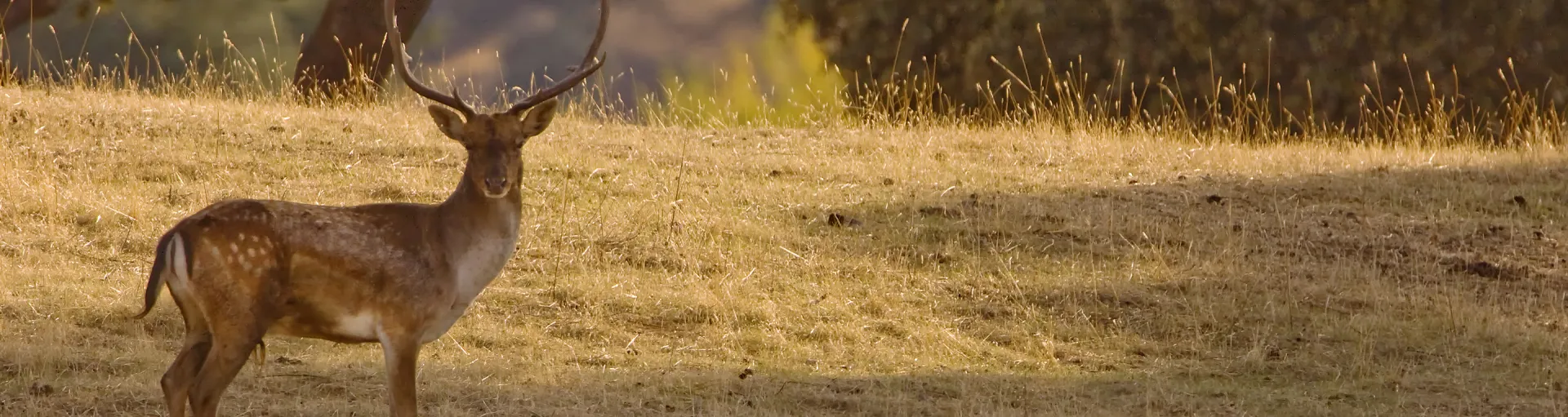
Deers, wowls, muflons, mountain goats, boars and various rapacious birds are very abundant, as a result of the southern part of the territory, its great extent and its good conservation.
But a number of considerations must be taken into account in order not to be disappointed in your expectations and in order that your activity does not disturb animal life:
The presence of wild animals is always unpredictable. Nowhere or at no time can one ensure that there will be sightings. Even if it's obvious, don't forget that the Park is not a zoo.
Most sightings occur at a long distance. It's important to take binoculars.
The observation of wild fauna depends on various environmental conditions, especially the weather, as well as the time of year and time of day. Generally, to see great herbivores you have to take advantage of the first and last hours of the day. However, the great rapes become more visible during the central hours of the day, as they take advantage of the warm thermal currents for the flight.
The color of the fur of the great herbivores the camouflage in the middle, so it is necessary to have patience and constancy in the observation. The most common is to detect their presence when they move.
- The changes we produce when we are in the environment in which animals live must be minimal. Some rules and attitudes will facilitate your observation and make it less difficult for them:
- Try to go unnoticed. It is better to go alone or in small groups, and with appropriate dress of unstriking color. Note that, in all likelihood, animals will detect your presence long before you, as fear of us is inscribed in their genetic memory after thousands of years of being persecuted by the
On the other hand, keep in mind that, in addition to the great herbivores and rapaces, the Natural Park is full of many other animals whose observation
You can find it very rewarding.The squirrels are abundant, as are the forest birds (coal, horseradish, myths, pinches, etc.) and many other birds. The unmistakable singing of small night raptures, such as the carabo and the autillo, are common in the forests of the Park and in the surroundings of villages and villages.
In the rivers you can see the water myrtle, living in the fast and clean waters. And, of course, to the trout. Thousands of invertebrate species, as well as small amphibians and reptiles will be offered in your sight... sometimes, there is no more exciting hunting scene than that of a simple Salamanca that haunts with infinite patience mosquitoes on the white walls of a cortijo, on the fresh and starry summer nights.
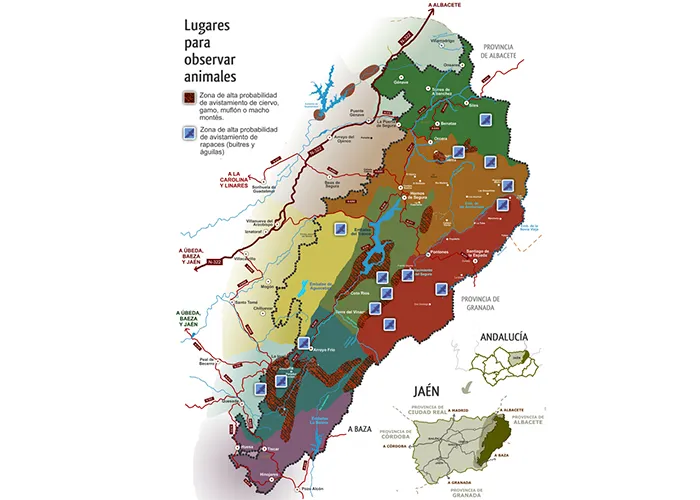
All over the Natural Park you can see wild fauna, but on this map we suggest a number of areas and enclaves where it is easier to observe the great herbivores and rapaces.
PATHS OF ORNITHOLOGICAL INTEREST
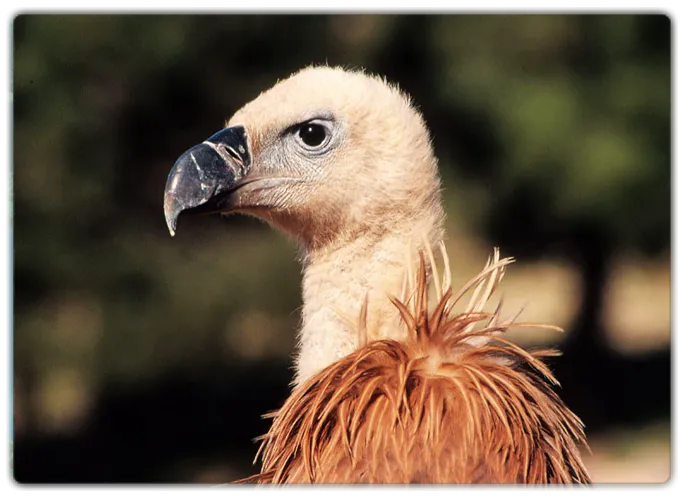
In the southern area of the Park and its nearby environment there are ten paths of Ornithological Interest. They are all in easily accessible places of great landscape beauty and at the beginning they have a panel with very complete information about the species of birds that can be observed, the route and the environment.
Below are the trails and some of the most interesting species that can be observed in each one:
Closed from the Utrel
Leonate vulture, fisher martin, water-eyed, red-headed chova, oropala, real defeat.
Laguna de Valdeazores
Gavilan, common azor, royal garza, common zampullin, common hens, anade azulón, common focal, lavanco somormujo, cárabo, oropella.
Rio Borosa
Common sugar, royal owl, royal eagle, gavilan, carabo, aquatic myrtle, fishing martin, oropella, hogano, dáurica golondrina.
