

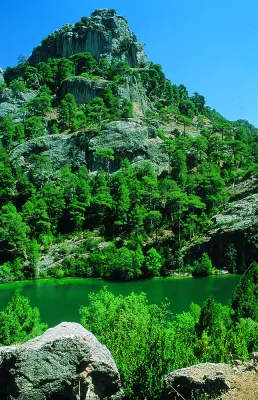
Description
Sponge limestone of the Chorro Road
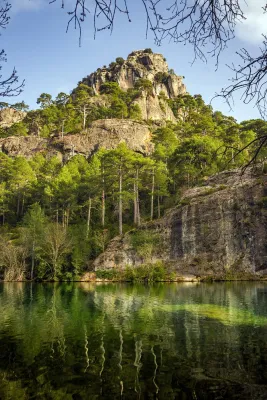
In the westernmost part of the Cazorla saw, tectonic scales of Cazorla and del Chorro, the Oxfordiense is also represented by nodular and rhythmic margoso- calcareas, by sponge and stromatolite bioconstructions, some of which perfectly retain the depository morphology, giving reliefs in the form of mounds ("mounds") made up of sponges and, most of them, of which are stromatolites. The spongiaries, siliceous sponges epigenized to calcite, appear mainly in the lower part of the bioherm, at first disorganized and fragmented and then adapted to different surfaces.
The stromatolites, on the other hand, constitute the majority of the bioconstructed body, and begin to be planar and then move to centrimetric columnar forms that together give cupolas of almost half a metre in diameter. Some of these depository morphologies can be observed on the slope of the road that from Cazorla leads to the Chorro, where this point of geological interest is located. These deposits culminate the depository sequence of the Oxfordiense in the saw of Cazorla, which is a sequence of deepening, in response to the oxfordiense transgression that caused the disappearance of the platform of the Lïas-Dogger, whose deposits are crowned by a "hardground" on which the Oxfordiense sequence is available. This sequence, in turn, is overtaken by another of lower Kimmeridgian age with which again the somerization that will culminate the Jurassic cycle begins.
Source: Inventory of Georresources of Andalusia. Environmental Council. Junta de Andalusia.
Is part of