

Description
Rio Borosa
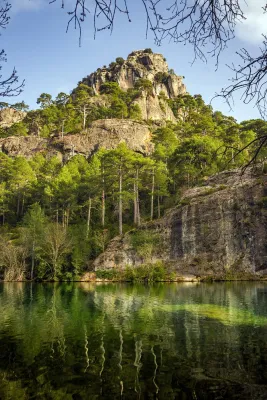
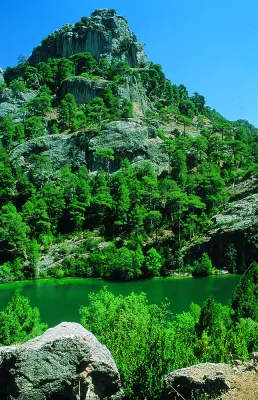
This type of forest can be the purest and best preserved that we find in the low mountain of the Park, refugee in unaltered ravines and slopes, where a fertile and deep soil is accumulated. There are some delays of this first formation, and one of the places where we can see it is in the lower basin of the Borosa River. On its slopes is an impressive lauroid forest of madroños, gracegos and doves. The highest point of this forest in our tour is the entrance to the closed of Elias, where a plant vault of madroños and agracejo covers us during a good stretch.
But what is a lauroid forest?
In Mediterranean forests we find several types of vegetation, determined by their conservation status, and the presence of more or less deep fertile soil. In the enclaves with better soil, deep and rich in organic matter, the lauroid forests, made up of shrubs and perennial, lustrous and always green leaves, grow.
The main components of this forest are the madroño (Arbutus unedo), the agracejo or labiérnago (Phillyrea latifolia), the pedillo or barbadija (Viburnum tinus), and climbers such as madreselvas (Lonicera implexa) and the zarzaparilla (Smilax aspera). These shrubs are sometimes accompanied by trees such as complaints and oaks (Quercus faginea and Quercus ilex ballota), although in closed formations of madroños and agracejo, it does not develop under them anything but their own seedlings, due to the dense shadow they form. These lauroid forests are the richest phase of plant succession in the low mountain of the Park.
These forests come from the vegetation that dominated southern Europe before the quaternary glaciations. After them the lauroid forests, which had more elements (trees such as the laurel, hence its name), had no choice but to adapt to a drier and colder climate, lost elements and took refuge on the middle slopes of the mountains and valleys where they found soil and softer climate with subhumid namoclima. Other plant elements that arrived with the northern latitudes glaciations found in these forests a suitable habitat, such as the complaints (Quercus faginea), the maple of Montpelier (Acer monspessulanum) and the pespejon (Sorbus tormentinalis).
LOCATION
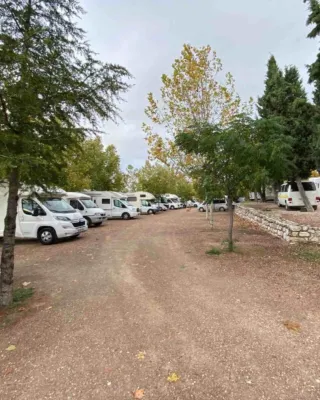
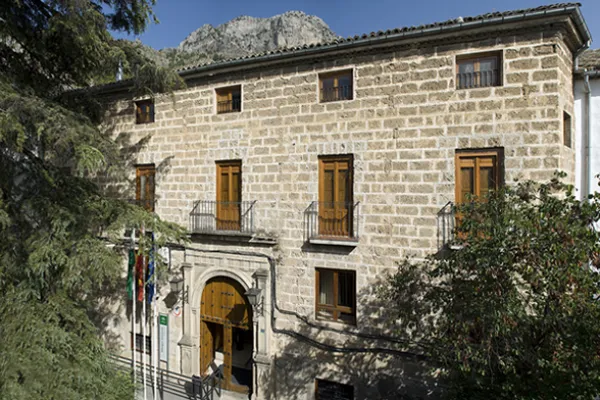
We'll access the Borosa for the A-319. At the height of the Visitor Reception Center Torre del Vinagre, we turn right to the farm, where we park and remount the river upstream. Soon, at the Shipyard's source, we began to see that Mediterranean formation of lauroid species. We can reach the end of the Cerrada de Elias, where we end our walk through the lauroid forests.
Is part of