

Description
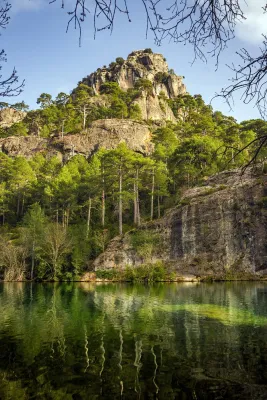
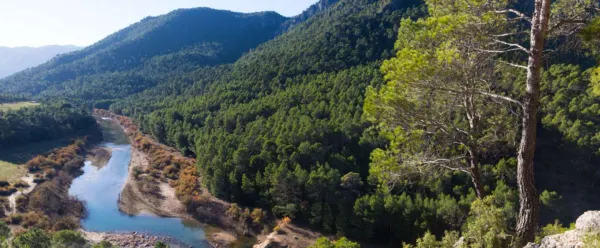
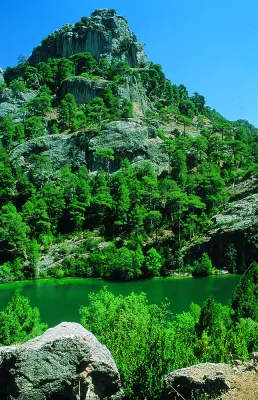
Lobo boat and Zumeta river
One of the most important plant formations of the park is the Sabinar of Sabina mora or simply of Sabina (Juniperus phoenicea). It is very important for its extension, for the habitat it occupies - rocks and dolomitic sandals - and for the large number of endemic species that it houses, including the most emblematic, the Cazorla violet (Viola cazorlensis) and the endemism of the Serra de Segura Jasione crispa seguridad. This training is therefore declared a Habitat of Community Interest in Natura 2000 Network.
It is presented to us in the form of clear sketches, where the black savina is the dominant plant element. We can find it in many areas of the Park, colonizing those places where other trees have not been able to develop, rocky, dry, wind-beat and with strong solar irradiation. You can say that sabina is the essence of hardness. We can also find it in isolation in almost all the forest formations of the Park, missing only in the high summits, so in many places we can see small sabinars more or less dense or scattered.
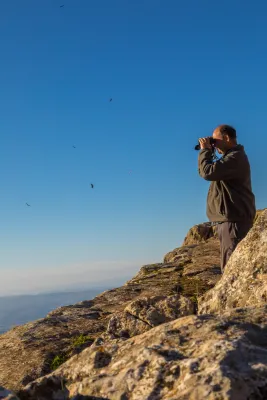
Inside Las Villas, on any side we will find sabinares. We've chosen the Wolf's boat. Once on the Sloth Hill, we will walk on the side of your left, according to the direction of the march. It is populated by savannas, juniperus oxicedrus, salgary and black pines (Pinus nigra salzmannii and Pinus pinaster), in a sparse and scattered manner, complaints and oinas (Quercus faginea and Quercus ilex ballota), thorns of dyes (Rhamnus saxatilis) and piorns (Erinacea anthyllis and Echinospartum boissierii). We are on this hill at the foot of the Blanquillo, the highest summit of the Las Villas saw.
Of the same characteristics as the one described - sabinar en rota - but with more cornicabra, are the sabinars of the Zumeta River, which extend throughout the left side in the sense of the waters. The sabinar is also seen from the other side, on the side of Albacete. We will see it from further, but in return we are compensated with the panoramic view of the Old Age reservoir.
LOCATION OF THE LOBO
We take the road that goes from the reservoir of Aguascebas to the Recreative Area of Gil Cobo. A little before we reach this area, we take a crossing that comes to our right, preferably on foot. We followed the track to a detour and took the one from the left, in gentle ascent, until we reached the Collado del Perenoso. To our left is the great lapiaz of the Lobo Boat.
ZUMETA LOCATION
In the village of Vites you have to head towards the Cortijo del Torcal.
Is part of