





Stage Jaén - Martos
Description
This stage marks the beginning of the Mozarabic Way of St James, starting in the city of Jaén, passing through the municipalities of Torredelcampo and Jamilena, and ending in Martos.
This stage of the Mozarabic Way of St James, which runs from Jaén to Martos, covers approximately 20 kilometres. Classified as moderately difficult, it provides an accessible challenge that allows pilgrims to enjoy an experience combining the urban surroundings of Jaén with the natural landscape of the Sierra Sur de Jaén.
START OF THE ROUTE IN JAÉN
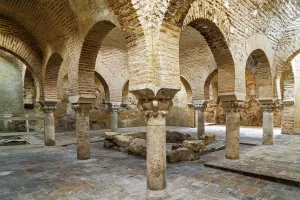
The stage begins in Plaza de Santa María, dominated by the Cathedral, which houses one of Christianity’s most important relics: the “Holy Face”. Following the yellow arrows, we enter Calle Maestra and continue through historic neighbourhoods where the legacy of Arab, Jewish and Christian cultures still survives. The route takes us past the Arco de San Lorenzo, Plazoleta de Santiago, the Church of San Juan, Villardompardo Palace, which contains important 10th-century Arab Baths, the Convent of Santo Domingo and the Church of La Magdalena, with its secluded courtyard. Pilgrim information centres can be found at the Jaén Tourist Office, the Province of Jaén Tourism Development Centre and Villardompardo Palace–Arab Baths.
From here, we continue along the Córdoba road, following our route towards the town of Torredelcampo.
TRANSITION TO THE COUNTRYSIDE
On leaving Jaén, the route heads towards the Córdoba road. Pilgrims follow the old road to Torredelcampo, gradually ascending through residential areas until the last buildings of Jaén are left behind. Once outside the urban area, the route enters the Sierra Sur, where the landscape changes to a more natural and rural setting.
The route includes descents through several stream valleys, marking the beginning of a steeper section. Pilgrims follow paths leading towards Casa del Vicario and the Sierra de Jabalcuz before climbing towards a motorway fence. Continuing onwards, the route reaches a junction with the Megatín road. After descending for approximately one kilometre, it begins to climb again, leading pilgrims towards Torredelcampo.
ARRIVAL AND EXPLORATION OF TORREDELCAMPO
As the route approaches Torredelcampo, it enters along Calle Andalucía. You will pass through this welcoming town until reaching the Church of San Bartolomé and the Town Hall, which serves as a Pilgrim Information Point. The route then continues towards the old Santa Ana road, reached after a short but steep climb. The origins of the present-day municipality are closely linked to the ancient Iberian inhabitants of Cerro Miguelico. During the 1st and 2nd centuries AD, part of the population moved to the location now occupied by Torredelcampo. Later, following the conflicts at the end of the Emirate period, the inhabitants of the area were forced to gather in a single settlement. Near the chapel dedicated to the town’s patron saint is Llano de Santa Ana, a recreational area with water and shade where you can enjoy a well-deserved rest. The area also contains part of the town’s historical heritage, including the remains of a Visigothic necropolis and an ancient Iberian oppidum.
DEPARTURE FROM TORREDELCAMPO
Having entered the town along Avenida de Andalucía, the starting point for this section is Plaza del Ayuntamiento, where the Pilgrim Assistance Office is located. Before leaving the municipality, we recommend visiting its three famous towers: Torre de la Muña, Torre Olvidada and Torre de la Aldehuela, clear examples of the large number of fortifications found throughout the province of Jaén.
Starting from the Church of San Bartolomé, located in Plaza del Ayuntamiento itself, we follow the signs for the Mozarabic Way. These take us through the streets and towards the outskirts of the town, leaving behind its welcoming squares and small buildings typical of the area. As we cross the centre of Torredelcampo and leave the urban area, we begin an ascent along a cobbled track towards the Chapel of Santa Ana, the patron saint of Torredelcampo.
ARRIVAL IN JAMILENA
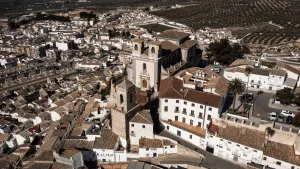
The route continues along a section of road towards Jamilena, with a short detour leading to a small wayside shrine where Nuestro Padre Jesús Nazareno, the town’s patron saint, is venerated. The route enters the centre of Jamilena through its narrow streets, lined with white houses typical of Andalusian architecture. Jamilena is known for its peaceful atmosphere and the hospitality of its residents, making this small town a welcoming stop for pilgrims.
DEPARTURE FROM JAMILENA
This section begins in the peaceful town of Jamilena, the municipality with the smallest administrative area in the entire province. It is known not only for its extensive olive groves, but also for another product that drives its economy: garlic. Some of its most characteristic landmarks include Plaza del Ayuntamiento and the Parish Church of Nuestra Señora de la Natividad.
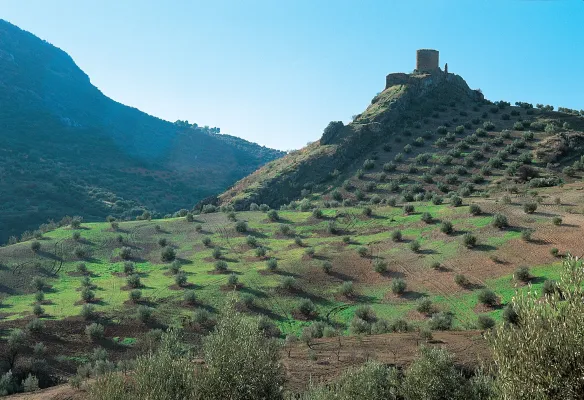
As we leave the urban area, the Peña de Martos appears on the horizon, dominating the landscape and accompanying us for almost the entire journey towards Martos. This section offers a perfect combination of nature and panoramic views over the vast olive groves that are so characteristic of the province.
The route towards Martos follows a historic path that connects the two municipalities and has been used for centuries. Although most of the route is relatively gentle, it includes several moderate climbs, particularly when approaching the town. However, the effort is rewarded by the views, the fresh air and the sense of tranquillity offered by the surroundings.
ARRIVAL IN MARTOS
The first landmark on arriving in Martos is the Chapel of Santa Lucía, an emblematic site marking the entrance to the town. From here, we begin an ascent towards the historic centre, passing the Parish Church of San Amador and Santa Ana, dedicated to the town’s Mozarabic patron saint. On reaching the old quarter, we encounter its rich heritage.
Among the places of interest that should not be missed in Martos are the former prison and council building, which is now used as the Town Hall and Pilgrim Information Point, the castles of La Peña and La Villa, and the Roman Bridge. The town also preserves part of its historic defensive walls.
Its most emblematic religious buildings include the Royal Parish Church of Santa Marta, the Sanctuary of María Santísima de la Villa and the Monastery of the Holy Trinity. The chapels of San Bartolomé and Santa Lucía are also well worth visiting.
For a well-deserved rest after completing the stage, the Convent of the Trinitarian Sisters offers welcoming accommodation for pilgrims in the heart of the town.
CONCLUSION OF THE ROUTE
The stage from Jaén to Martos offers an experience that balances the urban environment with the natural landscape of the Sierra Sur de Jaén. Its moderate level of difficulty makes it an accessible option, providing an opportunity to experience the beauty and history of the region. Throughout this stage, pilgrims not only enjoy a rewarding route but also have the opportunity to connect with the cultural heritage and tranquillity of this part of the Mozarabic Way of St James.
Datos de la ruta
ROUTE NAME
Etapa Jaén - Martos
TRAIL TYPE
--
DIFFICULTY
Moderada
TOTAL DISTANCE (IN KILOMETERS) 20,69 km
-
Stretch of asphalt or concrete: --
-
Section of track, forest road, or dry watercourse: --
-
Trail section: --
-
Sections of livestock trails: --
HUSO 30S
ESTIMATED TRAVEL TIME
ROAD SURFACE TYPE
Road
ELEVATION CHANGE
700mm
500mm
DIFFICULTY. RATING ACCORDING TO THE MIDE METHOD
--
MEANS
Severity of the natural environment
--
ITINERARY
Route guidance
--
DISPLACEMENT
Difficulty moving about
--
EFFORT
Amount of effort required
ACCESSIBILITY TYPE
TIME OF YEAR
SIGNALING
No
PERFIL DE ALTURAS

MORE INFORMATION
TUNNELS
STEEL VIADUCTS
METAL WALKWAYS
WATER POINTS
PONTOONS
GUARD BOOTHS AND BARRIERS
SWITCHMAN'S CABINS
CYCLABILITY
RECREATIONAL OR SPORTS AREAS NEAR THE TRAIL
AID STATIONS
LINKS TO OTHER TRAILS
SHELTERS
RECOMMENDATIONS
OTHER INFORMATION OF INTEREST (ARCHITECTURAL OR HISTORICAL-CULTURAL, GEOLOGICAL-ECOLOGICAL)