
Saltar al contenido principal

Torres de Albanchez

MUNICIPIOS
  • 6da44cc1-68e0-f537-4bbe-4bd00fb3a4bc?t=1603979645125
  • 97b3fe58-a709-2d54-15a9-f3267420ae6c?t=1595353210034
  • a98c5165-c97a-397f-f1f2-81971a8ce23b?t=1620332085324
  • 0f9593f5-fe76-3878-1ff9-43a1d476a669?t=1620332085366
  • 3af8e679-8ca7-80ae-3ed1-b59a8441dc78?t=1620332085410
  • 27a218c2-8bb0-f149-0e44-fd826447c469?t=1620332211943
  • 6da44cc1-68e0-f537-4bbe-4bd00fb3a4bc?t=1603979645125
  • 97b3fe58-a709-2d54-15a9-f3267420ae6c?t=1595353210034
  • a98c5165-c97a-397f-f1f2-81971a8ce23b?t=1620332085324
  • 0f9593f5-fe76-3878-1ff9-43a1d476a669?t=1620332085366
  • 3af8e679-8ca7-80ae-3ed1-b59a8441dc78?t=1620332085410
  • 27a218c2-8bb0-f149-0e44-fd826447c469?t=1620332211943

Description

It is a municipality located at the north-eastern end of Jaén provincein a valley in the mountains of the Sierra de Segura. It has some pedanias such as Fuente Carrasca or Fucofría, toponyms related to its springs.

Su municipal term is found included in the natural park de la Sierra de Cazorla, Segura and Las Villas.

Their lands, of flare reddish tonesthey have numerous springs and archaeological sites that witness their past.

This municipality has an enclave, Madroño Roomlocated between the municipality of Villarrodrigo and the limits of the provinces of Ciudad Real and Albacete.

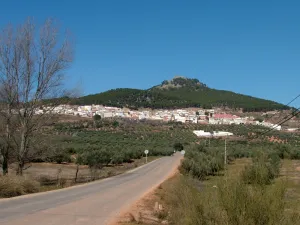
Torres de Albanchez enjoys of some of the best views of the province of Jaén, towards the Sierra de Segura and the plain of the Guadalimar. The numerous elevations that make up its municipal term provide natural viewpoints, such as the Mount Picarzo. It rises next to the Fort Tower, in a highly attractive mountain landscape, a mixture of olive groves, cereal lands, orchards and mountain areas.

In its monumental heritage we must highlight the Tower of Tributefrom the 14th century, which belonged to a castle of the Military Order of Santiago and the Parish Church of Our Lady of the Presentation.

Useful Information

Tourist area: Serras de Cazorla, Segura and the Villas

Distance to the capital (km): 155

Altitude over sea level (m): 880

Extension (km ²): 58

Number of inhabitants: 1,055

Gentillo: Torreños

Postal code: 23391

Is part of

AUDIOVISUAL CONTENT

MORE INFORMATION

Culture

  • Tribute Tower. This important tower is located in the centre of the village next to the church and the city hall, and dates back to the 14th century. It is square and is built in scarlet masonry in small yarn and with corners reinforced by sillery pieces arranged to rope and sawn. The outer enclosure It is composed of wall and four solid cubes that protect the corners. Inside Its stone is more well-kept and is structured on three floors: in the lower one there is an aljibe, and the superiors are divided, by a central wall, into two halves, covered by canyon vaults pointed and very low. It rises to the floors through an inner staircase that goes up around the tower. This tower of the homage of the old Castle was declared Good of Cultural Interest in 1985.
  • Yedra Castle. The primitive location of Torres de Albanchez was in a nearby mound, defended by the castle of Yedra, already melted, but from which some remains are preserved: remains of masonry walls, defensive structures and aljibes, excavated on the same rock. It is estimated that its origins may be in a Hispanic-Visigoda community between the centuries V and VIIwho, after leaving the vegas of the Guadalimar, settled in this strategic enclave. It was conquered by the troops of Fernando III the Holy in 1235, who granted it to the Military Order of Santiago, which promoted the construction of a new settlement in the present less abrupt place. The castle of Yedra was declared Good of Cultural Interest in 1985.
  • Church of Our Lady of the Presentation. Its construction began in the century XVI and rises in the square of the municipality. Its plant is rectangular and one-ship, divided into four sections covering half-barrel vaults with pseudophajon arches. The square base header was added in the 17th century. The towerbuilt in the 20th century, it is the least valuable and is not integrated into the whole.
  • House of Mayorship. In Torres de Albanchez, there have been a loss of lordial mansions of interest, such as this so-called House of Mayor. With Renaissance cover and characteristic hardware of the second half of the 16th century. Inside it had a cave with canyon vault for shelter in times of danger. The cover was intellized, provided with zapatas in rolls in the intrados. There is a new cultural equipment in the town, the Eidades de la Sierra interpretation centrein which the geological history of the Sierra de Segura is represented, including the phases of human occupation.

Nature

Most of the municipal term Torres de Albanchez is included in the Natural Park of the Serras de Cazorla, Segura and Las Villas.It is an eminently agricultural municipality, although it also has an important forest area located in the north of the city.

It's framed by limestone of 1200 and 1300 m of altitude, which by being limestone accumulate water, giving rise to more than 30 natural springs that we can visit the time we discover their villages. Among them we highlight the spring of Fuente Vieja, that of Fuente Larga and Fuente Bellia, from which We can see excellent panoramic, the Valle del Guadalimar and its tributaries, where it stands out the River Onsares, with fertile red triasic clays in which pine forests, olive groves, self-consumption cultivation gardens, pastures and bushes are transformed with the passage of the seasons. From its inclined streets can be seen peoples how Orcera, Siles and Segura de la Sierra.

Places that must be visited:

  • The village of Fuentefrera offers us the opportunity to contemplate beautiful panoramic views of the Natural Park. Near the settlement, we can visit the source of Fuentecolda spring located at the foot of Mount La Cordera.
  • The Tala and the Hoya, are two villages practically abandoned. The house is preserved, although already with remarkable flaws and some buildings in a ruinous state. Nearby you can visit the cave of La Tala and the cave of the Coto.
  • El Cerro del Castillo, is a natural enclave located at 1145 m high, from which we can enjoy impressive panoramic views of the Natural Park and the urban core.
  • The Hermitage of the Virgin of the Way, is located at the foot of the mountain Picarzo (1296 m.), this enclave has a natural water source, and is the ideal starting point for starting the routes that take us to the Natural Park.

Parties and Events

The parties in this municipality include:

  • La Candelariaon the 2nd of February, a feast in which the custom of making "lumbres" continues, around which you sing, dance and drink.
  • "The Eight of Torres," the name whose origin is to be sought in the ancient tradition by which every 8 May the Virgin of the Field was brought from her hermitage to the parish church, where she was to remain until 8 September, when she returned to her hermitage. Dates that were modified in 1968, going on to the last Sunday of May and the last of August, respectively, to facilitate the attendance of other migrant turreños to the party.
  • The Virgin of the Field, is held in the first days of September, in which are very traditional the taurino celebrations, following the serrana tradition.
  • San Marcoson April 25, when the Holy One is asked to bless the fields and to "fear the devil."
  • Our Lady of the Presentationunder his title is the parish and whose religious feast is held on November 21.
  • Romeria de la Virgen del Campo. The last Sunday of May. During her celebration she goes up with the Virgin to her hermitage, to spend the summer there. Then, at the end of the summer, it must be transported back to the village with another Romeria that is celebrated last Sunday of Augustso that the Virgin may remain in her church during the feast that is held in early September.

Gastronomy

It must be made clear that in the country's gastronomy it is called "garlic" to any stew in which the ingredients are crushed or crushed until they acquire the texture and appearance of a mashed, whether or not it has garlic.

Among the most traditional dishes, we highlight:

  • "Ajoatao." Prepared with cooked and crushed potatoes, linked in the mortar with olive oil from the ground with eggs and garlic. It is usually taken either in a slice of roasted bread, or as a garrison of the meat at the roast, like the following lamb.
  • "Ajoharina." It is a very old stew of flour, potatoes and a saffrito of vegetables, it weighs all in a frying pan.
  • "Ajopringue." It is made with the pig's liver once cooked and crushed that is served with olive oil, tomato, red peppers, garlic, parsley, bread miga and species: nail, oregano, pimenton and saffron.
  • Lome of orza. Which has already been preserved in olive oil or butter. He'll be present at the table all year.
  • Migas, with chorizo and turrezos.
  • Lamb to the young shepherd, Pastor chandelier or the lamb garlic cabañil, dishes that originate from the pastors, who used the meat of the following sheep.
  • Chickpeas. To consume preferably at Easter, and that in addition to the chickpeas is added spinach and cod.

In pastry shops:

  • "Fried roses." and "flowers" with sugar or honey for Easter days.
  • "Sweet peas with toast" for the day of All Saints, accompanied by milk or honey.

History

The occupation of the area dates back to the Copper age, III millennium BC, a time when the consolidation of agriculture and the development of mining and metallurgy will take place, leading to an increase in the number of settlements.

The Guadalquivir Valley will be a natural transit area of communication to Levante and the Plateau. For this reason, many settlements will be located in this area of communication, and will have a strategic mission to control these routes.

During the development of the Iberian culture, there is a restructuring in the territory that is characterized by the "oppid," fortified settlements in which an aristocrat exercises power.

It will be with the arrival of Roman civilization when the "oppid" are again transformed into rural settlements called "villae"

This settlement is known as Yedra Castleof which remains are still preserved such as masonry walls or aljibes, and which could be related to a hisponovisigoda community, that after leaving the vegas of the Guadalimar between the centuries V and VII, are established in this strategic place of the Sierra de Torres de Albanchez.

On the Islamic past of Torres de Albanchez there are virtually no signs, just that was conquered to the Muslims on 1 May 1235, integrating the castle and the place in the Encomienda de Segura, belonging to the Military Order of Santiago.

It will be this Military Order that promotes a new settlement in the current location, and they build the defenses on a rocky promontory.

It's in the middle of the 16th century, in 1552, when Torres de Albanchez achieve Segura de la Sierra segregation, giving Philip II the title of the villa.

During the 19th century, a demographic expansion began, with 1226 inhabitants in 1900.

The rotating phenomenon by which the mountains become farmland was an increase in the cultivated area, mainly dedicated to the cereal at the cost of the reduction of pasture and mountain. The population growth increased significantly in 1940 to have 2626 inhabitants.

From these years, in the middle of the post-war period, in Torres de Albanchez, emigration to the large Spanish cities or to countries of Europe began, thus decreasing the population.

In this municipality

3

Accommodations

1

Restaurants

4

Events

We recommend