

Tourist Office





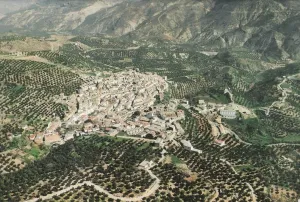




Municipality of the region of Sierra Magina located in the eastern center of it and of agricultural and livestock vocation. Most of its municipal term, including the urban core, is part of the Sierra Magina Natural Park.
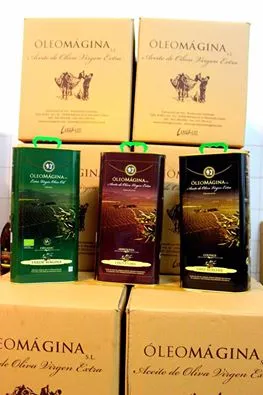
It is in the eastern part of the term where the areas of cultivation are concentrated, and where only a few small extensions of fruit break the supremacy of the olive tree. The local economy is based on the olive grove, mainly, and complemented by the fruit and some sheep cattle in the deforested lands of the saw.
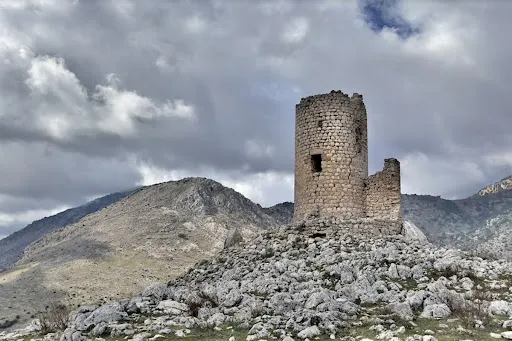
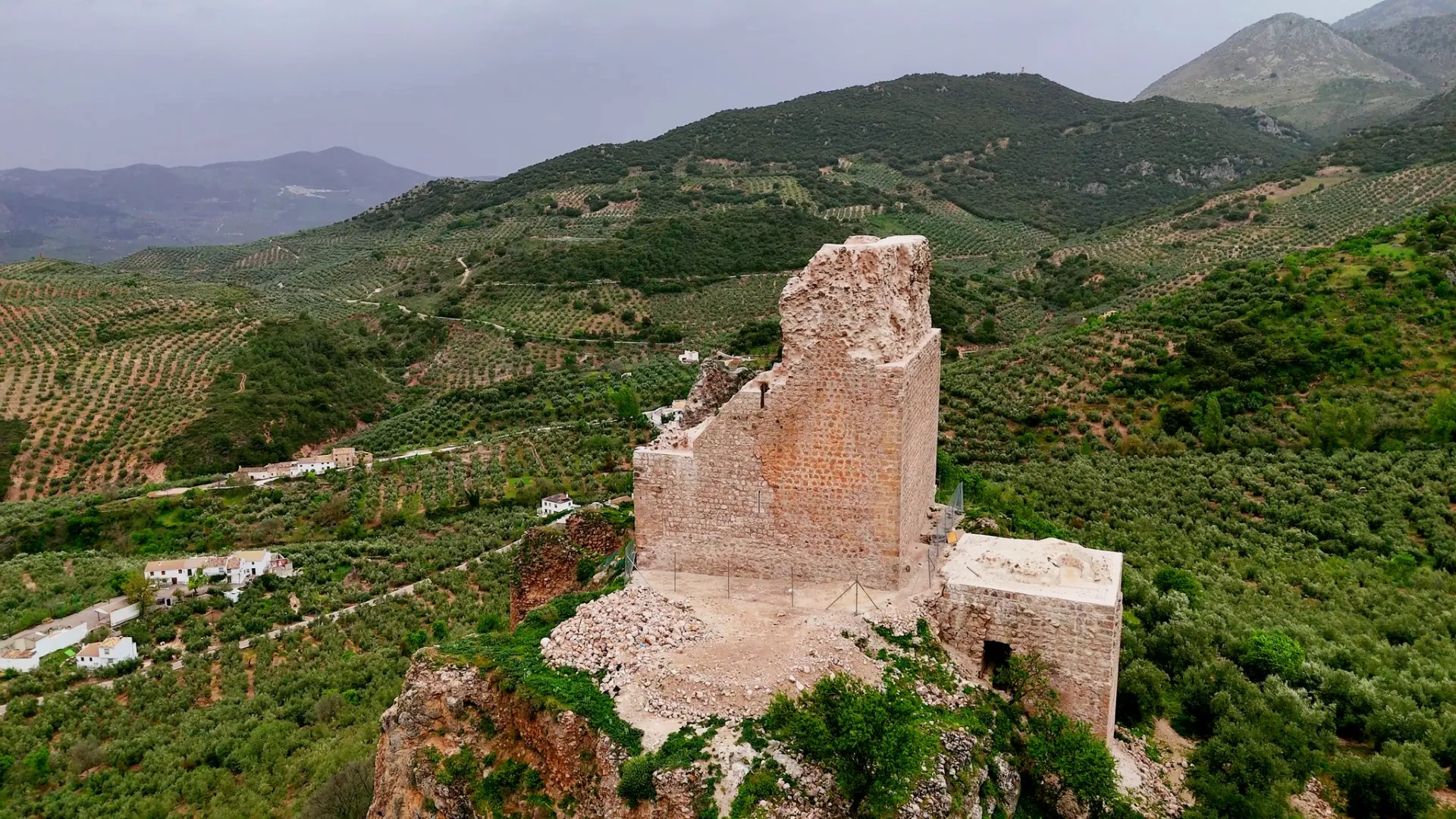
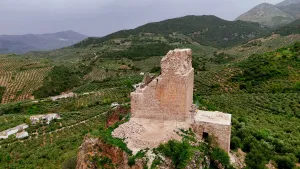
De Bélmez de la Moraleda has to be noted its medieval Castle, which was declared a Historical Monument in 1985, the Muslim torreons of Lucero and the Sun and the famous "Caras de Bélmez," a paranormal phenomenon that broke into the kitchen of a house near the local Church in 1971 and has not yet been scientifically explained. His visit has since been required and there have been many experts in paranormal phenomena who have come there and no certain explanation has yet been given on the matter.
Is part of


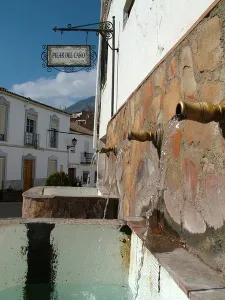
San Antón - 16 January - when fires are lit and around them are consumed rosets and roast pumpkins. By San Marcos - the 25th of April - the saint has been processed by the people following the route of the sources to ask for water for the fields. It was customary to sing litanies begging the saint for rain. The image of San Marcos carries a bull at its feet, which, being of small size, is popularly known as the "San Marcos Dog," which is thrown into the waters of a well located in the place known as El Nacimiento when the procession passes by.
From the 20th to the 22nd of August, the parties in honor of the Virgin of Peace and the Lord of Life, although these were celebrated earlier for the day of St. Andrew - the 30th of a bridegroom. During these major celebrations the "Relations" take place in Bélmez de la Moraleda, parties of Moors and Christians that can be considered as a continuation of those held in the village of Bélmez in May, also having as an argument the rescue of the painting of Our Lord of Life, in the hands of the Moors host, by Christian troops. These representations last two days, in which the pattern is solemnly processed. The texts were collected and verified in the 1950s by the poet Antonio Guzmán Merino, who must give the original texts of the late 18th century.
The crumbsthe rhinestones with hare and Chotto al ajillo.
Owners of Easter are the flowers, also called flakesand vigil potages with chickpeas, cod or breads.
The municipal term of Bélmez de la Moraleda offers us some settlements of the Iberian and Roman times of great interest and which clearly illustrate some of the historical and geographical circumstances of the environment. And among the latter, the character of passage, of transit between the current province of Granada and the Alto Guadalquivir through the valley of the Jandulilla River, which, turned into a true parade at some points. This strategic situation explains the location in the Iberian era of a settlement, the so-called Bélmez Entrance, located two hundred metres from the crossing of the road that goes up to the present town. It is a small hill with a soft profile on the river's Vega.
Although no remains of on-site infrastructure have been found, many stone blocks are visible and must have been part of a strategic and small construction. Although the surface remains are not very abundant, among other reasons for the deterioration of the top of the hill, here would be a fortified enclosure, a tower for the control of the passage. Among the materials located has been identified a cover of an earring urn, a characteristic ceramic form, linked to a chronological moment that must be located in the so-called Old Horizon of the Iberian world, that is, before the second half of the 5th century before our age.
From Ubeda la Vieja, right at the point of confluence of the Jandulilla with the Guadalquivir, it is the only settlement dated at that time, which makes it exceptional, also serving to explain some historical issues of great interest. We know that the passage through the Jandulilla Valley reached its greatest intensity during the 4th century BC, when the trade in Greek products was more intense and when the aristocracy of Ubeda la Vieja extended its control throughout the river valley, from the mouth to the hill of the Pajarillo in Huelma. The location of the Bélmez Entrance is to point to an occupation or at least control of the valley from an older moment. However, no archaeological elements have been found to allow us to think of a true agricultural exploitation of the valley and it seems that it does not begin until a later moment, according to the few indications we have, around the beginning of the second century before our age.
Very later in time another settlement, the so-called Barranco de Hornillos Bajo, shows us the occupation of the environment of Belgium in Roman times, although the limited information does not allow us to specify the specific moment of the occupation of the site. Located next to the river, on a hillside, we observe the presence of archaeological remains that confirm it. We are certainly faced with the presence of a rustic villa, an agricultural farm that will later have continuity in medieval times. The present town of Bélmez de la Moraleda is located a few kilometres from the medieval town that gave rise to it. Much of this region was dominated during the ninth century by the Muladi family of b. Habil, and the "castles" of which the Arab sources speak would mostly be fortified small places. The population lived in the villages that controlled these shelters.
So far we do not know whether Belgium already existed, although it seems very credible, since in 945, a few years after Abd'alRahman III submitted the whole region, a mosque was erected, as indicated by the inscription commemorating its construction. It is possible that this was a building jointly carried out by a group of villages, a solution that small populations adopted very often to "cover costs." But it cannot be ruled out that Belgium had already reached enough entity to provide itself with such construction.
However, the name Bélmez is not mentioned in the texts until the beginning of the 14th century. Belgium is a word of Arab root, meaning "protected place." In addition, the word "velmez" has been left in Spanish with the meaning of clothing that was put on the shirt to prevent the loriga and other annoying garrison in the body, which reaffirms the sense of protection. And the castle of Bélmez is in fact located inside a small Vega, protected by a mountain circle, so the towers of the Sun and the Lucero were built in the nearby heights to monitor the environment.
All this indicates that between the X and XIV centuries there were a number of changes in the physical structure of this town - and of other similarities - and in the way of controlling the territory. Between the X and XII centuries the scheme would be similar to that of the previous one, that is, many villages - including Belgium - which jointly have places of fortification for cases of danger. Then, especially from the end of the 13th century, in the face of the threatening Spanish presence, the population seems to be concentrated in some localities, which are surrounded by walls.
It is what Arab sources call "hisn" (plural "husun") and what castellans call "castles." It is the case of Belgium, taken in 1316 by the infant Don Pedro. But the Spanish crisis and the Nazi counter-attack will allow Muslims to recover some of the populations in the saw. And in some such as Bélmez they will do important works, so that when it is again conquered in 1448, the Spanish chronist already distinguishes between the population ("the place") and the castle itself. It is the latter that has been described on several occasions as much older than it actually is. The last transformation will be the change of location of the population, as we have said before, although, along with the remains of the Islamic settlement, there remains a cordijada that has kept the name. The taking and conquest of the castle of Bélmez in 1448 by Don Fernando de Villafañé came to mean in fact the end of the Islamic rule in the villa.
However, this conquest was only if it mitigated the context of struggles and struggles that had characterized its most recent past. A good test of this will be the numerous avatars through which the fortress of Belgium will pass through the years between 1464 and 1477, which are framed within the inner struggles that characterized most of the reign of Henry IV. Thus, in 1464 the castle suffered the assault and taking of the infant Don Alfonso; in 1465 the one favored by Don Juan de Vera; in 1476 the attempt to conquer the second viscount of Huelma and the commanding officer of Bedmar and Albanchez... Conflicts that were to a large extent explained, on the one hand, according to the control it allowed on the road to Granada and, on the other, to a no less important control on important areas of excellent pastures in Sierra Magina. This is evident in the case of disputes such as those held with the village of Huelma and, above all, the one held with the farmers of Ubeda for matters of portances and quintos, which will last at the end of 208 years.
These conflicting years gave way, in the 16th century, to a new type of litigation, this time of administrative character. In 1501 the Catholic Kings donated the castle of Bélmez and its terms, which since the 14th century had remained attached to the Lordship of Jódar, to the council of Granada, "on the condition that this council paid Alonso de Carvajal all the money that the kings owed him for the commitment of Belmez and that it was with a life character Alonso de Carvajal alcaide de Belmez." This donation will rereproduce old disputes about the possession of Bélmez, especially since the end of 1513, after the death of Don Alonso de Carvajal on Italian lands. The disputes were finally settled with the possession that Don Diego de Carvajal obtained from it, that is, in exchange for a census paid to the city of Granada.
And it was this fact that, in the end, it was another of the transcendental changes that are going to take place in the history of Belgium in the 16th century: the modification, since 1534, of the location of its population core, propitiated by the attitude taken since those dates by that lord when he began to give land as a lease to some farmers, who began to rotate the dehesa and to build their houses near the birth of the Moraleda. This attitude already had its background in the villa in some information of 1510, when it was possible to distribute land to potential resettlers in view of the fact that many fields offered a marked aspect of inculcated and with more than irregular exploitation.
In the 16th century most of the land was intended for the cultivation of wheat, barley, flax and hemp, as well as the presence of caprine, pigmeat, cattle and cavalry. In addition, the collection of spartum and juniper, of wood or hunting, as well as the land intended for pasture, were its most important activities. This little varied throughout the Modern Age, given that in the mid-19th century the cultivation and collection of wheat, barley, rye, corn, bellot, chickpeas, beans and all kinds of seeds, fruits and vegetables remained characteristics of an economy strongly turned to agricultural and livestock activities, the latter focusing on the livestock, the goat and to some extent the pigs. And all this developed by a population of about 896.
At the end of the 19th century, the image had hardly been altered: the land of pastures (1,712 hectares) and of mountains (1,670 hectares) stood out to some extent on the cereal crop (1,326 hectares) and on the olive tree (116 hectares). A century later, this is, at the end of the 20th, the productive physionomy of the town has changed: the 1,679 hectares of olive trees are very much over 51 for herbaceans or 128 for fruit. In addition to the important role of the olive tree, the area of pastures (1,673 hectares) will also remain privileged.
These superficial magnities and this agricultural image were accompanied by a poorly claimed peasant and labor-related social scenario in the 19th century at the same time as in the 20th century. The agricultural problems resulting both from the effects of the crisis of the persistence and from the finisecular agricultural crisis and the modernization processes undertaken from the crisis have increased the agricultural social question, which has repeatedly led to unemployment and hunger. In this sense, the statistical data provided in 1930 / 31 on unemployed in Belgium is more than illustrative: 75% of its workers' and peasants' census.
It should not be surprising that it is precisely in these years, as was also the case in other neighbouring municipalities, when the trade union and political discourse of the class is deeply calmed in its working population: the constitution of the local section of the FNTT is 1932, and those of the PCE and the FRCA of 1937. The political translation of this situation was to some extent in line with what was said: in 1931 the PSOE's candidacy for the legislative elections will be successful for the first time in the municipality, although in the 1933 legislative elections right-wing candidates will achieve the electoral triumph, which will remain in 1936 within the so-called National Block.
This social conflict in the first half of the 20th century will be accompanied by a certain degree of demographic vitality: if in 1900 the town was to add a total of 1,488 inhabitants, in 1930 they had increased to 2,177, to reach 2,588 in 1950, which meant its highest demographic moment. From this date, and throughout the second half of the 20th century, the municipality has experienced a situation, first - especially in the 1960s - of some setback and then of the maintenance of its 2,000 inhabitants. It begins to open something beyond Belgium, towards the Guadalquivir.
7
3


