

Description
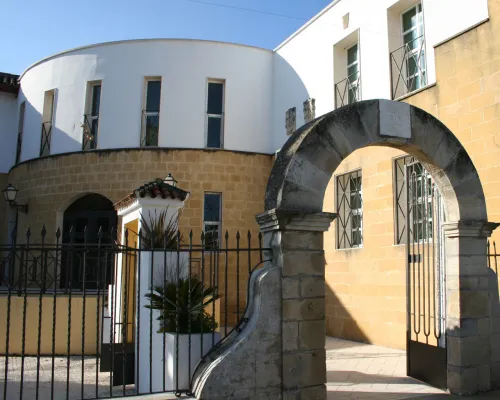
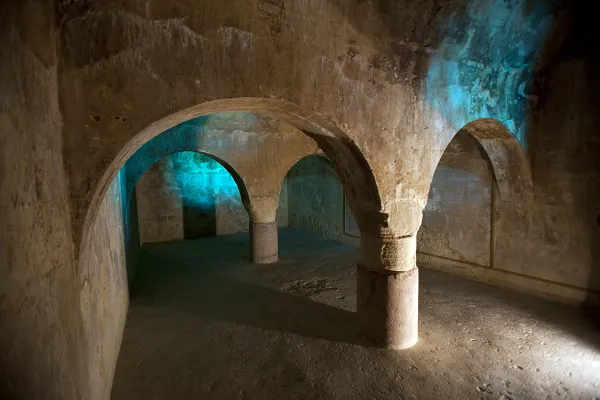
Religious building that stands on the same site, which some scholars and historians attribute, was the Roman temple dedicated to Bacchus and later Jewish Synagogue. The current temple began to be built in the 16th century, although it was practically destroyed in 1936 as a result of the events that occurred in the Spanish Civil War. Its reconstruction was left in the hands of Devastated Regions directed by Fernando Wilhemi Manzano, who modified the floor plan quite a bit, adding a more framed bay over two towers, of which only one was raised.This reconstruction has lasted until the beginning of the 21st century, when serious structural problems were detected that forced the main vault to be demolished. (Currently under reconstruction). Currently, its interior follows a Neo-Gothic style, with a plan of three naves separated by pointed arches that rise on pillars that imitate large jambs, which lead to a ribbed vault, the central nave being higher than the side ones. The presbytery is elevated and has an altar, in whose central street there is a dressing room in which the Virgin of Sorrows is located, patron saint of the town, the work of the Granada artist Navas Parejo. Of its primitive construction, only one door remains, currently placed at the foot of the church, this being not its original location. This doorway was made by Juan Marquina in 1531, in the Plateresque style, formed by a semicircular arch with voussoirs decorated by angels, medallions appear on imposts and spandrels, topped with a round pediment in whose tympanum there is a niche, with two emblems that were originally those of Cardinal Merino, all on Corinthian pilasters with candelieris decoration. Inside, together with the already mentioned image of Nuestra Señora de los Dolores, we find the image of the owner, San Juan Bautista, the work of Jose Risueño, Nuestro Padre Jesús Nazareno de Palma Burgos, the Santísimo Cristo de la Expiración by José Garcés or the San Antonio, the work of the Granada sculptor Pedro de Mena, to which Navas Parejo added the Child in 1942 (All these images are currently distributed in the different Churches of the locality, due to the restoration works that are being carried out in the Iglesia de San Juan). Along with the previously mentioned imagery, we must highlight the Tabernacle, which was made by the Archpriest of Arjona Juan Antonio León, thanks to the donations of gold and silver given by parishioners in donations around 1950. Iglesia de San Juan Bautista is only mentioned once in Juan Eslava Galán's book, specifically on the last page, but it is of great importance, since it is where the Templar tombstone was found, in an underground burial (the Crypt of Barón de Velasco, Barón de Velillos in the work).