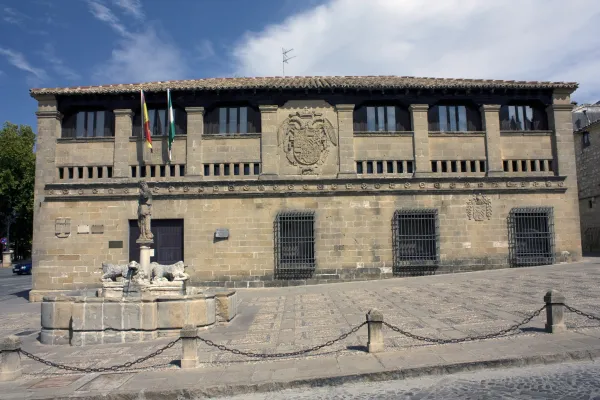


Description
In 1538 the Franciscan community of Baeza agreed to carry out the construction of a new temple, due to the poor state of the primitive. At that time, he was a patron of his major chapel, "Day Sanchez of Quesada," Mr. de Garcíez, who showed little interest in the new major chapel to build, which forced the Franciscan monks to seek other masters.
The election was in the Baezan noble family of Los Benavides. The transfer of the patronate was made in Valencia de Benavides, being its descendants and, after solving various disputes, the promoters of such an important company, which certainly intended to emulate the funeral chapel of the Saviour of Ubeda, built by the secretary of the Emperor Charles V, Francisco de los Cobos. The will of Valencia de Benavides, granted in 1538, requires the endowments to complete the factory, which is obviously intended for its burial and descendants. The work of the new church had to begin at the beginning of the 1540's, and it was extended for many years, since the major chapel had not yet been completed in 1563.
In the visit of Philip IV to the city of Baeza in 1624 the chapel is finished, not so the rest of the body of the temple, whose construction was extended until well into the 17th century. But the misfortune is going to pursue this great work, because in the mid-17th century it already needed to be repaired. In the early 19th century the header was ruined by a seismic movement, which forced the disassembly of what was left of it. In the 1850 Parcerisa engraving, the romantic aspect it presents is total ruin and abandonment. The rest of the church and the convent also underwent numerous transformations throughout the 19th and 20th centuries to adapt the architectural complex to new uses: flour factory, theatre and housing. The restoration and consolidation of the whole was carried out, not without criticism, between 1986 and 1988 for its preparation as an auditorium, leaving the main chapel discovered and separated from the rest of the body of the church by a large glass. The cloister and other units were transferred to the Vandelvira Restaurant in 1990.
The one chosen to raise such a monumental chapel was Andrés de Vandelvira, master barber, already well known for his great projects in other populations of the Loma. Although the contract of works between the Benavides, the friars of San Francisco and Vandelvira has not yet been discovered, his authorship is given by the testimony of his son Alonso by referring to the "cross chapel" in his famous Treaty of Architecture: "This chapel in San Francisco in the city of Baeza by my father and I understand is the best particular chapel and more well ordered and adorned in our Spain, it has sixty feet of hollow without the inings that has 8 feet."
In this factory Vandelvira works freely, out of impositions as in the Salvador of Ubeda. It sheds the Gothic cruises and the grotesques, incorporating the ornament more clearly in relation to the architectural elements. In his conception he also moves away from what is to be realized in the Saviour, as he proposes a great square space covered by a vase reinforced by cruises that come to coincide with the pairs of columns of the toral arches, rising on the funerary altards, of which only the Gospel has been preserved. These serlian tread stables are framed by large arcosols and double columns of elongated canon. At the header is the main altar above three acasetonated arcosols.
The breadth of the iconographic program developed was to follow a plan perfectly conceived and determined by the funerary character of the whole: Evangelists, Fathers of the Church, Saints; in the preserved petreous altarpiece we have funerary and heraldic symbols, the Epiphany on the left, the worship of the pastors on the right (with the date of 1560), in the center of the Resurrection (eardrum) with the Tetramorphs. Of excellent quality are also the heads of the craftsmen of the arcosoles of the main altar, as well as their eardrums of mythical inspiration and the semicircle with a Dolored Mater with the lying Christ, recurring with the funerary theme of the project. The fundamental sculptors of this extraordinary iconographic program, in a regular state of conservation, were Esteban Jamete and Juan de Reolidgen.
Is part of