




Description
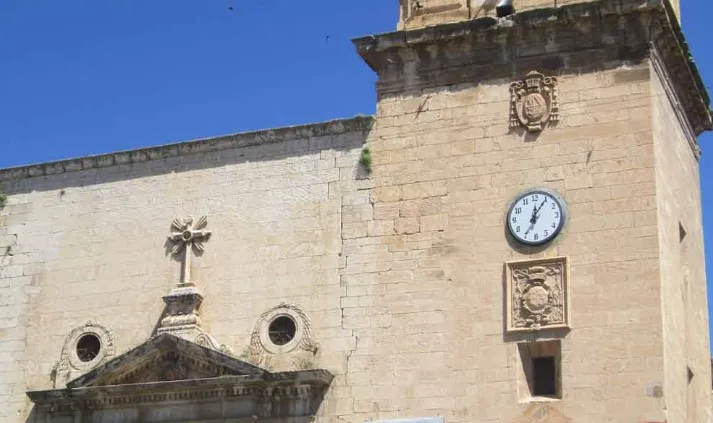
With a classical Renaissance façade, the main temple of the town dates from mid-XVI, at which time it was built on the site of an ancient church of Santa Maria which in turn was located on the major mosque. It is a Latin cross plant with side chapels like Andrés de Vandelvira. Covered with canyon vault and dome on breast on the cruise. The cruise, the presbytery and the major chapel are 1775.
The beautiful tower is the work of John de Aranda (1640) decorated with episcopal shields. The cover is neoclassical from the end of the 18th work of Manuel Caballero, one of the best in the province due to its airful proportions. Located on the wall, there is the valuable 'Ibero-Latin inscription of Galdur' old cradle city of Jódar, of the 1st century. C. This practice served to enaltecer the classical antiquity, where this architectural style found its roots.
History
It was built on the primitive Mosque, documented by the Arab geographer Al-Himyari, which mentions that it was "three ships supported by marble columns."
His primitive advocation was that of Santa Maria, not knowing what the primitive building was, only that the Altar Mayor was oriented to the west and its main door to the north, next to the so-called "Source of the Place." The first documentary data on the works of the present temple dates back to 1547, bringing the stone from the quarry of Bedmar. In 1569 the Sunday Master of Uriarte worked on it. From 1582 to 1589 the work was carried out by Juan Vizcaino. In 1591, the Gaspar and Francisco de Aranda brothers were mentioned as builders and singers, building the central ship with their six side chapels with cassette vaults, so to the use of Vandelvira, who was the supervisor of the works of the temples of the Diocese. The whole set is of Renaissance-purist style.
In 1613 the construction of the Tower began, according to the trace of Juan de Aranda Salazar in a baroque style. Three shields belonging to the Bishops are carved in stone: Sancho Dávila, Cardinal Moscoso and Fernando Andrade, in the work of the Masters Francisco de Zamora, Alonso Galan, Andrés and Diego Guerrero, being completed in 1661 by Euphrassio López de Rojas, a shield of Sancho Dávila is found inside. One of its four bells is 1794.
In 1729 he repaired the header or Major Chapel by Juan de Consuegra. From 1771 to 1780 is built the current cruise, Capilla Mayor and dome of the Evangelists in neoclassical style with details of the rocky in the dome that was built by Pedro Fernández, Manuel and Juan Armenteros. In 1799, the pulpits and graderies were placed and the construction of the Main Fachada in neoclassical style was started by Manuel Caballero, who finished it, along with the choir in 1801. According to some historians, the façade is one of the best in the province because of its irous proportions. In 1864 the Capels of Expiration and Baptism were built. In 1877 the construction work of the Chapel of San José, directed by the architect Pedro Pascual Samaniego, with elegant orange half, was completed and decorated with interesting frescoes from 1915. From 1989 to 1992 the temple suffered a profound restoration by adding elements that further enhance its interior as several altarpieces in Macael marble and stone, the magnificent Reja and silery of the Chapel of San José, lighting, etc.
Is part of


