17
Jan
San Antón
17 January 2026
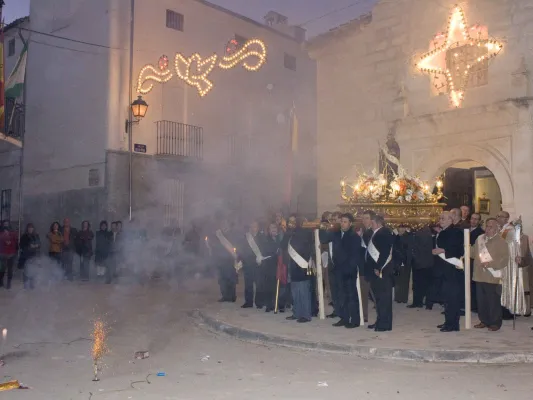


Where does the origin of the Moors and Christians Festivities lie, and its connection with the Virgen del Rosario in Carchelejo?
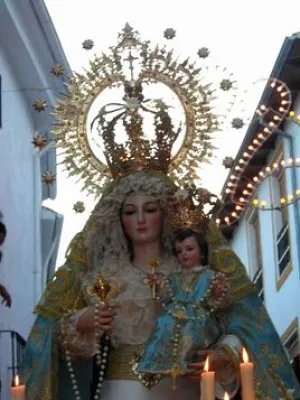
The feast of the Virgen del Rosario was established at the request of Pope Gregory XIII, to commemorate the naval victory won over the Turks by the Christian fleet at the Battle of Lepanto on 7 October 1571. That Christian fleet sailed under the patronage of the Virgen del Rosario, as shown on the standard preserved in the National Naval Museum.
Several theories can be put forward regarding the origin of these Moors and Christians festivities. On one hand, there is the deep-seated warlike sentiment reflecting the historical vicissitudes of border towns that lived for 250 years alongside the Muslims of Granada (as in the case of Carchelejo, Campillo de Arenas and Bélmez de la Moraleda).
On the other hand, we must consider the basic association made by ordinary people between victory and supernatural intervention, aligning the Moors and Christians re-enactments with the patron saint's festivities. This coincidence may stem from the periodic training that local militias had to carry out, which over time came to coincide with the patron saint festivities, days on which farm work was set aside and used instead for military drills.
The earliest documentary records of the Brotherhood of Nuestra Señora del Rosario de Carchelejo date back to 1751 and are recorded in the Cadastre of the Marqués de la Ensenada. The brotherhood was obliged each year to hold 4 plain festivals, 16 festivals with procession, and “one festival with procession, priest, sacristan and sermon”. This last one was likely the brotherhood's main festival.
The text of Las Embajadas, full of familiar tropes, doctrinal references and historical allusions, blends together various events being commemorated, such as the aforementioned Battle of Lepanto, the struggles against Protestants and Jews, and above all the struggle of Catholic Christianity, deeply embedded in the social mindset and popular tradition, combined with religious doctrine, reflected in the act of affirming faith in the mysteries of the Trinity and the Virgin's virginity. The rest consists of updates and additions that oral tradition itself has continued to incorporate as Spanish history has unfolded — such as references to Ferdinand VII, once the War of Independence had ended, or to nationalist Christians. I cannot determine the exact origin of these Moors and Christians festivities in Carchelejo, but it is likely that the combination of devotion to the Virgen del Rosario, the brotherhood's obligation to hold annual festivals, and the aforementioned military references gave rise to today's festival. This leads us to reflect that traditions are, and should always be, ever-changing — otherwise, a moment may come when the reason or basis behind the festivities is no longer understood, and the dialogues and texts become fossilised to the point of becoming incomprehensible.
This change shows that the tradition remains alive and fresh, carried forward by the people who create and live it, and will therefore never die.
Is part of

17
Jan
17 January 2026
26
Apr
26 April 2026

13
Jun
13 June 2026

12
Aug