

Pegalajar Climbing Areas
Description
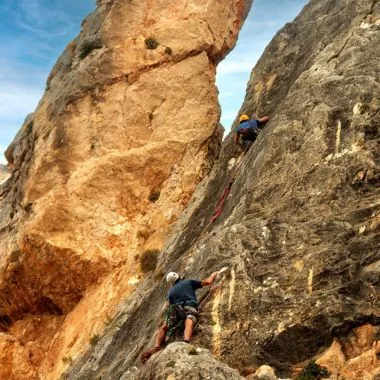
The Pegalajar Climbing Area is one of the most complete and well-established spots in the Sierra Mágina. It is a climbing school on high-quality grey and orange limestone, combining sport climbing, traditional and adventure climbing, and bouldering, in a natural setting close to the town but with a distinct mountain character.
Although the cliffs of the Peña de los Buitres stand out from the motorway linking Jaén and Granada, for years it was a little-visited area. Since 2011, thanks to the ongoing work of local climbers such as José Robles, José E. Carrillo and the Al-hayar Youth Association, the climbing school has developed significantly, especially in the sport climbing and bouldering sectors, becoming today a provincial benchmark.
The variety of styles, orientations and grades makes Pegalajar a suitable destination for both beginners and experienced climbers, provided the sometimes variable rock quality in certain sectors is taken into account.
The sectors and their features are detailed below:
1. Sport climbing sectors
These sectors have modern bolting and single-pitch routes:
- Iniciación: The sector closest to the village, ideal for beginners. It has between 22 and 23 routes on grey limestone with plenty of pockets and "water drops," with grades ranging from IV to 6c.
- Arabaico: Located at the foot of the Portichuelo crag, this is an expanding sector with long routes (an 80 m rope is recommended) of great technical quality. It has around 16 routes with grades between IV+ and 7c.
- Aromático: Located next to the Serrezuela trail, it offers short but intense routes with magnificent views. It has 15 routes with difficulties between 6a and 7a.
- El Escondite (Sport): A sector that includes routes such as El pecho de un lagarto (6a) and Smile time (7b).
2. Traditional and adventure climbing sectors
Areas of large walls where multi-pitch routes, self-belay and greater technical commitment predominate.
- Portichuelo: Large cliffs with routes up to 100 metres and 5 pitches. Notable routes include Gripe (6a+) and Bienvenida (6a+).
- Peña de los Buitres: The main crag, home to committing routes such as D.D.T. (6a+), Manuela (6a) and Fisura Salomón.
- Peña Grajera: A north-facing sector, located 3 km from the village towards Mancha Real. It features routes such as Diedro Lucifer (6a+) and Ensalada templada (7a+).
3. Bouldering sectors
Pegalajar has more than a hundred boulders, spread across different areas, mainly beneath the Portichuelo. The rock is generally of excellent quality, especially in the beginner sectors, although there are stretches with loose blocks that require caution.
- Perdigón: The most developed and well-known sector, located in the shade of the pine trees. Due to its size, it is divided into several specific sub-sectors:
- Rockland: With high-difficulty boulders such as Rockland (8A).
- La Estrecha: Includes lines such as Serrano Airlines (7A) and Kinderheim 511 (8A).
- El Capitán: With grade 6 lines and arêtes.
- El Vacín: Includes boulders such as Sugurus victory (6C) and Sandrova (7B).
- El Hombre: Boulders such as Levitación (7A) and Aromas de Chefchaouen (6A).
- Puto Bloke: An area with grade 5 and 6 boulders.
- Villa Calzones: With boulders such as Kraken (7B) and Lagarto pegalajero (7A).
- Solera: Located just above Perdigón, on the scree slope beneath the Portichuelo.
- Peñorares (or Peñonares): A smaller area with more scattered boulders.
- El Ático: Located next to the Serrezuela trail.
- Escondite (Boulder): Located near the access to the Arabaico sector.
Warnings and restrictions
- On the long routes at Portichuelo and Peña de los Buitres, climbing is strictly forbidden from January to July, due to raptor nesting, particularly of the Bonelli's eagle.
- There are stretches with poor-quality rock and loose blocks, especially on the long routes, so extra caution is recommended.
- Some equipped long routes are not suitable for beginners and require prior experience, as well as sound route-reading skills.
Orientation and recommended season
The variety of orientations allows for climbing almost all year round, by choosing the sector according to the season.
- South-facing sectors work well in winter.
- Peña Grajera, north-facing, is cooler, but not excessively shaded.
- In the Portichuelo and Peña de los Buitres sectors, climbing is strictly forbidden from January to July. These walls serve as shelter and nesting sites for species such as the Bonelli's eagle.
Is part of

