

Battlefields
Description
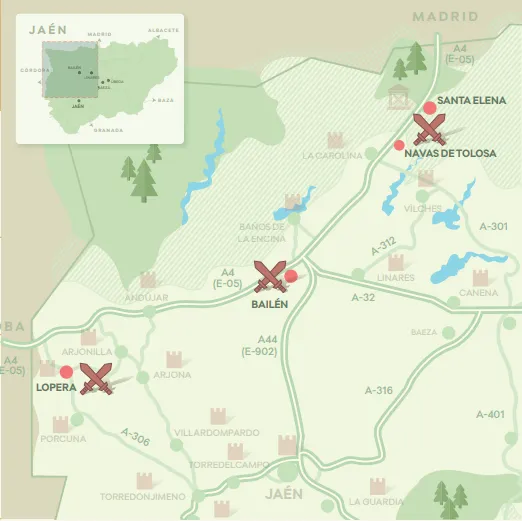
ROUTE FROM SANTA ELENA (LAS NAVAS DE TOLOSA) TO LOPERA
WAR MILESTONES THAT CHANGED THE COURSE OF HISTORY
This adventure takes travellers to the sites of the three most significant battles that took place on the lands of Jaén: Las Navas de Tolosa (1212), Bailén (1808) and Lopera (1936).
The first two were especially momentous, as they determined the fate of the rivals they pitted against each other: in the first case, the Kingdom of Castile against the Almohad Caliphate; and in the second, Spain against France. The third is remembered, among other things, for the tragic fate of the international brigade members who took part, including the English poet John Cornford (great-grandson of Charles Darwin) and the writer Ralph Winston Fox. "Battlefields" highlights the province's geographical position, which has historically made it a strategic stronghold from the time of the Roman conquest of Hispania — with the Battle of Baecula (currently under study) — right through to the Spanish War of Independence in the 19th century. All three battles have a museum or interpretation centre where visitors can learn first-hand about the historical and military background of each and their consequences.
Is part of

Rutómetro
Battle of Las Navas de Tolosa
Navas de Tolosa
THE GREAT CRUSADE ON THE PENINSULA
The Battle of Las Navas de Tolosa on 16 July 1212, in the province of Jaén, represents one of the great events of medieval history on the Iberian Peninsula, owing to its significance in the advance of the Christian kingdoms over Al-Andalus.
The conflict was conceived as a crusade — preached by Pope Innocent III — and pitted an army of men from the peninsular kingdoms and from beyond the Pyrenees, led by the Christian kings Alfonso VIII of Castile, Peter II of Aragon and Sancho VII of Navarre, against the forces of the Almohad Caliph Muhammad al-Nasir, whose army brought together fighters from the Maghreb, sub-Saharan territories and Turkish contingents. The confrontation proved vital for the territory's future, as the Almohad defeat at Las Navas de Tolosa marked the beginning of the definitive conquest of Al-Andalus by the Christian kingdoms of the peninsula. It is precisely in the Despeñaperros Natural Park, a short distance from where the battle took place, that the Museum of the Battle of Las Navas de Tolosa can be found, specifically in the town of Santa Elena. This space guides visitors through the history of the conflict, from its build-up to the decisive confrontation, using audiovisual displays and staged scenes, educational workshops, and visits to the battlefield and the Despeñaperros Natural Park. It is also a starting point and information hub for the Castles and Battles of the Kingdom of Jaén route.

Battle of Bailén
Bailén
NAPOLEON'S FIRST MAJOR SETBACK
If there was one key moment in the later course of the War of Independence, it was the Battle of Bailén, on 19 July 1808, as it marked the first major defeat of the French imperial army against the Spanish side.
That day, Divisional General Pierre Dupont, after a long day of continuous, unsuccessful attacks — and with an army weakened by heat and lack of water — surrendered to the troops organised by the Captain General of Andalusia, Francisco Javier Castaños. The victory at Bailén had major consequences for the course of the war against the French, as it psychologically raised Spanish morale and, politically, supported the argument for the need to establish a single authority to lead the war. Militarily, it opened the way to Madrid, forcing Joseph I to withdraw to Vitoria. Thus began the first chapter of a war that would last until 1814. The Museum of the Battle of Bailén offers the chance to learn about this key episode in Spain's contemporary history and gain a historical overview of the War of Independence, through a journey through the six years of conflict and its consequences.

Battle of Lopera
Lopera
THE BLOODY FRONTLINE BETWEEN TWO SIDES
During the early stages of the Spanish Civil War, the province of Jaén became a vital territory for controlling the route towards the north of the peninsula.
Lopera was one of the key towns in this reality, which kept Jaén on the front line for more than three years of conflict. In late 1936, the advance of the Francoist troops under Commander Redondo forced the Republican armies to block their path in the area around Porcuna and Lopera. In this latter town, the XIV International Brigade — led by General Walter, on the Republican side — clashed with the troops of Commander Redondo — on the side of the rebels. It was Christmas 1936. Because Lopera remained the dividing line between the two sides until the end of the war, visitors can find remains of trenches, machine-gun nests, bunkers, small forts, caves, shelters and more, scattered across the area. Lopera Castle houses a museum with an exhibition dedicated to the Civil War and to this battle.

