

Description
The Palace of the Ducal House of Medinaceli and the Castle of Don Men Rodríguez, known by Castillo de Pallarés, overlap in a single monumental set.
The first reliable constancy of documentary sources dates from 1,371, year of creation of the lord of Santisteban by Henry II in favor of Men Rodríguez Biedma, later last name Benavides. The lordship included the Villa de Santisteban del Puerto, along with the places of Castellar and the Navas. Later in 1,473, Henry IV made the title of Count by Sánchez de Benavides and Dávila with the same name. It is at this time that the construction of the walled enclosure that is still preserved begins.
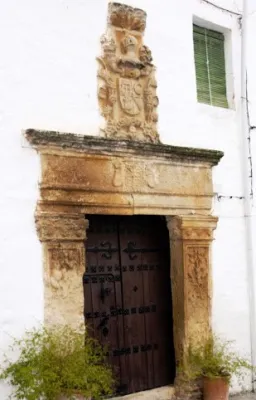
After the Christian Reconquest, the Castle loses its military function. The Dukes of Medinaceli, the last feudal lords of the place, kept within them the tower of the fourteenth century tribute, called Pallarés, and the courtyard of arms of the old fortress, raised a palace of good silery. In line with the Spanish stylistic fashion, the cover presents a robust half-point arc and blasphemous shields in the outgoing key and in the shrouds, framed by stylized columns and flaminers.
His name as the Palace of Medinaceli is due to the second half of the 18th century, when Louis Mary, Duke of Medinaceli, son of Pedro Alcántara and Maria Javiera of Gonzaga, obtained the title of Duke of Santisteban for his marriage to Joaquina de Benavides, daughter of Antonio Benavides and Ana Maria, sister of Pedro Alcántara.
At the end of the last century the Palace became a Liberal Casino, after the civil war it was the seat of the Labradores Circle and is currently the Casa Consistorial de Castellar, restored following the original guidelines.
As for the tower, called Pallarés, of a square floor, it consists of two floors with ten meters of width and fifteen meters of height. From its first floor it is worth noting its beautiful pointed bow, and from its second floor, it is worth admiring its dome on the breast as well as its unrelenting steaks or saetries. In 1996 it was registered in the General Catalogue of the Andalusian Historical Heritage and since 1998 it has been hosting the Iberian Museum of Castellar, where you can see some of the important archaeological pieces found in the town, mostly bronze exvotes, as well as arrow tips, axes or ceramic containers.
The double personality of the whole, Castle and Palace, Palace and Castle is visible, with the refined and crude, civil and military, rustic and urban, naive and sophisticated concepts appearing in one and the other, both of which are the protagonists of this unique conglomerate.