

Description
Declared Monument 03 / 06 / 1931. In the 16th century, both the Crown and the private initiative led to the establishment and construction of many hospital or charitable facilities to address, but not enough, the serious problems of poverty and social marginalization. In the city of Ubeda more than a dozen of these institutions came to work in the Renaissance, of which only some of them have arrived to us.
In the central decades of the 16th century we have documentary record that Andrés de Vandelvira intervened in two important care foundations: the Hospital of the Honored Old of El Salvador and the Hospital of the Most Holy Sacrament or Pedro Almindez Chirino. Of this last nothing left of its architecture, but we know that in August 1552 the bartender Gonzalo Martínez de Alarcos was forced to work the chairs of the jambas of its covers, taking into account the conditions written by Andrés de Vandelvira, according to V. M. Ruiz Fuentes.
The Old Honors of El Salvador, a hospital founded in the middle of the 14th century by a Brotherhood of plural composition at the request of Bishop Narváez, to protect old, devoid Christians, radically removed their property in such a way that basically what has come to us belongs to the Renaissance. The benefactor of the Institution was the famous secretary of the Emperor Charles V, the ubetense Francisco de los Cobos, who assigned them an annual rent of 100 ducats by the solar that had given him for the construction of his funeral Chapel of El Salvador.
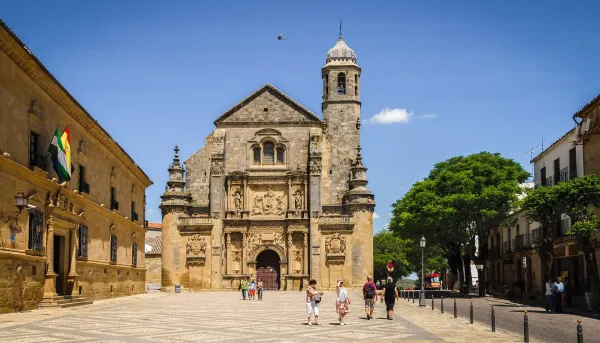
Located close to the head of the Sacra Capilla, of its old configuration two arches of its courtyard, the chapel and the cover remain standing. In 1548 Andrés de Vandelvira gave the conditions to make the "fourth of the church of the hospital," data published by Fernando Chueca Goitia. A series of documents, released by V. M. Ruiz Fuentes, allow us to learn more about the constructive process. The material execution was carried out by the cantero Antón Ruiz, also fenced by Vandelvira, being finished in 1551 and with a simple rectangular trace, which 1563 the carpenter Juan Navarro covered with a wooden ceiling with beautiful canisters of bow of boat with angelotes, according to the project also of Andrés de Vandelvira.
Of the double panda of the courtyard, the one that rises in front of the chapel is due to the bartender Diego de Escalona, who, in 1552, gave plans and conditions, although we assume that the works should have been carried out under the supervision of Vandelvira. The other, in line with the facade, was concluded in 1581 following models of S. Serlio. The cover, dated 1567, was carved according to the plans and conditions of Andrés de Vandelvira by the singers Diego de Alcaraz, Martín López de Alcaraz and Pedro Hernández de Cantabrana. Alongside the southern part of the Sacra Capilla, it is more simple and serious as it corresponds to the Institution; it is articulated in two bodies, the bass with dogrous columns on high basements cover the arch of half point of entry, after the opening the second body is drawn following a typical serlian composition, half point arc as a hornaine to cover the Holy holder and on the intelated windows, all being framed by Ionian columns on which it calls for a second opening. On the roof and -moved from the cover a simple swordsman is raised over the triangular front with a relief of God the Father.
Is part of