

Description
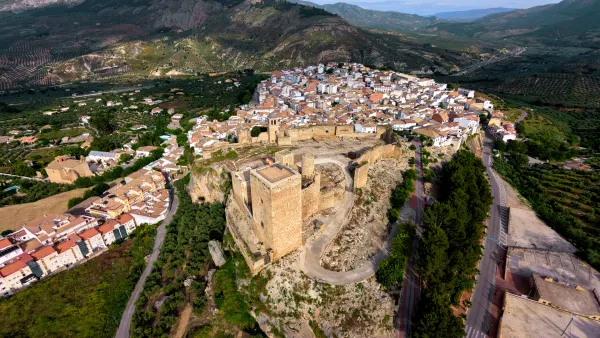
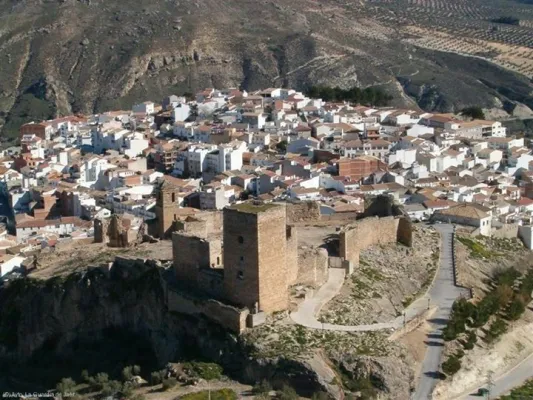
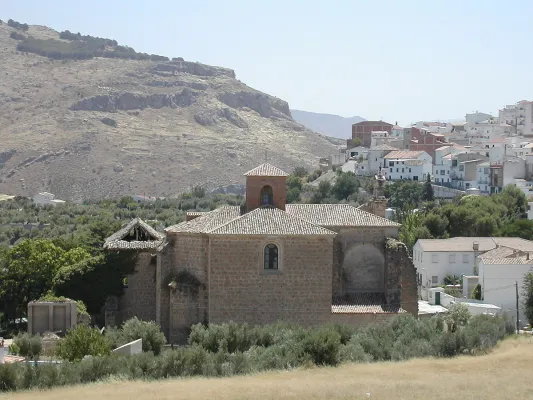
Monument of the Historical-Artistic Set. Declared 06 / 07 / 1983 To the Messies, lords and Marquis of La Guardia, the architectural wealth preserved in this villa is largely due. Thanks to its performance, not without taste, the old Bajomieval fortress adapted to the new palaciegos (typical of the reign of the Catholic Kings) with a beautiful tarootic cover and encouraged the foundation of a convent run by the Dominicans, in which consecrated architects such as Andrés de Vandelvira and Francisco del Castillo "El Mozo" would intervene throughout the 16th century.
Precisely, to the cloister of the said convent, Mr Gonzalo Messía Carrillo Fonseca, I Marqués de La Guardia, commissioned the execution of an exempt fountain, crowned by the Magdalena and dated 1577, which has been attributed to Francisco del Castillo "El Mozo," currently located in the courtyard of the Excel. Provincial Council of Jaén. Years earlier, and perhaps to commemorate the appointment as I Marqués de La Guardia, Gonzalo Messía ordered to raise a pilar-abrevadero at the entrance of the population, near the Dominican convent, to serve as a water supply to the neighbors and their animals. This beautiful space, threatened with splendid gardens, over time became a plateau made up of the source itself and a nobility house of silery built according to the date of 1814.
The pilar-abrevadero, in a landscape and built of silary stone, is formed by a wall articulated by two bodies and attic. In the first body there are five caños of bronze out of avenerated hornazas that pour abundant waters on a rectangular pillar, in the second a beautiful frame was carved with hanging cloth with the inscription allusive to the comitant and the date of execution: "This work command to do the Iltmo. Mr. Don Gonzalo Mexia Carrillo, my lord. Year 1566." Throughout this second body there is an internment supported at the ends in Ionian striated columns. In the center of the attic two canes, with the garruches of the Messia family, hold an oval shield on the mould with the crown of Marquis and the following inscription "Plaza de Isabel II Reina Constitucional," with which this place has been known since. In its origin the dogs held the shield with the weapons of Don Gonzalo Messia Carrillo; it is overcome with a fronton with a central relief flanked by fins and crowned with a Cross, to the ends and bearing the cross of Santiago have settled two lying lions (all very redone).
Although the tracist of this beautiful pillar is not known, the stylems incorporated in it, columns with alternating sticks, the scroll with cloth (similar to the carved ones in the City Palace of Ubeda), the molding of the inlet and the cut-off hides of the shield held by the canes point to a possible intervention by Andrés de Vandelvira. Professor Galera Andreu expresses himself in this respect: I do not believe that the public source is not at his hand, despite the reforms (...) to be highlighted by the small scale of the columns attached in an application to the reverse of what was done in the chapel of the Benavides in Baeza. The set was restored by the local workshop school in 1991.
Is part of