


Description
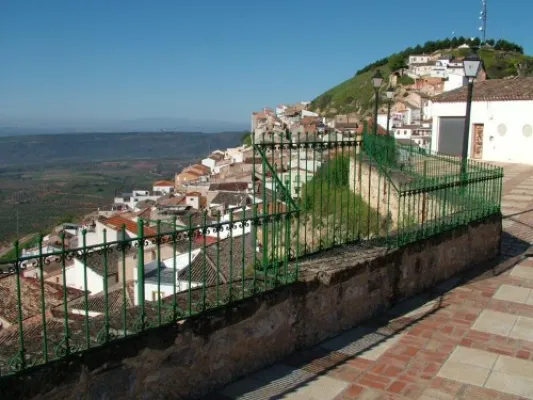
The population core that formed around the peñasco, bordering the castle, gradually expanded at the feet of the nearby hill, that of the Atalaya.
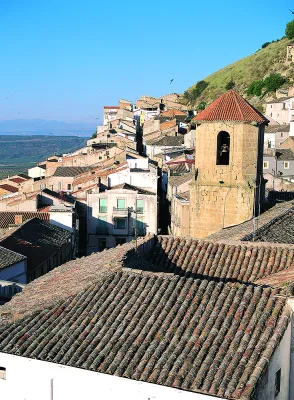
Between the two hills the square was established, which would henceforth be the religious and political centre of the people. There, between the end of the 16th century and the first third of the 17th century, the parish church of San Pedro was erected in an explanade located in a peñasco, on the site of an ancient medieval temple. Its only plant is rectangular with four hornadine chapels and flat tester presbytery. As an autonomous ornament of the architectural one can describe the pile of holy, Renaissance, carved stone water; the image in size of the Virgin, from the 18th century; and, something later, the oil of St. Peter.
The outer vision of the parishioners is impressive: magnificent silvery, counter-strong, and steps to access the southern cover, which has a half-point bow flanked by the curved pilasters, a ball-split fronton, a hornaine in the eardrum and another, this time curved fronton, to host the image of the holy headline. The most prominent element may be the tower, raised on the side of the epistle, of square floor and two bodies, the bass with two windows, vault and arch and covered down, and, separated by a cornice, the second body, with canyon vault and snail staircase and, to the outside, half-point vanos for bells and corners with flanked flyers; a cornose with three gargoes with anthropomorphic figures is the whole.