

Trail Castañar de Valdeazores
Description
Covered by the bottom of the ravine of the Valdeazores stream, the path will lead us between strawberries and alles to beautiful examples of chestnut that leave no one indifferent, going up the water, we will be able to delight ourselves with the spectacular tones that the darkness in front of us in certain seasons of the year, thanks to species such as the whine, the melo, the mustard or the wild pear.
It is a two-way path, leaving users at their choice whether to walk it upstream or downstream. If you decide to start it at the bottom (from the N-IV), the path is ascending in all its path, although we find two different sections.
Datos de la ruta
ROUTE NAME
Sendero Castañar de Valdeazores
TRAIL TYPE
Trail
DIFFICULTY
Baja
TOTAL DISTANCE (IN KILOMETERS) 2,8 km
-
Stretch of asphalt or concrete:
-
Section of track, forest road, or dry watercourse:
-
Trail section:
-
Sections of livestock trails:
HUSO 30S
ESTIMATED TRAVEL TIME
1 h 30 min
ROAD SURFACE TYPE
Trail
--
--
DIFFICULTY. RATING ACCORDING TO THE MIDE METHOD
--
MEANS
Severity of the natural environment
--
ITINERARY
Route guidance
--
DISPLACEMENT
Difficulty moving about
--
EFFORT
Amount of effort required
ACCESSIBILITY TYPE
On foot
TIME OF YEAR
All year round
SIGNALING
No
MORE INFORMATION
TUNNELS
STEEL VIADUCTS
METAL WALKWAYS
WATER POINTS
PONTOONS
GUARD BOOTHS AND BARRIERS
SWITCHMAN'S CABINS
CYCLABILITY
RECREATIONAL OR SPORTS AREAS NEAR THE TRAIL
AID STATIONS
LINKS TO OTHER TRAILS
SHELTERS
RECOMMENDATIONS
- In front of COVID19, keep the safety distance and carry a mask, avoid agglomerations and contact with surfaces, wash your hands frequently, use hydroalcoholic gel and consult the available digital materials. Take care of your health and others.
- It works to prevent fires. Do not throw cigarettes or any other object that produces combustion.
- By consuming local products and having companies in the area you will contribute to rural development.
- He lives with the local people and other users. It respects private property and property.
- Unwind in a sustainable way: public transport, bike, walk, shared vehicle...
- Noise is another form of pollution. In silence you will enjoy your experience more.
- It facilitates the use of people with special needs.
- The trash doesn't come back alone. Take her with you to the nearest container. Reduce, reuse, recycle.
- Don't leave a mark on your way through nature.
- It practices a responsible and committed tourism with the environment. Be a real ecotourist!
- Respect the facilities at your disposal. We all pay for your maintenance.
- Check the weather forecast before starting your activity.
- Avoid going out alone. If you do, it communicates tour and time of return to other people.
- Extreme caution under adverse conditions and with the occasional presence of animals or motor vehicles.
- Please provide prior information on the possible existence of cynegetic activity.
- It has water, sun protection, proper clothes and shoes.
- It carries a mobile with enough battery in case of emergency (112), but remember that there is not always coverage.
- Don't even bother animals. You would negatively alter his behavior.
- For your safety and the safety of the environment, don't get out of the signposted road or take shortcuts.
- Remember that the capture of animals, light fire, fish and collect plants or minerals is prohibited.
- If you bring a dog, take him with his strap and make sure he doesn't bother other animals or people.
- Your safety is our concern, but it's your responsibility.
Thank you for your cooperation!
OTHER INFORMATION OF INTEREST (ARCHITECTURAL OR HISTORICAL-CULTURAL, GEOLOGICAL-ECOLOGICAL)
Technical Description
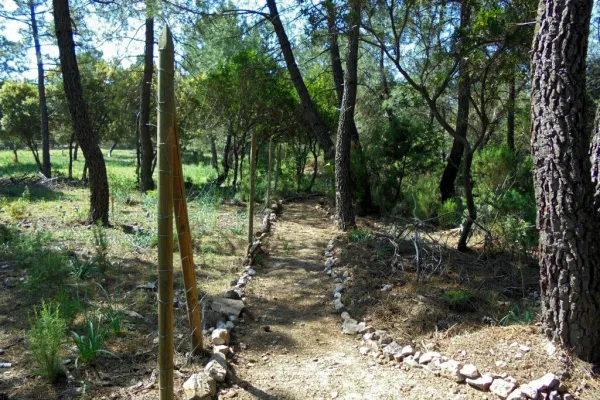
The first section runs from its beginning parallel to the Barranco de Valdeazores, sometimes crossing it and partly coinciding with the driving that supplies the gardens of Despeñacolos. The slope of this first part is soft, and will allow us to delight with a well-preserved gallery forest of mainly strawberries and alms. In spring, the peonies will give a touch of color to our march.
After a mile and a half, majestic chestnut specimens will give us a beautiful landscape in which to stop and take a breath, taking advantage to refresh us in the source of the spring that provides the driving.
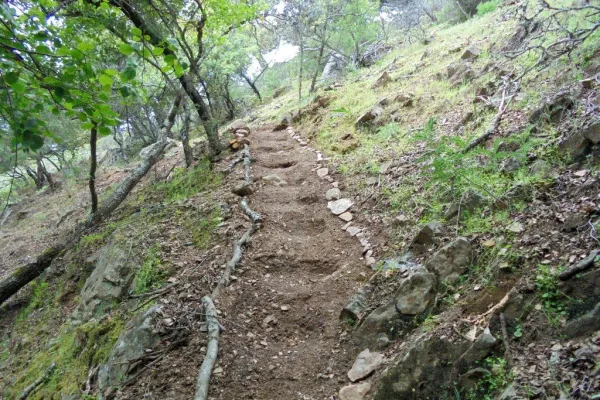
After a break, we will resume the march and move on to the second stretch. This part of the path is a little more abrupt, running along the right bank of the Barranco. During this stretch, the vegetation that will accompany us will be made up of pine trees, oaks, dyes, junips, pans, jars and other species typical of the Mediterranean mountain.
Already reaching the end of the path, we will find a large number of complaints, above which, even if we do not reach the view, there is one of the best preserved melojars of the Natural Park Despeñacolos. It is not surprising that, already in the first botanical treaties, the illustrious Professor Font Quer defined this place as a "true botanical paradise."
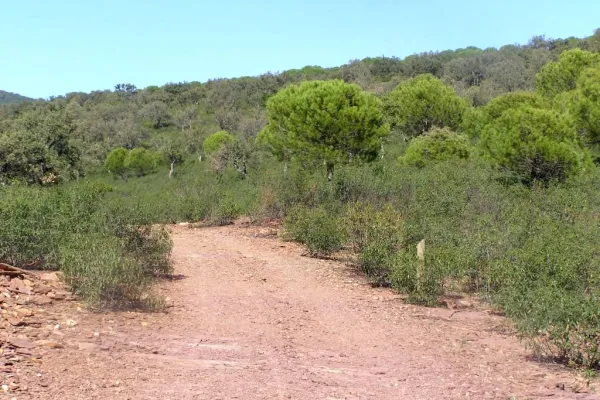
The path made in this sense ends on the track of Las Correderas, the turning point of the Barranco de Valdeazores path, where we will have the option to go down to the road by the House of Valdeazores (to the right) or to continue on the left towards the lookout the Organs (where there are indescribable views of the Natural Monument of Los Organos); from where we will drop back to the N-IV by the Barranco de la Nimuco path.
In the opposite or descending sense, those users who come back from the lookout or who have come up through the house of Valdeazores can return to the N-IV by coming down this new path.