

Description
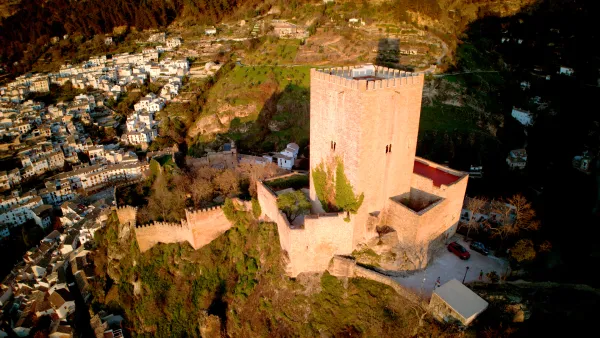
Monument of the Historical-Artistic Set. Declared 13 / 07 / 1972. The advance of Cazorla remained under the jurisdiction of the Archbishop of Toledo from the 13th to the 16th century. The large territory provided important benefits and the position of Advantado gave prestige to the one who held them. Both reasons must have weighed enough for Don Francisco de los Cobos, the prepowerful secretary of the Emperor Charles V, to come up with all the means at his disposal to obtain the rule and charge of such wide-ranging dominion for himself and his descendants.
It cost him the effort, but in the end, and despite Toledo's resistance, in 1534 he obtained the title, but his descendants could not keep it, as he was reintegrated to his former owners after a sound lawsuit in 1634. Cobos would soon complete his dream of becoming a great lord with the purchase of the jiennese villas of Sabiote, Canena, Torres and Velliza (Valladolid); his wife, Maria de Mendoza, rounded this great state with the acquisition of Jimena, whose purchase process was already initiated by her husband.
In all these enclaves, more in his hometown and in that of his wife (Ubeda and Valladolid, respectively), Francisco de los Cobos planned great building programs of marked artistic and propaganda significance. This double intention is perfectly reflected in the project of the church of Santa Maria, which was in all probability carried out by his trusted man, the deán Ortega, who in turn would entrust the works and direction in Andrés de Vandelvira, the master of the house's quarry, especially from the works in El Salvador de Ubeda.
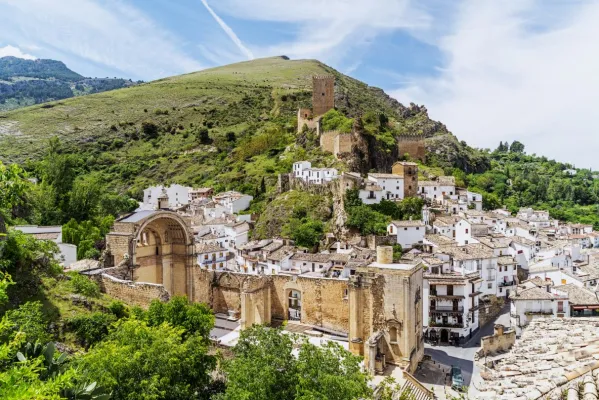
The new church would rise on the way of the River Cerezuelo, but for this it was necessary to abovednot only the space dedicated to the church, but also the rest of the same located in front of it. Thus the temple closes and presides over the square, which also had the City Hall building (now hidden) and a beautiful pilar-abrevadero, which Chueca Goitia attributes to the hand of Andrés de Vandelvira, although the date 1606 carved in its large central billboard indicates otherwise. We must not forget that the advance to Toledo was returned the traces of Cobos and his descendants, the Marquis of Camarasa, had to be erased in all those goods where they were present.
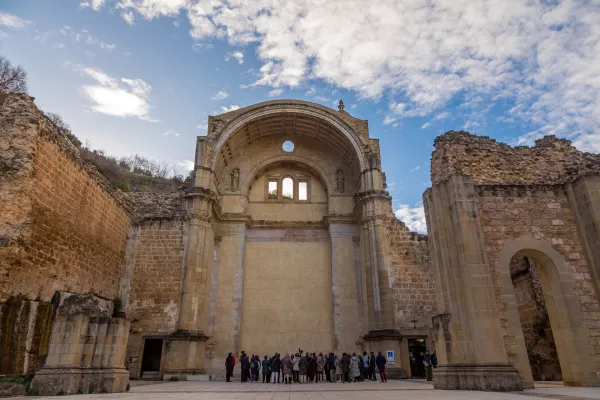
This temple, located in a unique natural setting, suffered a catastrophic raid at the end of the 17th century, taking with it almost all its movable property. The fire by the Napoleonic troops in the War of Independence left the factory ruined, remaining standing the header, part of the perimeter walls, one of the two foot towers, with various remains, and a cover on the side of the Epistle. The destruction and the limited documentation found so far about its constructive process makes it difficult to set the stages and the teachers responsible for its factory. In any case, the difference in style between the header and the rest seems clear. Andrés de Vandelvira is present in the head and chapel of San Isicio, leaving out of his language the part of the feet and the side cover, which, according to José María Crespo, was able to run to a large extent by Alonso Barba.
The canyon vault of the presbyterium, the serlian vanity of the tester, the angular pillars that would form the cruise, with half Corinthian columns and fantastic heads, and the snail staircase topped into a cylindrical body are certainly elements used by Vandelvira around the 1540's. The vault of the chapel of San Isicio, for its part, is closely related to the one located under the tower-bell tower of El Salvador de Ubeda. The plant, made up of a ship and cruise to cover (at least in the initial project) with boned vaults, would approach the type of La Guardia, a conventual church in which Vandelvira also left the best of its art in the major chapel and cruise.
The ruins of Santa María, currently in the process of restoration in accordance with the project of the architect Mr Pedro Salmerón, still show today the proud architecture with which it was conceived by one of the most influential men of the 16th century in Spain, Don Francisco de los Cobos, who was also lucky to have at his service Andrés de Vandelvira, one of the most outstanding singers of the Spanish Renaissance.
Is part of