Tourist Office



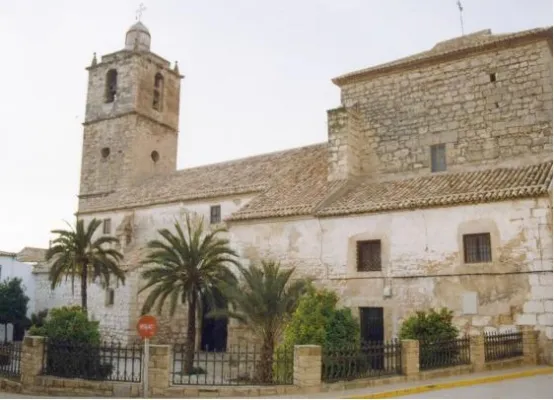
Villardompardo is a small municipality in terms of area, located in the Campiña region west of the provincial capital, on the banks of the Salado de los Villares stream, whose main landscape feature is the olive grove. The municipal area is almost entirely flat, with some sloped areas, and its town centre sits on top of a low hill. The municipality's economic activity is almost exclusively agricultural, specifically the single-crop rainfed olive grove, which occupies practically the entire area. In recent years, activity has diversified with the creation of small industries and construction firms. Worth highlighting are the town's gypsum quarries, a resource with potential for exploitation. In Villardompardo, made-to-order furniture is still crafted today. The finest examples of this cabinetmaking follow a classic Spanish, Renaissance-inspired style, close to the furniture that characterised Granada in the first half of the 20th century. Among the woods used, beech and chestnut stand out. In terms of historical heritage, the most notable features are its Castle, declared a Site of Cultural Interest in 1985, and the Church of Nuestra Señora de Gracia.
Is part of


The landscape offered by Villardompardo is almost entirely flat, with very gently sloping hills, and rather monotonous, as it is almost entirely covered by olive groves. The Salado de Villares stream runs through the municipality; it has a low flow and dries up in summer, which is why it is not used for irrigation. Most of the crops are rainfed.
As in most other towns of the Campiña, natural vegetation is practically non-existent, reduced to field boundaries, paths and the banks of the Salado stream.
The olive tree plays an important ecological role: numerous birds, mammals and reptiles find shelter in its old trunks, and its fruit is also a highly energy-rich food source.
Few species are found continuously in pure olive groves, as they are mostly used as feeding or transit areas by certain species. Here you can spot species such as the European serin and the greenfinch; and in winter, the blackcap, the robin and the song thrush.
Biodiversity in the olive grove increases where streams appear alongside riparian woodland or Mediterranean scrub boundaries made up of reeds, oleanders and tamarisks. Here you can find house sparrows, chaffinches, goldfinches, nightingales, crested larks, quail and carrion crows. Amphibians: common toad, green frog, salamander; reptiles: Montpellier snake, ocellated lizard and wall lizards; mammals: hares, rabbits, foxes, badgers, genets…
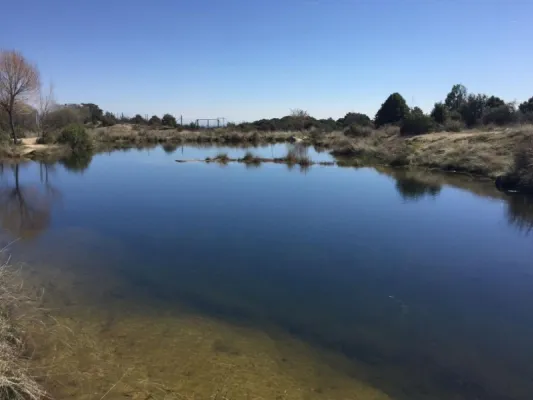
The Charca de Pajarejo, to the northeast of the town, is a natural pond that only forms after heavy rainfall, functioning as a temporary wetland ecosystem where various waterbirds nest.
Villardompardo's traditional festivals are closely linked to agricultural work:
The town also boasts delicious pastries:
The discovery of archaeological remains predating the Middle Ages in Villardompardo, such as Neolithic axes, Roman troughs and brick pavements, indicates that the area was inhabited in earlier periods.
In the surroundings of the town, traces of Iberian and Roman presence have been found, including the possible existence of rural villas devoted to agriculture in places such as Las Piedras de la Rata and Cerro Pelado.
However, there is no mention of Villardompardo until its conquest by Ferdinand III the Saint in 1245. The municipality was a small hamlet devastated by the war between Christians and Muslims. It was granted by the king to a nobleman who accompanied him, Don Pedro Aznar Pardo, from whom it took its name (El Villar de Don Pardo), with the task of resettling it and organising an appropriate defensive system. It is very likely that the castle was built around that time, though smaller than the one we see today. The instability of the war meant it was repeatedly devastated and resettled until, in 1371, King Henry II turned it into a lordship entrusted to Don Pedro Ruiz de Torres, on condition that he resettle it once again.
In the 15th century, the castle was used militarily in the fight against knights of the Order of Calatrava who had risen up against King Henry IV. The town gradually gained more privileges, and in 1558 Philip II elevated the lordship to a county, naming Don Fernando de Portugal y Torres the first Count of Villardompardo. He was responsible for the major works carried out on the castle in the 16th century to transform it into a residential palace.
Under the feudal regime, the population went through very difficult times — famines, wars and epidemics — until the Constitution of 1812, which abolished lordships and entailed estates. The two 19th-century disentailments, that of Mendizábal and that of Madoz, which put the Count's lands, Church lands and communal lands up for sale, were decisive in significantly boosting the local economy and population.
The population held steady until, in the 1960s and 1970s, its people emigrated to other, more industrialised areas of Spain or to European countries, in search of a better standard of living.
4