Tourist Office
Paseo Santo-Cristo



Municipality located in the eastern part of La Loma and the Four Villas, in the north-eastern part of the province and at 794 m altitude. It has two well-defined orographic sectors, on the one hand the area of the countryside, of land alominated and occupied by a true "sea of olive trees," and on the other, the area of the Sierra de las Villas, where the coniferous, the bushes and the low mountain define the landscape.
Several rivers irrigate their territory: Guadalimar, which serves as a natural border with the region of El Condado; Guadalquivir, which separates the countryside from the saw, with its two tributaries, the Huascebas Grande and Avocados Chico.
The municipality of Villacarillense includes the following population units: Villacarillo, Cabeza de Mogón, La Caleruela and Agupación de Mogón y Arroturas.
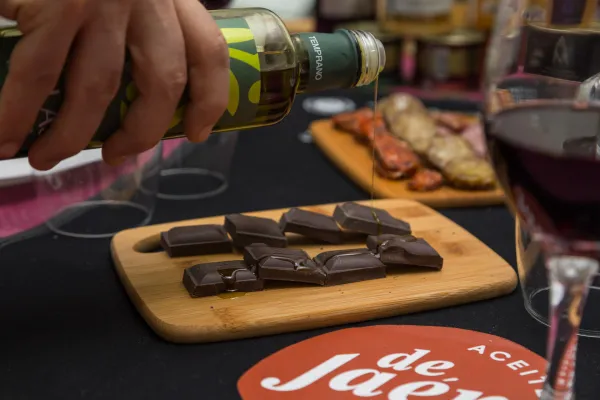
The economy is based almost exclusively on the cultivation of the olive tree, we cannot forget that Villacarillo is currently the world's largest olive oil producer.
The historical-artistic heritage of the town is much and varied. Among others, the Church of the Assumption, the Church of Santa Isabel de los Angeles, the City Council, the House of Inquisition, anti-aircraft shelters, as well as numerous palaces and houses of different times and great artistic interest.

Is part of


- Parish of the Assumption.It's the most important monument of Villacarillo, is a proud building built between the 16th and 17th centuries, in which the last forms of the Gothic and the first manifestations of the Renaissance coexist. It is one of the great works of Andrés de Vandelvira, who set up his first home here, married the neighbor of this city, Luisa de Luna, and had seven children. The construction works begin in the year 1540, setting up the Vandelvirian project on the primitive medieval castle of Mingo Priego, part of which is integrated into the upper dependencies of the temple, now converted into a museum.
The Church of the Assumption is extraordinary for the uniqueness of its volumetric profile, the inner spatial grandiosity, the originality and beauty of its vaults, and the integration of medieval traditions into Renaissance classicism. It is one of the most significant churches of the Renaissance in the diocese of Jaén. National Monument since 1931. The interior is of basic and three ships with the same height separated by high and slender pillars that complete the feeling of a monumental set. Even with Gothic resabies, visible on the pillars and side ships, it shows what will be the idea of a Christian temple that Vandelvira has, dominated by vaults of a vanish type. On the side walls, hornadine chapels are opened, which are covered with nerve vaults.
The Central cover It is formed by a beautiful succession of half orange domes with lanterns on decorated breasts. We can imagine Vandelvira and his assistants during the first years of the construction of this church, large wooden scaffolding, the noise of the quarries, piles of stone to be turned into armchairs and the caleros selling lime for the argamase. Without a doubt, the most curious image should be the perplexity of the elderly, seeing such thin pillars on the sides of a great central ship, nothing to do with the churches of the area, or the recite Sanctuary of the Virgin of Fuensanta, in the nearby Villanueva of the Archbishop. Very important will be all the pictorial decoration of vaults, The work of Peter of Raxis, mainly dated from 1575, representing scenes of the Old Testament and the Passion of Christ.
The altarpiece, Baroque, by Juan Gómez Lobo, from Toledana, in 1670; Chapel of the Christ of the Veracruz, with his baroque shrimp of the 18th century and the Sacristywhich begins to be built after the temple is finished at the end of the 16th century, in which Alonso Barba must intervene, on what had until then been a parish of Santa María del Castillo of Gothic style. It has a rectangular floor, with a cover divided into three sections with vaulted vaults.
The Puerta de Sol and Door of the Umbria are the main accesses to the temple. The tower designed by Vandelvira is quadrangular, topped by a body of bells, crowned by a regular octagon and petreous cone and located on the right side of the main door, Puerta del Sol, its height is 56 meters. The climb of stairs is helical. In Parish Museum of La Asunción the collection of baroque goldsmiths of the 17th, 18th and 19th centuries, as well as misals, bibles, casullas, etc.
- Church of Santa Isabel de los Angeles is one of the most important monuments of Villacarillo, of Renaissance style. It is located on Ramón and Cajal Street, popularly known as "Cuesta de las Monjas." Old Franciscan convent, built in 1645 and made by the architect Juan de Aranda Salazar. The interior of a single ship with a barrel vault, with high chorus to the feet and remarkable frescoes that are attributed to the village of Escudero de la Torre. The baroque-style golden altarpiece has salomonic columns that are decorated with grapes, sardines and glass leaves. The facade is made of stone with irregular armchairs and a simple three-body swordsman.
The cover, elegant and classic, with a garden in which you will find the stone image of Santa Isabel of Hungary. In 1812, a solemn act of swearing of the Constitution of Cadiz, popularly known as "The Pepa". The building attached to the church was a closing convent until 1737, a public prison during the French occupation and, from 1884, a hospital to which the services of the former San Lorenzo Hospital were transferred. Between 2012 and 2013, a number of work has been done to recover the damaged church areas. Today it houses several municipal units.
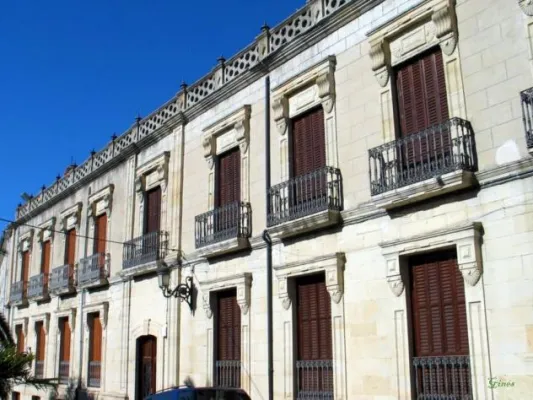
- Municipal Public Library. It is a 19th century building considered of high value, with two floors of height and marked modernist and eclectic character in its architectural concept. Inside, the staircase and the entrance fireplace stand out. Also, the decoration of the ancestors of the low windows and balconies is remarkable.
- City Hall. In a neoclassical style, it was built in the 19th century, with horizontal façade with three clearly differentiated floors and regularly distributed vain. It highlights his cover.
- The House of Inquisition. Located in the old town, on Repullete Street, it is a historic three-storey building built between the 16th and 17th centuries. The original facade, the grating and the rise of the gilded stairs with shields of the Holy Office of the Inquisition and a pontored cross are preserved.
- La Feria Streetthe main artery, in which the best examples of domestic housing are located, particularly bright in the casas- palaces like the House of the Rubials; Palace of Cardinal Benavides; Courts; current House of Youth and below we find that of the Regil, of the 17th century, which must have belonged to this family of quarters who also worked in the church.
- Vandelvira's house and bust. On the side of the church and on Vandelvira Street there is a house, at number seven, which is held by the house of the master in Villacarillo and a bust tribute to Vandelvira.
- Anti-aircraft shelters. They were built in the middle of the Civil War in 1937 to protect the population in the event of air bombardment. They never got used. They have subsequently served as a food store. In 2018 they were rehabilitated to be included in the city's heritage. The shelters and the Parish are within the program "Hidden Treasures" de la Loma and Las Villas.
- Archaeological settlements. Villacarillo is prodigy in archaeological discoveries that shed light on the successive peoples and civilizations who chose their territory to settle. Many of them are concentrated in the Turruñuelos fieldwhere the human presence has been documented, and almost uninterruptedly, from the Copper Age to the Roman era. The Castellones de Mogón, place located on the right bank of Guadalquivir, have documented the existence of a village appeared in the 6th century BC, From this place comes a relief known as the Domador de Caballos. The ceramic elements located west of the mouth of the Arroyo Del PocicoThey say it would be a necropolis.
- Other interesting constructions are the bridges in Villacarillo and Mogón, as well as the hydroelectric power plant of the Duende or the Gardening Mill of the Pepper in La Caleruela.
- Almazara Tourist Agricultural Cooperative Ntra. Mrs. del Pilar, the largest of the province and surely of Spain, built on a plot of 160,000 m ² located on the outskirts of the municipality, includes a factory of 12 production lines and more than 11,000 m ², four industrial ships, several wineries and a social building of 2 floors, with 1,800 m built.
Villacarillo with an extensive municipal term, has two well-defined orographic areas:
- The countryside, which extends through the eastern end of the region of La Loma, occupying most of the municipal term. The orography of this area is of lomas with soft slopes and almost entirely covered by olive trees. It is the fauna of the olive tree that corresponds to the small-game cynetic species: hare, rabbits, partridges, clumsy pigeons, badgers... Without forgetting the olive fauna, both the birds that the shelter has here and those who feed on it on their migration trips. To point out the importance of insecticide birds to prevent the spread of pests in the olive tree, an ecological insecticide.
- The area of the Sierra de las four Villas, which is part of the Natural Park of the Sierras de Cazorla, Segura and Las Villas. One of the features that draws the attention of the landscape of this area, is the water abundance and lush vegetation. Four rivers go through its term: The Guadalimar, which is a natural limit to the region of El Condado; the Guadalquivirwhich serves as the border between La Campña and the Sierra and the rivers Huascebas Grande and Chico hives, whose waters will go to Guadalquivir. These waters make up an agribusiness relief, with large cliff slopes, enclosed valleys, canyons, flashlights... The water dissolves the limestone and while modeling the landscape will result in karmic formations such as caves, wells, bowling...
The vegetation In this area it is colonized by large-scale larix and black pines, strawberries, maples, boj, madroños, tejos, some of them millennia. It's an ideal place for it to develop cynetic species of major game like: the boar, deer, gamo... and it is very easy to see the royal eagle, the perdicular eagle or the black vulture or the leonated vulture lying in the rocks or flying over the skies of the area.
Walking the trails of the area is to have the opportunity to enjoy really wonderful panoramic, as you can see the Guadalquivir Valley, the Yelmo, the villages of La Loma or even Sierra Nevada.
Mirador: Road A-316 in its Torreperogil- Villacarillo-Villanueva del Archbishop section. It is just an example of the great olive groves that can be seen when travelling through the province of Jaén. In particular this stretch of road runs almost air in the interflude of the valleys of the Guadalimar and the Guadalquivir. From this area you can see thousands of hectares of olive trees in a single look, framed by the horizons of Sierra Morena on one side, and Sierra de Segura and Sierra de Las Villas on the other.
There are many places where we can enjoy an exuberant nature at the end of Villacarillo, but we will quote three of them: The Path of the Odera, the Cascade of Chorrogil and the reservoir of Aguascebas.
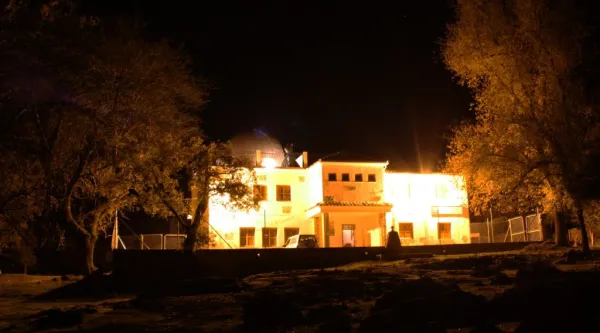
In Mogón, the StrawberryIt's a beautiful natural place surrounded by trees. There is the Astronomical Outreach Centre of La Fresnedilla, which aims to introduce the visitor into the various techniques and means of astronomical observation.
- Holy Week. Festivity of great tradition in Villacarillo, dates back to the 16th century and stands out for the solemnity of its steps, for the Songs of Passion and Saetas, for the devotion of the cofrades and in general, of all the participants. They have processions every day, from Dolores Friday to Resurrection Sunday. The cornet and drum bands that spread along with the hermandades are originating in Villacarillo. The traditional "songs of passion" take place on Good Friday. This is all what makes this holiday really unique.
- San Isidro. On May 15, the image of San Isidro comes out in procession, accompanied by horsemen with typical costumes and beautifully decorated carrots, from the church of Our Lady of the Assumption, to the hermitage located in the Mastizal Road. There the Eucharist is celebrated in honor of the farmers' pattern and the fields are blessed. After the religious events, the attendees have in the surroundings of the hermitage a day of coexistence and a meal of brotherhood.
- Corpus Christi. It is the most important and traditional holiday of Villacarillo. It has been held for about 650 years and since the 19th century this celebration is held in the afternoon due to a papal bull (Lion XIII). The streets through which the custody will pass are covered with pots and pits, the floors are covered with carpets made with colored sawdust and flower petals, creating true works of art and covered with awnings and banners. To highlight the gothic silver custody in which the Body of Christ has been processed since the 17th century. The court leaves the Parish Church of Our Lady of the Assumption. The public influx during the celebration or following it from the balconies is a massive one. The National Poetry Prize "Corpus Christi" in Villacarillo has been held since 1975.
- Fairs and parties. The origin dates back to the trade fair and livestock which was held in the Middle Ages. Fernando VII gives him an official character. Parties between the 9-14 September in honor of the patterns, The Most Holy Christ of the Vera Cross and Our Lady of the Rosary. In the first days the traditional braggard coils, they go back to the 18th century and enjoy great popularity. The bullring that since 1955 has seen the first figures of the bullfighting, has gained a well-deserved prestige. Many cultural, sports, concerts, verbenas... organized by the City Council.
- Patterns. In honor of their patterns, in addition to the September parties are held individually, the 3 May, theLegacy of the Christ of the Vera Cross a Villacarillo; and 7 October the day of Our Lady of the Rosary.
- Serrano bowling. The serrano bowling is a way of expression, in the form of a traditional game or sport, which is shared and internalized by the inhabitants of the mountain massif that forms the current Natural Park of the Sierras de Cazorla, Segura and the Villas as part of their identity, with Villacarillo being the municipality that provides the largest number of practitioners and currently has seven active bowls.
- The Calandrajos. They have as ingredients water, flour and salt for wafers. In the frying pan a saffrito of tomato, garlic, onion, green pepper, a little spicy and rabbit, hare or partridge. When cooked the meat is added the wafers and let be boiled. They're served in the same pan.
- The Migas. It was a dish used to take advantage of hard bread. They are fried in a frying pan of garlic teeth, to which the bread is added until it is touched. The crumbs are usually served with fried peppers, torreznos, sardines, grapes and melon.
- The Harina Garlic. A saffrito is made with tomato, onion, potato and eggplant. In the frying pan, dry red peppers are tasted, once toast is crushed in the mortar with cumins and salt. When everything is ready, water is added and at the end flour is to be weighed.
- The Popes' Hat. It is a mashed potatoes with garlic and is added a saffrito of tomato, onions, peppers, pepper and cumin. It rehogs all together and can be served hot or cold.
- The piirrana. and the damp, the latter with crushed chickpeas and cod strips. Others: La Gachamita, El Ajo de Morcilla, El Picadillo, la Morcilla Blanca and the Papajotes.
- Other: The Gachamita, the Ajo de Morcilla, El Picadillo, the White Morcilla and the Papajotes.
In the pastry shop:
- The Sweet Gachas. They are made from roasted flour, bread, milk, cinnamon, sugar, olive oil and matalahúva or anis. They're typical of All Saints Day.
- The Bitch. Made with a bread made of oil and egg cooked in the center. It's consumed on Easter.
- The Drinks. Oil, wine, flour, a little anise and sugar.
- The Sobaos. It's a big, baked, sugar-cooked rosy. Also typical of Easter.
- The fried thighs, Pestives, butter and butter cakes, made in a handmade way.
Although we have no archaeological research that can specify the antiquity of human occupation in the locality, the quality and quantity of the remains found in its surroundings allow us to go back to the Neolithic. Among these, we quote numerous legal instruments, such as neolithic axes, funeral tombstones of different historical times, the Treasure of Mogon, currently in the National Archaeological Museum, the Mercury God, in golden bronze, the Winged Sphinx of Phoenician origin or the Roman mosaic of Teatino. The Iberian and Roman settlements were very important.
Villacarillo originated in the Muslim era as a fortress defending Iznatoraf. After the conquest of this by Fernando III the Holy one in 1226, his evolution began. At first he was known as the village of Mingo Priego, which the king donated to the advance of Cazorla.
The growth and importance of the population were increasing until the archbishop of Toledo, Alfonso Carrillo, gave him the category of independent villa in 1449, giving him his name and shield. Category that was later confirmed by King John II of Castile and later, in 1498, by the Catholic Kings.
The richness of its cerealistic field will allow for a rapid growth maintained over the following centuries, the population has been consolidating and increasing, leading to the formation of the urban town of regular layout and large solariegal houses. In the 19th and 20th centuries it enjoyed an important boom that is reflected in the modernist buildings that splash their streets. By Royal Decree of 8 March 1877, Alfonso XII grants the City title.
28
8
12
5