Tourist Office



Valdepeñas de Jaén is a municipality in the province of Jaén, located in the Sierra Sur region, south-west of the province.
The forest area of its municipal area is important, as it is located between the mountains of the Pandera, to the north, and from Alta Coloma to the southeast. Giant Simas, complaints and centenary oaks with peaks that reach 2000 m., define this territory. This particular environment makes this territory ideal for major hunting.
Thanks to its privileged geographical location, Valdepeñas de Jaén has natural areas of great beauty, with abundant water, many fountains and streams, such as the "Las Chorreras" and "El canyon de Pitillos."
Valdepeñas de Jaén is an agricultural municipality, dedicated mainly to the cultivation of the olive tree; livestock, with a significant number of dairy goats, and with the oil industry, as the only representation of the industrial sector.
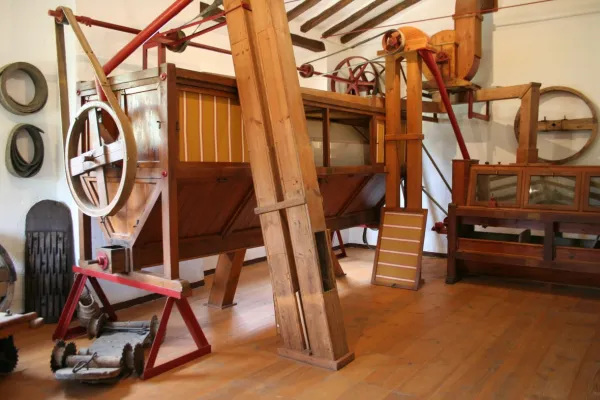
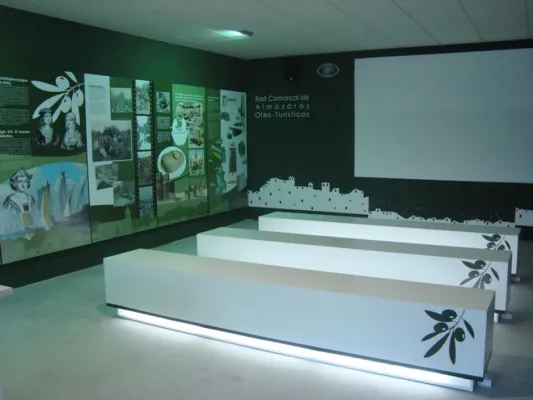
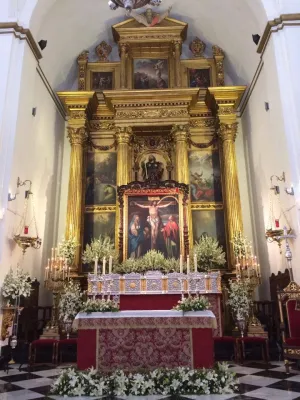
From the point of view of the architectural and cultural heritage, they stand out: the church of Santiago Apostle, from the 16th century; the Mill and Museum of Santa Ana and the hermitage of the Holy Christ of Chircales.
Is part of


Valdepeñas de Jaén, founded by Carlos I, shares with Mancha Real and Los Villares, being one of the paradigms of the Renaissance urbanism, inspired by the theories of the trattadist Vitrubio.
Its urban morphology had to adapt a reticular route to the irregular orography of the hill on which this municipality is based. The city centre was located in the most flat part with a large trapezoidal square where the most emblematic buildings are located.
Other monuments of interest are: the episcopal residence, reformed in the 17th century under the inspection of Eufrassio López de Rojas and converted into episcopal headquarters when the Augustino bishop Fray Diego Melo of Portugal took refuge until his death in Valdepeñas; the Hermitage of Our Lady of the Angustias of the Parrizoso (on the banks of the Quebrajano reservoir) and the Hermitage of San SebastiánIn the old Egido, it has an attached cemetery.
Valdepeñas de Jaén is a municipality with large forest mass when placed inside the subbetic saws. It is the highest point in the South Sierra to the north with the Pandera saw, with 1872 m., and to the south with the Alta Coloma saw.
The city centre is located 920 m. of altitude, located in a valley and surrounded by huge mountains. The natural environment with little exploitation by man must be highlighted. An environment full of walnuts, pastures, chaps and centenary complaints. His great saws, the Pandera and Sierra Vestinkers, mountains that are covered in snow during the winter.
Among the trees, the Coal Complaints, a millennial tree that has been declared a natural monument.
In this landscape of high mountains and abrupt areas lives a great diversity of wild animals who freely camp through the saws. An ideal place for the cynegetic species, especially for major hunting: deer, wowls, boars, muflons... among others.
A place where water is a true treasure of these lands that offer us countless fountains, waterfalls, reservoirs, rivers and streams which are contonated by these saws giving rise to places of a unique beauty such as: Paraje de las Chorras, Pitillos, declared Natural Monument and which conserves a forest of unique tiles in the region and of the few existing in Andalusia, Navalayegua's lookout, Salto del Hoyo, Chircales, el Castellón, el Vadillo or el Charco de Utrera, a large waterfall of 25 m, or the swamp of the Quebrajano and its imposing cannons.
The areas of the valley, populated by olive trees is the primary crop, next to the livestock and small game cynetic species, also has a goats' cabin Very important dairy.
We can say that the term of Valdepeñas we offers privileged places to contemplate nature in its greatest splendor and let him delight us and seduce us.
Valdepeñas is a town of deep-rooted customs and traditions that make it unique. Where festivities are held that do not lose traditions like La Candelaria, In which the fire remains the protagonist, or the carnivals that fill the streets of the town with color and joy. There are also these parties:Holy Week, with dramatic representations of scenes of the Passion of Christ full of religiosity and that awaken the emotion among the attendees.
The gastronomy in the town is very linked to the livestock. The local receptarium gives hands to the surrounding mountains to incorporate into the table Triguero asparagus and cardo mushrooms and also aromatic herbs used as additives in many of the dishes.
Of the most typical dishes, we highlight:
Between the typical sweets: "Ochíos" "nochebuenos as" "Sin salas," rosquetas, "roscos de vino" and "bollas de higo."
Typical drinks as the "resol" and "old milk", typical Christmas drink that mixes: milk, spirit, coffee, cinnamon and lemon crusts.
The oldest remains documented in the term Valdepeñas go back to the Bronze ageand are located in the area called "Castellón."
During Roman times a proliferation of small houses linked to the peasantry, as the remains in the Ventilla, Navalenga, El Torcal, La Solana, Pitillos and others testify.
In the Islamic period the castle of Susana, mentioned in the Arab and Christian chronicles, is raised with a rather busy existence, being conquered on several occasions by both sides.
What today is Valdepeñas de Jaén was founded on 1539 by the Emperor Carlos V, as a new population, within the project of colonization and repopulation of the saws of Jaén.
In the new towns is implanted a urbanism called colonial, in the form of a damer, in which the streets in reticle will give to the main square, the place in which are the most representative buildings: church, town hall, posite... A kind of urbanism that has been maintained to this day.
By 1550, the population was fully constituted, but as a place under the jurisdiction of Jaén. It will be in 1579 and thanks to the donation of 1,370,000 Maravedis who contributed their 170 neighbors, King Philip II gives Valdepeñas the title of the village, disconnecting from the city of Jaén.
Valdepeñas took an active part in the War of Independence, possibly encouraged by the Bishop of Jaén, who resided in the palace that the bishopric had in the city.
In 1917 obtained the title City, granted by S.M. King D. Alfonso XIII.
7
3
1
5