Saltar al contenido principal

Iznatoraf

MUNICIPIOS
  • Iznatoraf
  • e44ccc0f-c0c8-5efb-6379-aaeaec9b5995?t=1595512030295
  • 36109a4f-dd90-ee2e-1589-5eec29c2fa9d?t=1618496951759
  • img_9498-jpg
  • 1b5bb631-9d13-f9d1-5545-ed0298066094?t=1595512273130
  • 97ae8a28-43f2-a8ca-bdf2-26f5097dd6f6?t=1618497158369
  • 28e4e19c-3103-3488-ac95-935e087e61b5?t=1618497158473
  • bbd2ff61-a4c0-4bcd-d582-78965f65205e?t=1618497158542
  • 6a0fd625-07c8-a8bd-b6a8-e16db69ebff4?t=1618497158595
  • img_9499-jpg
  • Iznatoraf
  • e44ccc0f-c0c8-5efb-6379-aaeaec9b5995?t=1595512030295
  • 36109a4f-dd90-ee2e-1589-5eec29c2fa9d?t=1618496951759
  • img_9498-jpg
  • 1b5bb631-9d13-f9d1-5545-ed0298066094?t=1595512273130
  • 97ae8a28-43f2-a8ca-bdf2-26f5097dd6f6?t=1618497158369
  • 28e4e19c-3103-3488-ac95-935e087e61b5?t=1618497158473
  • bbd2ff61-a4c0-4bcd-d582-78965f65205e?t=1618497158542
  • 6a0fd625-07c8-a8bd-b6a8-e16db69ebff4?t=1618497158595
  • img_9499-jpg

Description

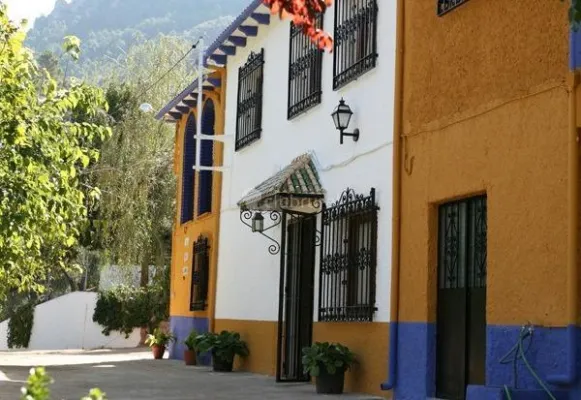
Iznatoraf (also known as Torafe) is one of the most beautiful places in Jaén, one of the highest in Andalusia and one of the most surprising to the traveller. It is located to the north-east of the region of Las Villas and is located on a hill of 1,036 m, as a lookout post over tens of kilometres of olive trees in all directions. The view of the Sierra de Las Villas is spectacular.

It is an almost unique viewpoint to see much of the province and a crucible of cultures (Arab, Jewish and Christian) that have left a rich artistic legacy. It retains its urban layout of narrow, slimmed and winding streets within an Arab-based walled enclosure.

Its term is divided into two separate enclaves: one to the west, where the urban core is located and above all the olive tree; and the other to the east, essentially forest and within the limits of the Natural Park of the Sierras de Cazorla, Segura and Las Villas.

Several are the houses inhabited by the municipal term, such as Batanejo, 15 km away and others like Santa Marina or Sillero, in the Sierra de Las Villas.

Economic activity is the olive tree and the oil industry. Tourism in this region has virtually not developed.

Among its historical heritage are the Church of the Assumption, the remains of the medieval wall with its access doors and the Hermitage of the Christ of the Veracruz, among others.
The old town of Iznatoraf was declared an Artistic Historical Set on May 15, 2012.

Since 2020, Iznatoraf has had the distinction of Flor de Andalucía, with the category of four flowers, given by the Multisectoral Association of the Andalusian Gardening, being the only municipality in Gienese that obtained this qualification. It also belongs to the network of Magical Peoples of Spain, the only people in the province, which unites peoples with charm from various European and Ibero-American countries.

Tourist Office

Zona turística: Sierras de Cazorla, Segura y las Villas
Distancia a la capital (km): 102,9
Altitud sobre el nivel del mar (m): 1036
Extensión (Km²): 86,47
N° de Habitantes: 960
Gentilicio: Torafejos o torafeños
Código postal: 23338

Contact Details

953 451 507

Fax: 953 452 492

www.iznatoraf.es

Is part of

AUDIOVISUAL CONTENT

MORE INFORMATION

Culture

From its monumental heritage we detail:

  • Parish Church of the Assumption. Data from the late 16th century and early XVII years. In it are mixed the baroque and mannerist styles. Its interior is Vandelvirian, of almost square floor, four large pillars divide it into three ships; the decks are vaulted vaults and of the edge, highlighting in all of them a delicate mannerist decoration that augurs the end of the Renaissance, no doubt traces from the followers of the Master, perhaps Alonso Barba. At the foot of the temple is the choir with baroque silery of great beauty and quality. The sacristy with the shield of Bishop Andrade and Castro is baroque. On the side of the main façade is a body for parish dependencies and its small tower compared to the rest of the building. The church keeps a dazzling wealth. Cartons, rolls and heraldic motifs, but the the greatest treasure is the sacristy and the set of ornaments and liturgical pieces it hosts. It has a table of black marble and abalastro of the 18th century with huge walnut drawers with excellent stems with magnificent Renaissance reliefs, dated in the early years of the 16th century, as well as an important goldsmiths: crosses, custodians, chalices... and liturgical dresses.
  • Walls and Arches. The wall of Iznatoraf was an imposing fortification built in masonry of Arab origin, consisting of eleven fortines and nine doors arches to facilitate the entry and exit of the enclosure, made in irregular masonry and argamase. They are covered with arches of half-point imperfect trace and vertebra the inner space. Some 500 metres of the wall of the ancient Arab fortress, as well as several of the access arches and ten of the eleven towers that were at that time, are preserved. In the popularly known as Castle or house of Ali Menon, We can admire an authentic Arab bass made up of ceramic conductions and, within it, an aljibe. The remains of the The Gate of Arms and the Gate of the Virgin of the Postigo, composed of half-point arches with wooden beams and double brick arches inside, they are among the few such samples that are preserved. The Gate of the Virgin of the Postigo was declared Historical Monument in 1985. From the end of the 16th century, the exits and entrances were carried out through the various doors of access to the intramuro core: Puerta del Campo, del Arrabal..., the latter, also called the Royal Gate, is of Renaissance style, raised in line with the wall, with a half-point arch of quarry on imposts on its outer side and irregular silery as a whole. Inside it, it has a half-canyon vault with a hornacino that welcomes a relief of the Virgin, classicist, framed by small pilasters and cornices, also of irregular silery as a whole. The urban wall of Iznatoraf has been declared in 1985 Good for Cultural Interest.
  • Hermitage of the Christ of the Vera Cross. The hermitage is a religious building built between the 17th and 18th centuries. It was rebuilt in the 19th. Its plant is of Latin cross covered by half-canyon vault, on the cruise it is oval and on the half-orange shrimp with the four evangelists in high relief in the pechines and decorated with baroque-style vegetable motifs. On the outside, swordsmanship and on its cover scarlet arch and smooth jambas.

Nature

Iznatoraf is one of the four villas which, along with Villacarillo, Villanueva del Archbishop and Sorihuela del Guadalimarthey make up the region called Las Villas.

A town where there are many sites of extraordinary environmental and landscape value that are the gateway to the fascinating Sierra de las Cuatro Villas.

By its municipal term the rivers run Guadalquivir and Guadalimar, that add beauty to the landscape wealth to both vegetation and fauna. Surrounded by a sea of olive trees and cereal fields, part of its territory is included in the Natural Park of the Serras de Cazorla, Segura and Las Villas.

It is one of the localities where the vegetation has a greater variety, with the species of the High mountain, such as the larix pine or the acebo, they live with other species that develop to lower height, such as black pine, tile or boj and with those that develop in the lowest area: melojo oak, the oak oak, coscoja, olive trees, and other endemic and aromatic plants.
To this vegetation we will add the one that develops in the river banks: Chopos, willows, mumberas, tarais...

The faunain line with the plant variety and the numerous habitats in the term, abundant and diverse.

A raptures and mountain scavengers, eagles, broken bones, lethargy vultures, the cynetic speciesboth major hunting, deer, muflon, boar, like the minor hunting, rabbit, hare, partridges, gines, badgers, quail...

Without forgetting the typical olive birdswho either live in it, or feed on migration movements: curuca, verderon, zorzal, petirred... The fauna of the rivers of crystal clear water in its high courses: trout, barbo, otters, salamanders... Just like reptiles and amphibians.

A privileged world where Nature is the main attraction of these lands. Nothing better than to discover it in one of the many places in municipal terms, we will point out three recreational areas and have good accessibility:

  • Cueva del Peinero. It is one of the most abrupt and steep places in the park. Its natural exit is the impressive throat where the river runs Huascebas Grande, whose crystal waters descend into successive waterfalls. There is a road with areas of shade, barbecues and drinking water, as well as a forest shelter, which is an ideal starting point for excursions inside the Natural Park. In the recreational area, the river is sorely and quiet between the thick vegetation of willows, chopos and nozzles. The huge lanterns that close the site rise more than 600 meters, forming scalated poyos covered with fully virgin vegetation by the difficult access. It tells the tradition that this cave was inhabited in the summer by a craftsman who was dedicated to making boj wood utensils, very abundant material in the area, and among other objects, made hair combs.
  • Landscape of La Parra. It is a road with shadow areas from where you can enjoy beautiful landscapes; there is a forest house, being an ideal starting point for excursions inside the Natural Park.
  • The place of Jesus of the Mount. The Cañada de la Madera has access to this natural setting, with good views of the park and a well-equipped road with drinking water and a hermitage. In this same place stands the Fuente del Avellano.

Parties and Events

Among the holidays of Iznatoraf we will highlight the Festivals of San Isidro and the Corpus and those with the most popular roots:

  • Holy Week. Very interesting are the celebrations that take place on Thursday and Good Friday, with representations of passages of the Passion. They have always been characterized by their great simplicity and austerity, being followed with deep recollection.
  • Patrons in honor of the Virgin of the Fuensana and the Christ of the Veracruz. Iznatoraf celebrates its patron parties in honor of the Holy Christ of the Vera Cruz during the first week of September, being the afternoon of day 3 when the Holy One is honored with the image procession.The day 7 is celebrated the rosemary in honor of the patron, in the splanade of the Sanctuary of the Fuensanta. The next day has place la procession of the image of Our Lady of the Fuensana, Patrona de las Cuatro Villas y Señora del Olivar. Many cultural, sports and playful activities are planned. Among them, the most successful are the nocturnal cores of raves, who go through the streets of the population. These bulls are the only ones in the province who have the privilege of being nocturnal, this is due to their great tradition, for after the conquest of the king, Fernando III, he authorizes his parties with the cumshot of braves.

Gastronomy

It shares its traditional cuisine with which it is unique to the region of the Four Villas to which it belongs, but it stands out the products that are obtained from the traditional slaughter of the pig, being the "chickenpox" The most characteristic.

  • "Kale-hole.". It is made of fried onion, cooked rice, abundant garlic, spices, undisturbed pork butter and the blood of the pig. It takes hot with tender bread.
  • "Pipirrana". Made of cooked potatoes, dried peppers and fried fried, oil, garlic and salt.
  • "Chickpeas with muffins". They are chickpeas with meatballs made of bread, garlic and chopped parsley. It's like Holy Week.
  • "Tarrafeña". It's a way to prepare the rabbit in sauce. The name can be a phonetic deformation of the word "Torafeña" or "Torafeño," which is what is known as those born in the municipality.

In pastry shops:

  • "Wind coffins.", of hollow interior, which demonstrate the Arab presence in the origins of its kitchen.

History

Although discontinuous in time, the settlement is very early in this area. The first evidence of occupation in Iznatoraf dates from the Bronze Age (II millennium BC). It's supposed to have, like, to control the road to the mines of Sierra Morena.

The human presence continues to the Iberians since the 6th century BC, perhaps with a small atalaya. The plateau would then function as an oppidum in the Iberorroman period and it is also known of the visionary military population thanks to the archaeological finding of pieces of this period.

In Muslim times, the Torafeño enclave expands south, covering the rest of the plateau. Possibly in the 11th century and above structures an important defensive square was erected with its walls and alcázar, as a system of protection of the inhabitants of the environment, thus increasing the strategic value of the enclave.

The name of Iznatoraf is of Arab origin and refers to its wall ("Castle of the Way" or of the Street). As in other cases, it was not conquered by weapons but by negotiation.
Its narrow streets and its solid fortification, speak of the military importance it had to have.

In 1235 Fernando III obtained possession of the villa, granted to Iznatoraf, once repopulated, of Cuenca and their lands are declared realingoIn other words, it is not given to any master or military order or to the Church. From this moment on, the walls are reinforced and the castle is erected, the residence of the authority and now disappeared.

But this lasted for a short time, because Alfonso X, in 1252, gave the place to the Archbishop of Toledo, thus becoming part of the Cazorla's advance.

With the advance of the Reconquista, it loses military importance, but it becomes a strong economic center, to such a extent that the population overflows its walls and is established outside them, leading to the growth of the populations around it. Thus, La Moraleja becomes a village and is renamed Villanueva del Archbishop in 1396, and in 1450, Archbishop Alfonso Carrillo independence the Tower of Mingo Priego which will take the name Villacarillo.

In 16th century the municipality is head of the arzimortamiento and the construction of the church of Our Lady of the Assumption begins.

For a long time the history of Iznatoraf is that of an agricultural villa that knows a certain prosperity by highlighting its oil production.

In this municipality

6

Accommodations

1

Services

3

Events

We recommend