Tourist Office



Ibros is a small municipality located in the north-west of the La Loma y Las Villas region. Its municipal area consists of olive-growing countryside sloping down towards the Guadalimar river.
The olive groves are of very high quality, and an important local olive oil industry has developed around them.
Other significant activities include market gardening, woodworking crafts, metal processing, and municipal waste sorting through the plant installed in the municipality.
Local life in Ibros is strongly shaped by its proximity to the larger cities of Linares, Baeza and Úbeda, with unemployed residents often finding work in the construction, services or industrial sectors of these cities.
Among its architectural heritage, notable features include the Cyclopean Wall, built in the 1st century BC and declared a Historic-Artistic Monument in 1931, and the Church of San Pedro y San Pablo, built in Renaissance style.

The municipal area of Ibros covers 55 km², with flat terrain showing almost no relief, crossed by several streams that run through the territory from south to north to flow into the Guadalimar river.
Most of its farmland is devoted to olive groves, sloping gradually down towards the Guadalimar river. This river forms the border with the neighbouring municipality of Linares over a significant stretch, which is why Ibros has a considerable area of fertile riverside plain, giving fruit and vegetable farming great importance here too, while also contributing to the town's biological and ecological diversity.
Along with the numerous species living in the olive groves — some as emblematic as the hoopoe, the red-necked nightjar, the great tit, the hen harrier and the Montagu's harrier — mammals such as the fox, rabbit, genet and deer should also be added. Not forgetting the birds that feed in the olive groves during their long migratory journeys across the peninsula, finding here a nutritious food source to help them regain their strength.
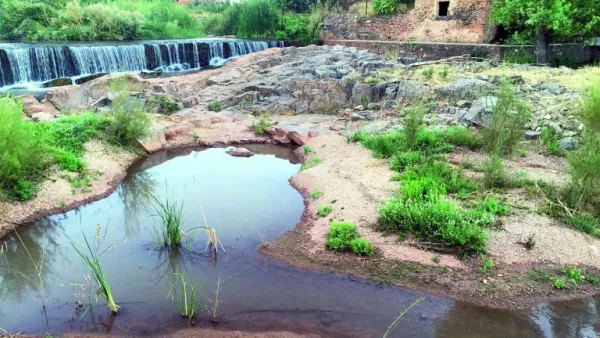
Alongside the fauna and flora typical of the olive groves, there is also that generated by the Guadalimar river as it passes through the municipality, and by the Giribaile reservoir on this same river. Near the riverbeds, where riparian woodland forms with poplars, willows, tamarisks and birches, an ideal ecosystem is created for species such as the Guadiana barbel-relative fish, the Andalusian barbel, the ladder snake, the grey heron, the European otter, and all the birdlife typical of gallery woodland.
For this reason, Ibros is a town with a diversity of ecosystems that enrich both its fauna and its flora.
The main festivals celebrated in Ibros are:
In the cuisine of Ibros, two ideas are always present: the widespread use of olive oil in most of its dishes, and the use of the resources nature provides locally — vegetables and produce from its market gardens, asparagus, saffron milk-cap mushrooms, or meat from animals raised in the fields and, during hunting season, wild game.
Among the most traditional dishes are:
Among the pastries, notable examples include:
According to some authors, this is the ancient "Ibes" or "Ibris" of the Oretani, home to a legendary Iberian king who gave the settlement its name.
The numerous archaeological remains found in the municipal area show intense human occupation during the Roman period. These are rural villas, among which those of Cortijo del Álamo, the Horcajo area and Corral del Manchego stand out, the latter also home to a small necropolis.
From the Islamic period, two inscriptions have been found in the town. The first is a funerary stone dated to 1205, now held at the National Archaeological Museum; the second, dated to the 12th century, is kept at the Provincial Museum of Jaén.
The Christians took the town in 1157, but it fell back into Arab hands until it was definitively conquered by Ferdinand III the Saint.
Following the Castilian conquest, it was divided into two jurisdictions:
This division shaped the layout of the town, with two distinct areas: "Ibros del Rey", around the parish church and Town Hall, with noble ashlar-stone houses and cobbled streets; and "Ibros del Señorío", a picturesque, working-class quarter reflecting its origins among families of lower economic standing.
In 1836, Carlist forces operating in La Mancha were repelled at Ibros. Its fortress was mentioned by Sarthou in his work "Castillos de España" (Castles of Spain), noted for its cyclopean walls.
4