Saltar al contenido principal

Hinojares

MUNICIPIOS
  • Hinojares
  • 3620de2a-7871-c5ce-06c2-315740196b13?t=1595007399397
  • e6511218-ab8e-17d4-15ac-77f36d161aeb?t=1595007479169
  • cf56932d-c7c9-dc10-08d6-0aaa08ece42e?t=1595007406260
  • Hinojares
  • 3620de2a-7871-c5ce-06c2-315740196b13?t=1595007399397
  • e6511218-ab8e-17d4-15ac-77f36d161aeb?t=1595007479169
  • cf56932d-c7c9-dc10-08d6-0aaa08ece42e?t=1595007406260

Description

Hinojares is a small town located to the south-east of the province of Jaén, extends its landscape in the region of Alto Guadalquivir, south of the Natural Park of the Sierras de Cazorla, Segura and Las Villas, and much of its municipal term belongs to the Park. It is limited to the terms of Quesada, Pozo Alcón and Bone.

Hinojares is accessed by the autonomous road A-315 Torreperogil-Baza, diverting on the stretch between Huesa and Pozo Alcón, on the road JA-8200.

The municipality has the pastry of Cuenca, where the river Turrilla is born.

It is now one of the least populated Jienian municipalities, only four hundred, of which one quarter are foreigners who have bought the damaged houses, reformed them and established their residence in the municipality.

Contact Details

953 738 111

Fax: 953 738 260

hinojares@dipujaen.es

www.hinojares.es

Useful Information

Tourist area: Serras de Cazorla, Segura and the Villas
Distance to the capital (km): 94.2
Altitude over sea level (m): 659
Extension (Km2): 40
Number of inhabitants: 401
Gentillo: Hinojareños e Hinojarienses
Postal code: 23486

Is part of

AUDIOVISUAL CONTENT

MORE INFORMATION

Culture

In his artistic heritage we highlight:

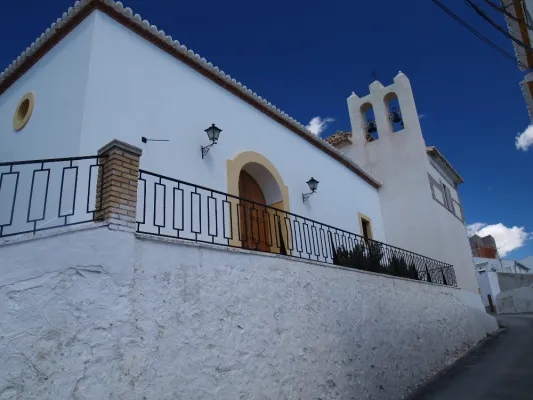
  • Church of San Marcos Evangelista. Built in the late 17th century, it is the most remarkable building in Hinojares. It is an austere construction that stands out by the rotunity of its volume, marked by the white of its walls, with few and reduced voids, whether circular or rectangular and a side access door with no ornamentation. It completes a bell tower, simulating a swordsman, placed on the wall that links the header with the rest of the temple body, closing the strip that borders the only ship. Inside it is adapted to the shape of a Latin cross and has a Renaissance altarpiece and a baptismal pile of white marble to which the parishioners have in great esteem.
  • City Council. It is the same line of architectural austerity, and without concessions to decoration and aesthetics. It has three heights and intoned holes, the most outstanding is that of the balcony on the first floor, in vertical line with the access door and crowned by a small attic with a watch that imitates that of the municipalities colonized in the 18th century, although it is not located in the center, but on one of the sides of the building and on which a small bell is installed.
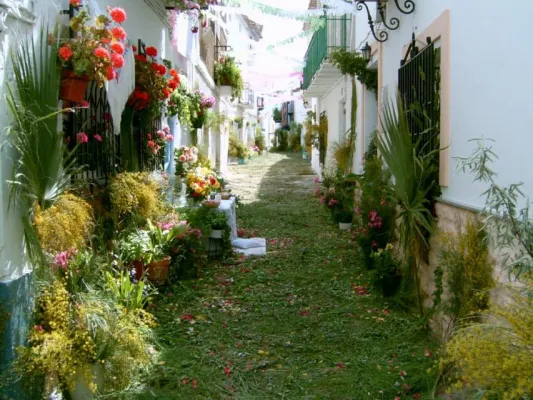
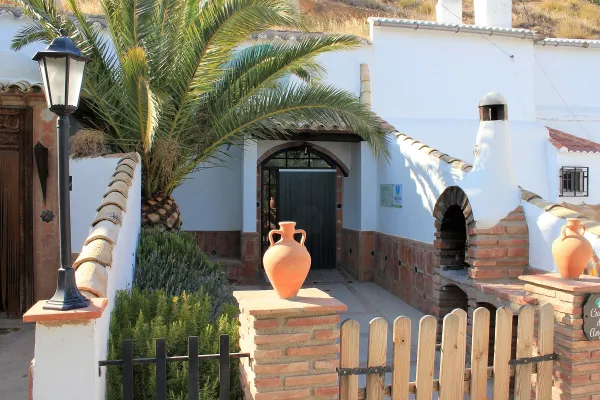
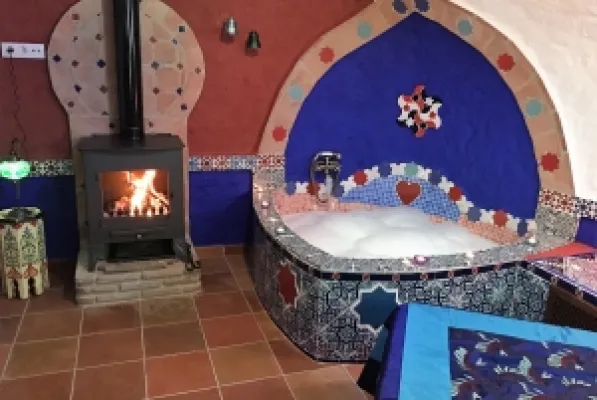
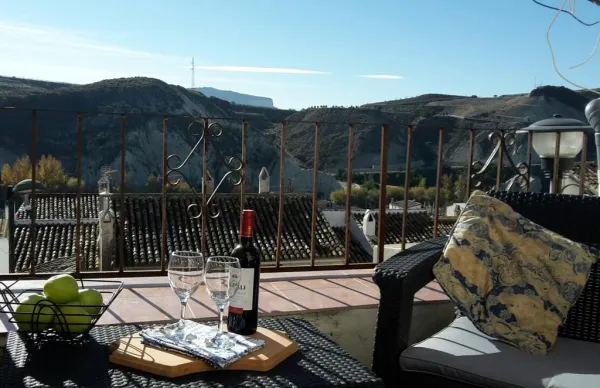
  • Urban helmet. Urbanistically this municipality has not been configured with prior planning. It is a set of traditional houses whitened and covered in two waters with Arab tiles, with small verticalized holes to avoid the rigors of winter and adapted to the simple habits of the inhabitants dedicated to the tasks of hunting, pastures and agricultural, and in more peripheral positions, houses with floor structures, with a maximum of four heights and roofed to four waters. Of great ethnic value are the "casas- caves"which have become a defining element par excellence in the people of Hinojares. Built without having to take the hands of architects, the forms and volumes depend to a large extent on the characteristics of the rock in which they have been excavated and on the originality and needs of the building. The caves, located on the slopes of the hills, in the canyons and in the rails, with an anarchic distribution, with their curved lines, lime, vaulted ceilings and chimneys, make up an interesting set of uniqueness. Its architectural originality, its temperature (18 ° C to 20 ° C, so no bedding is necessary) and its welcoming, intimate and rustic environment have made them a very appreciated habitat.

Nature

Hinojares is the gateway to a world full of contrasts and beauty, diverse and rich, an example of human and natural coexistence for millennia.

The Guadiana Minor and Turrillas rivers, with its short but fruitful vegas and the sharp and cut orography, cause a natural corridor which links the Alto del Guadalquivir with the Mediterranean coast, and are essential elements that explain the location, situation and morphology of the population nuclei of the Nagorno-Chinese territory, as well as the way of life of its neighbours.

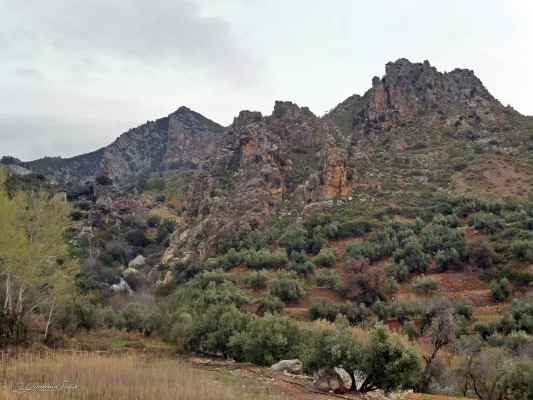
The municipal term of Hinojares is an authentic maze of valleys, calares, slices, mountains and streams that convert water in the real protagonist of these places.

To better understand the physiognomy of this territory, nothing better than to approach one of the following places to admire nature and let us captive:

  • The birth of the river Turrillas. It is the natural element that is most conclusive in the vertebration of the term of Hinojares. To this end we move to the village of Basin, a very preserved and peculiar small village, belonging to Hinojares and within the Natural Park of the Sierras de Cazorla, Segura and Las Villas. Here we will find a spring of fresh and crystalline water, called Seven Sources, which begins to give life to the valley and is the place of official birth of the river. However, its first waters come from a few kilometres above, with the Arroyo de las Doves, your true precursor. Its usual flow rate is filtered in the middle of the route, but in times of abundant rains, the spring is cleared by an impressive cut of more than 100 meters in height, resulting in the spectacular Cascade of the Vinatera of an extraordinary beauty. The neighbors consider this waterfall a talisman of good crops. In front, the Clock Stone, with the game of shadows that form its three vertical steps, informs the locals of the time of day in which they are found.
  • Salinas de Chillar. They are located near the village of Cuenca, and date from the XX-XX century. They are spring salins, i.e. salted water from the subsoil and that emerges to the surface naturally. The process for the exploitation of salt is simple: during the months of autumn, winter and spring, the water from the spring is collected and concentrated in heaters (pools), where at the end of spring, when the water is evaporated, the salt is left, which when it reaches a thickness of 5 cm. is collected, treated and packaged for sale.

There is a possibility of many activities in nature: ravine, multiadventure circuit, all-terrain bicycles, kayac and pyragüismo, paintball, horse routes, trekking and hiking.

Places and routes of interest near Hinojares:

  • Route to the Pico Cabañas
  • Passerella on the Castril River
  • Water Cave
  • Fishing point Peralta
  • Several viewpoints: the Lirio, Peña de Quesada, La Alcantarilla
  • Arroyo Guazalamanco
  • Bread Packaging

So much. fauna as flora of the territory It is abundant and very diverse.

In the vegetation We find pineapples, preferably in the higher and more steep areas, a mixture of different indigenous coniferous and bushes, areas of pasture and the coastal forests along the river line, with birches, chopos, alamos, mitreras...

The groups of animals that make up the fauna of this territory are as follows: Avian (coal, chochyn, montesino, codorniz...); Dam birds (close it, pilgrim hawk, black milano); mammals (hares, rabbits, foxes, gines, boar and badger); reptiles (rib, lizard, Salamanca) and fish (barbs, tents, trout and gobbles).

Parties and Events

In the municipality of Hinojares, the following parties are held:

  • San Marcos. It's the Hinojar Patron. It is held on April 25. On that day the evangelist is processed with a cake on his left arm. A symbol that at the end of religious trades they will be shared between their own and visitors.
  • Holy Christ of forgiveness. It was held at the end of September, when the summer agricultural work had been completed. But because many Hinojareños this month came to the harvest of other places, he moved to August 21, 22 and 23.
  • Saint Anton. The 17 January with traditional fire-ignition, asking for the health of the animals that help them in the agricultural tasks. He sings and dances, eats and drinks. A party that puts final brooch to Christmas parties is what the saying says:"Even San Antón, Pascuas are."
  • The Candelaria. February 2nd. Where at the touch of souls the fires are rekindled with the purifying sense of the commemoration of Mary's Purification and the Presentation of Jesus in the Temple.
  • The "bordes"It is a curious carnival tradition, in which the young men use the "bordos," the fruit of the anea, with which once they were clenched the asses of the chairs, and whose long strips rubbed until they released a white and sticky hair that was attached to the hair or to the clothes of the young woman to which they wanted to demonstrate their love, being a reason for pride for the mothers of the props to see that their daughters returned with many "bordos," an unequivocal sign that they had many suitors.
  • Lent and Holy Week. On Ash Wednesday, or some Lent Fridays, it is tradition to sing the old "Cops of the Way of the Cross," quartets whose origin is lost in the popular poetry of the Golden Century. On Easter, the so-called "Courts," a popular piece of the sacred theatre, carried out by the neighbors of the village, are represented in Hinojares Square.

Gastronomy

The gastronomy of Hinojares is immersed in what is typical of the region to which it belongs. We highlight the following dishes:

  • Ajo hasherowhich was prepared by the pine cutters with some guizcanos (niscalos) from the saw.
  • Ahomaran, With this dish the days of the morning rite were over. With pork they made a good relationship of home sausages, which will be the ones that give body from the traditional cooked and pudding of the rest of the year to the loin of orza, chorizo with pimenton and morcilla.
  • Gachamasthat they must be included in the artisan-made viandas.
  • Andrajos, cooked in the broth of boiling minor game pieces with peppermint and a saffrito of vegetables and strips of flour made of jirones that take the name of "talarines."
  • MaimonsThey're bread soups.
  • The crumbs of bread with torreznos.

In the gastronomy of Hinojares, the sweets: for Christmas, fried rosses for Easter and cupcakes home for family celebrations of other times.

Without forgetting the "San Marcos cake.", distributed after the procession. They are round pieces with ribetated edges of a size and weight of "five a kilo.", which are decorated with flowers and various decorative motifs that are made with wooden mold.

History

In order to know the Prehistory and Ancient History of Hinojares, we must refer to the Castles of Ceal, one of the most important Iberian settlements in the province of Jaén.

The origin of this settlement is in the control of the commercial route who from Levante introduced Greek manufactured products into the Guadalquivir Valley. It is located in a spur, with a circular plateau, where the remains of walls and housing buildings are abundant.

The study of the Iberian phase of necropolis with rich joules in which Greek weapons and ceramics appear, points to the presence in the village of powerful aristocratic characters.

The first phase of the occupation of this settlement went to the end of the 7th and 6th century BC; later abandoned until it was built the Iberian village in the 4th century BC and that lasted until the Roman Republican stage.

The origin of the present Hinojares is uncertain, as it is not cited in the medieval documents of the conquest of the Sierra Quesada- Cazorla. However, in its term there are villages and cortijos whose names do appear in the chronicles of the Spanish conquest. In this period there was a transfer of the population from the mountain to the valley. One of these examples is Cuenca, which was converted into the village of Quesada in 1257.

Hinojares must have been a plateau or a new foundation in the valley after the Spanish conquest of these lands. Until 1648 it depended on Quesada. And from this date it will become a village of Well, Alcon.

In the year 1690 got the title of villa and thus the independence of well of Alcon.

This title was similar to his concession in Temporary Lordship Mr Íñigo Rodulfo Fernández Angulo Sandoval, from the habit of Santiago, who asks the monarch to be given the name of Hinojares.

This Lord later passed to the nobility house of the Count of Arenal. At the end of the 18th century the Marquis de Guadalcázar will be honorary lord of the Villa of Hinojares.

In this municipality

29

Accommodations

2

Restaurants

3

Services

3

Events

We recommend