Contact Details
Fax: 953 56 54 66



Fuensanta de Martos is a municipality located in the central part of the Sierra Sur region, between mountainous lands to the south and east, and olive countryside to the west and north. The towns of Los Encinares, El Regüelo and La Ribera are part of this municipality. There are also sources that speak of other minor entities of the municipal term. Thus Vadohornillo divides into four small population cores: Vadohornillo, Las Ventes, Las Veletas and La Castilería.
A significant part of its territory is cultivated and agriculture is the basis of its economy. The cultivation of the olive tree, along with the Almazara industry, are one of the main economic activities within the municipality.
The furniture upholstery industry is also important for the volume of business and industrial employment that provides a very valuable sector at the Andalusian level.
Another activity to be taken into account is the breeding and fattening of stabulated pigs, the third producer municipality in the province.
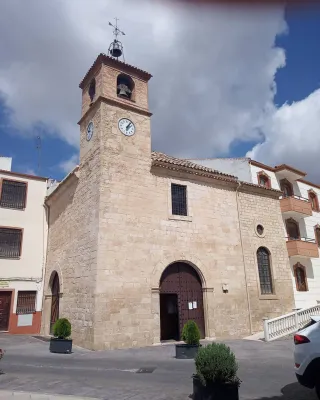
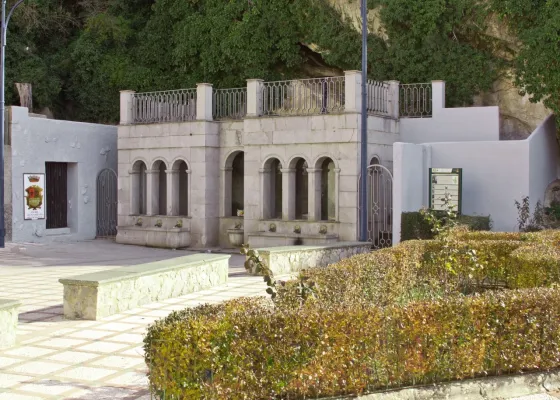
From its historical heritage we highlight the church of Nuestra Señora de la Fuensanta, Fuente de la Negra, El Lavadero, The defensive towers of Torrevieja and the Algarrobo, as well as the hermites of Los Encinares, La Ribera and El Regüelo.
Is part of


Fuensanta de Martos is located at an altitude of 725 m and its municipal term has high areas with steep terrain. The vegetation of this area of saw includes areas of rosemary along with coconuts and costomals as well as other indigenous species.
It stands out the stream of the Humbria, by the small canyon next to the town, as well as being a link to the mountain area. Its valley connects the village with the highest area of the city. The channel is accompanied by a path that begins directly in the urban centre.
The territory is essentially agricultural at 90% dedicated to woody crops in the dry. The lands, which are mainly pastures that interspersed with low mountain straps with majuelos, wild rosals and cherry plantations, giving rise to a mosaic landscape that favours the presence of a varied number of birds.
Abundation of the montesine cuff favored by the pasture grounds, as well as the soteño scribe, common rust and the coal.
The myrtle, the zorzal charlo and the lard will come to the frequent cherry plantations.
The term is also rich in amphibians and reptiles, favored by the variety of environments as well as by the river Víboras that crosses the municipality: Salamanca, different types of culebras and the viper hocucuda.
The festive calendar of Fuensanta de Martos is characterized by the celebration of traditional and popular parties:
We must first highlight the quality of olive oil, of the best in the province, and qualified as extraordinary, and secondly the quality of the products obtained in its gardens. No doubt, two quality ingredients that will become part of most of the dishes of your gastronomy.
The tradition is important slaughterhouse de Fuensanta, and although it does not have the intensity of other times, it does maintain the quality of its products such as chorizos, onion morcilla, orza loin, which to consume it we add olive oil that softens its texture and completes its taste.
The geographical location of this municipality, between the mountains and the countryside, has marked its role as the core of control throughout history, leaving remains of fortified enclosures of different periods at various points in its territory.
From the end of the Iberian stage and the beginning of the romanization of this area is the Cerro del Algarrobo, a trapezoidal fortification.
In the last phase of the Roman era a proliferation of rustic villas such as those of the Atalaya and the nunswhere a black marble funerary with an inscription was found, and is currently in the Provincial Museum.
From his Arab past is the Hins- shelter located on the hill of the Atalaya and where numerous ceramic remains have been found, dating from the 8th to X. centuries There must have been agricultural settlements next to the Fuensanta stream.
After the conquest of this region by Fernando III the Holy, the king gave it to the Lord of the Military Order of Calatrava. At this time it is part of the Marts and Vipers. In the municipality two defensive towers of the Order of Calatrava are preserved, are those of Torreviejaand a smaller one in the Cerro del Algarrobo. Both have been declared Good of Cultural Interest in 1985.
In the Modern Age we have no notable references of this population. It must have been a village dedicated to agriculture that used the sources of the environment, such as the Black Source and the source of the Borrachos.
It reached independence of Martos by the Royal Cédula de Doña María Cristina de Borbon in 1835.
For some historians we know the presence of orchard, fruit and cereal crops, as well as the rotation of montuous areas for the planting of olive trees that took place in the mid-19th century. In the last years of this century there was an agrarian crisis that suffered the entire province, which meant that olive cultivation would spread. A trend that would increase throughout the twentieth century.
5
2