Escañuela



Esquuuela is a small town located in the region of La Campiña, west of the province and south of Andújar. It is an eminently agricultural municipality, one can say that one hundred percent of its term is made up of farmland, the monoculture of the olive tree being the predominant. In the irrigated areas near the Salted Arroyo there were small areas of other crops, such as cereals and orchards, but they are being replaced by new olive plantations.
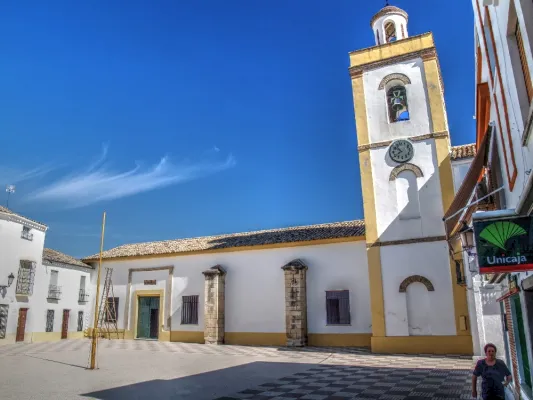
The parish church of San Pedro Ad Vincula, built in the mid-19th century on the remains of a small hermitage of the 15th century, is the highest exponent of the historical-artistic heritage of Escuela. Apart from a peculiarity on their flag, in which they are represented, by privilege granted by the Roman curia, "The papal tiara and the keys of St. Peter" and the chains that refer to the peculiar devotion to which the apostle is professed here.

The Parish Church of San Pedro Ad Vincula of Scañuela data from the second half of the 19th century. It is built on a small 15th-century hermitage and the old cemetery. It consists of a single ship articulated in sections, with curved header and irregular plant, due to the annexation of spaces for chapels on the side of the Gospel.
It is covered with Arab tile and its height is no greater than that of the houses around it.
The current cover has been remodeled and does not correspond to the initial track. The facade is reinforced by small counterstrengths and in the tower located on a side of the presbytery, of a square floor, its chapel has also been replaced by a slender flashlight.
Scork is one of the 16 populations which make up the Jienese countryside. Located to the south-east of the countryside, it is a town surrounded by olive trees and that lives mainly from the olive tree.
A people who, despite the passage of time, have been able to maintain their customs and traditions, which makes it a town with a special charm.
Much of its crops are of dryexcept in the areas near the River Salado, where the neighbors have their orchards. We'll quote the Municipal Road, a recreational space, with tables, fountains and trees where it is very pleasant to spend a little rest.
Both the vegetation and the fauna of this town, is that of the Jienese countryside: olive trees and river vegetation by the way of the River Salado, the mimberas, the willows, the white wings and the tarais, among others. The fauna is the characteristic of the countryside, hares, rabbits, lizards, partridges and foxes, as well as a large variety of rapacious birds. Without forgetting the typical fauna of the riverside forests by the River Salado.
From the time his destiny was attached to the lordship of the house of the Torres and Portugal, the devotion to San Pedro Ad Vincula.
The day 1 August is the big day of the "Feast of the Vincula," which is thus popularly known, in the course of which the saint is honored with various acts that culminate in the night with a solemn procession. In the morning there is a flourished musical target in which the authorities, with the mayor in front, invite the neighbors to participate in the acts of the patron
In mid-September the party known as "The Vanchilla "in which the images of the Patron, The Virgin of the Dolores, and Jesus, are venerated and processed.
There is a deep and ancient devotion to the Virgin of Alharilla, patron of the neighbouring town of Porcra, for that reason, the second Sunday of MayHe's going to the shop.
The day 1 November, feast of All Saints, has a particularity in Escuela. As in other places, there is also a visit to the cemetery, but our visit by the graves will last until one or two in the morning, to prevent the "luminaries," butterflies and candles, which have been lit during the day, from turning off before midnight, fulfilling a deep-rooted belief.
The virgin olive oil, as in the rest of the villages of the region, it is an ingredient that forms part of the dishes of the gastronomy of Escuela.
It has a summer dish that can well form the saint and sign of its popular and traditional cuisine. It is the "cucaporro," cold soup or thick gazpacho, as you can see, made mainly of a lot of garlic, bread miga, peeled tomato without nuggets, olive oil, and topped with pieces of hard egg.
Plato, also of the summer days, is the "white garlic," made of ground dried beans, olive oil, raw garlic and salt, well-trimmed all in the same sauce that would have to whiten and taste the fresh water with which the peasant, in other times, attenuated in the lunches the heat of the agricultural works of the summer, and which today remains in force at the tables of Escuela.
By Easter, the "cod potting 'means: which has traditionally been fulfilled with the vigil of Thursday and Good Friday. Also typical of these dates of penance are the "rule cakes," elongated and rectangular (perhaps from there the name comes) that the women of Escuela prepared in their homes and led to cook in the ovens of the tahonas. This Passion Week concludes with the preparation of the bake of Easter Sunday to be consumed later by all members of the family.
For the night of the Saints, at the beginning of November, the traditional ones are prepared Sweet peaswith whose remaining mass are covered by the chiquilleria the locks of the neighbouring doors, in a rite, which despite its child naivety, keeps the keys of other ancestral rites where life and death are founded on the same festive event.
For the major feast of San Pedro Ad Vincula, which takes place in the first days of August, it is customary to "kill a bunny for La Vincula" as popularly known to the feast of the Patron, which will then be prepared, above all, "to the ajillo," serving in a source where in love and company will account for him relatives and friends.
Within the traditional desserts, Escuela shares with other places in the province the peculiar rice with chestnuts cooked in milkwhere the lemon scraping, in which the ingredients are cooked, and the final touch of the cinnamon powder, put the counterpoint of aromas that so much remind us of the popular rice with milk, so extended by the provincial cuisine.
Archaeological remains found in the surroundings of Escuela have seen the human presence in this municipality since the 3rd millennium BC. In the place known as Pozo de Marisancho there appeared remains of dark ceramic belonging to this period of the Copper Age. From his Iberian past are known several places of remarkable interest; in the same Well of Marisancho Iberian ceramics decorated with geometric motifs of bands or circles were collected.
During the Roman occupation, the division of the territory followed the system of centurization and the creation of rustic villas. One of these examples is the Higueras.
From the Spanish conquest of the region, San Pedro de Escuela, as this population was called until the end of the 19th century, remained within the Alfoz de Arjona. As mentioned in the relations of the Synod of Jaén of 1311 Arjona was the center of an Arcipreggreso, being Escuela one of the parishes belonging to it.
In 1385 the population appeared as Lordship of Don Pedro Ruiz de Torres. According to a document of the Provincial Historical Archive, in which this donation appears, the town had previously belonged to this man. The attacks by the Nazaris on the lands of Jaén struck the place, which would be dispopulated. This would lead to the loss of the rights of Don Pedro Ruiz, who would claim them again, to what John I agreed, although apparently without making it effective, a fact that happened at the time of Henry III.
In 1394 the heiress of this lordship married a gift Fernando de Portugal, who formed with their possessions (Escuela and Villardompardo) the Lordship of the Torres and Portugal. This lineage would be intertwined with the Constable Lucas de Iranzo, who added the possessions of the Villargoro House, thus forming a great Lordship that would become County in the 16th century with the name of Villardompardo. The villa of Escuela belonged to this lordship until its suppression by the Cut of Cadiz in 1812.
It conserves Escuela from the times when its destiny was attached to the lordship of the house of the Torres and Portugal, contes of Villardompardo, devotion to San Pedro Ad Vincula. This advocation refers to the vicissitudes of the first Pope, Apostle Simon, during his imprisonment in Rome in the year 67, in the course of the persecution against Christians decreed by Nero. This curious devotion, which gave rise to today's popularly known parties of "The Link", has its origins in the taxes that the Counts of Villardompardo paid to the Pope of Rome, the so-called tithes, so called because their amount is the tenth part of the crops that the land of the lordship produced. The Roman curia corresponded to such donations by giving the people the privilege that it could be called San Pedro de Escuela, flying as its own the flag on which the Vatican's shield "La tiara papal and the keys of San Pedro" and the chains that refer to the peculiar advocation to which it is taught here, which made it possible for Escuela, for such reasons, to be known popularly in other places as "Rome The Girl".
In 1814-15 the disgregating process of Escuela was initiated with respect to Villardompardo, which culminated in the 1930s with the full legal and territorial independence of Escuela. Throughout this century the city centre, the municipal institutions are being consolidated, and although with some difficulties, the municipality will begin to shine with its own light, now to be called only, Escuela.
1
4