

Description
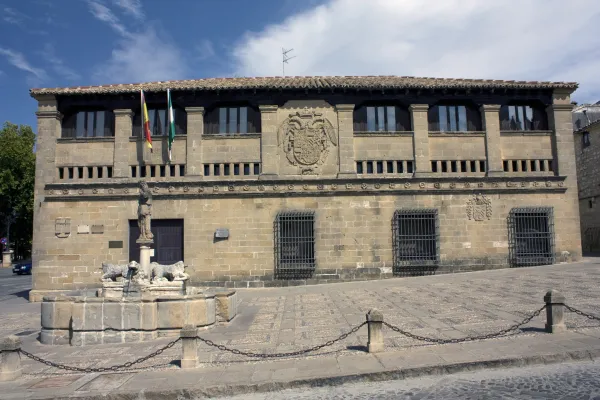
It is the most visited place in the city, the historic heart of the city. It is home to the Old University, the Upper Town Halls, the Fuente de Santa María and the main façade of the Cathedral.Machado tells us that his hobbies were walking and reading. José Chamorro, in his work Antonio Machado in the Province of Jaén, tries to reconstruct the poet's itinerary on his walks: "the streets of Santo Domingo, San Pablo, San Andrés, Puerta de Úbeda, Arco del Barbudo, etc.; highlighting "precincts as artistic and Spanish as the Plaza de la Catedral with its monumental fountain, erected with the majesty of a triumphal arch, a plaza as solemn as lonely with the moss of the old walls and the little green grass between the flagstones and stones of the pavement.” Among his wanderings through the historic center of Baeza, Machado has left some stanzas dedicated to this space, such as the famous San Cristobalón poem. NOTES III Through a window, the owl came in in the cathedral. San Cristobalón He wanted to scare her, seeing that he was drinking of the oil candle from Santa María. The Virgin spoke: -Let her drink, San Cristobalón. The Cathedral of Baeza, a Site of Cultural Interest since 1931, has been built on successive buildings: a Roman temple, later a mosque, until its conversion to Christian worship in the 12th century. Since then it has undergone numerous architectural transformations to its current state, with multiple elements from various periods, such as the Puerta de la Luna, in the Mudejar Gothic style. The Puerta del Perdón, Gothic style; or the main façade which is in the Renaissance style, which is its most dominant character. Andrés de Vandelvira collaborated in the Renaissance reform. The interior of the Baeza Cathedral also presents different styles, with Gothic pillars, cross vaults, Renaissance bars, Mudejar chapels and Renaissance chapels, as well as the main altarpiece, in the Baroque style. Also inside the Cathedral is the Museo Catedralicio, which preserves pieces of great value and recognized prestige. The space made up of the Baeza Cathedral, the plaza and the fuente de Santa María are main elements in Federico García Lorca's description of the city in Ciudad Perdida. LOST CITY (BAEZA) I Baeza (…) This square, a formidable romantic expression where antiquity teaches us its ancestry of melancholy, a place of retreat, of peace, of manly sadness, was planned to be desecrated when I visited Baeza. (…) On the other hand, fuente de Santa María, which takes its name from the square and which, together with the Lions fountain on Plaza del Pópulo, is the most emblematic of Baeza. Of Renaissance style and built in the mid-16th century, it has a lower body formed by three openings, along with a column structure with two fronts, in which the shield of Philip II can be seen. LOST CITY (BAEZA) I Baeza In its center, a fountain of pagan severity, it seems like the final body of a triumphal arch that the earth had swallowed. (…) Finally, the Baeza Cathedral, an Asset of Cultural Interest since 1931 and which has been built on successive buildings: a Roman temple, later a mosque, until its conversion to Christian worship in the 13th century. Since then it has undergone numerous architectural transformations to its current state, with multiple elements from various periods, such as Puerta de la Luna, in the Gothic-Mudejar style; the Puerta del Perdón, Gothic style; or the main façade which is in the Renaissance style, which is its most dominant character. Andrés de Vandelvira collaborated in the Renaissance reform. The interior of the Baeza Cathedral also presents different styles, with Gothic pillars, cross vaults, Renaissance bars, Mudejar chapels and Renaissance chapels, as well as the main altarpiece, in the Baroque style. The Museo Catedralicio also preserves pieces of great value and recognized prestige. LOST CITY (BAEZA) I Baeza (…) The cathedral covers the square with its shadow, and perfumes it with its smell of incense and wax that filters through its walls as a reminder of holiness. (…) Furthermore, in a postcard dated in Granada on November 7, 1925, once he had returned from the trip to Jaén and also addressed to his friend Melchor Fernández Almagro, the poet García Lorca makes reference to various Giennese places and icons. Lorca alternates the texts of the postcard with his friends and in it he reviews such iconic landmarks of Jaén as the Cathedral, the Plaza de Santa María or the relics of the Santo Rostro. Below is part of the text of the aforementioned postcard: (…) “Mac Donald continues his downhill slope of Granada disappointments Instead, he has discovered in pleasant company the beauty of Jaén, with its graceful cathedral, open by hundreds of balconies to the streets and the square, crowned with apostles and prophets and guardian of the Santo Rostro, which we most solemnly adore. You can make the trip by kissing the glass where the Byzantine face of Christ emerges, oily and full of sweet intimacy between the old emeralds and rubies of the old Catholic frame. Wrapped, furthermore, in the silky anointing of the liturgy. Granada is no longer. Granada has it, Jaén is unified. Due to the beauty of the environment, as well as its size, it is the best space to delve into the poet Miguel Hernández's view of the bombing of Jaén, which he reveals through the articles he publishes in Frente Sur in the following days. The author was not in the city at that time as he was carrying out propaganda duties on the Extremadura front, but his wife was present, so the bombing must have affected him in a special way. “(…) Jaén is bombed: the trilite shakes and bursts even the deepest stones of the city, and the houses collapse, and the mothers do not know which corner to go into with their children, and the innocent dead, the destroyed, are a bleeding quantity of heads, arms, and disconcerted flesh (…) (…) Has Jaén already woken up from his incredulous and Moorish drowsiness? (…)” Miguel Hernandez. Southern Front. “La ciudad bombardeada”, No. 7 –April 11, 1937–. According to the historian Juan Cuevas Mata in his book “El bombardeo de Jaén”, the bomber squadrons were deployed over the city, crossing it from south to north, leaving the Cathedral on the left, which was their main reference (159 people died, the bombing that left the most deaths in a single action in the Spanish Civil War). This imposing religious building and its beauty and monumentality do not escape the interest of Juan Eslava Galán, who describes it in a sublime way in his work Los Templarios y la Mesa de Salomón. (…) The Cathedral of Jaén! It was the first time I had entered that unique monument. I was immediately captivated by its contained beauty. Those tall, silent ships in darkness, like a harmonious cavern only illuminated by the diffuse light that filtered from the tall colored stained glass windows! The Templars and Solomon's Table. Chapter 1I. Designed by the architect Andrés de Vandelvira, it is the main reference of the Spanish Renaissance in the second half of the 16th century and aspires to be a World Heritage Site.