

Description
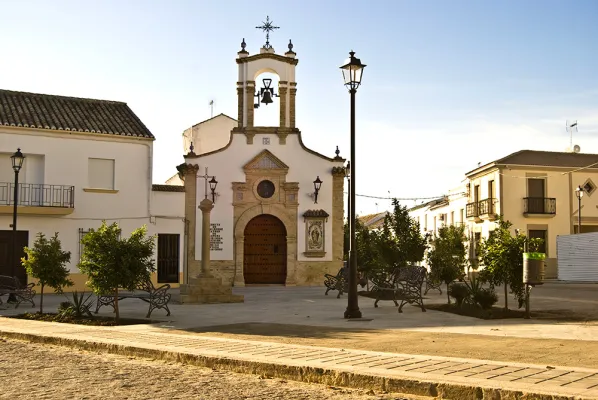
The Hermitage of Jesus. Its main cover is from the 18th century and it belongs to the Baroque style. The main door is located between counterstrengths, consists of two floors, with a trilobulated arch appearing both on the lower and upper floor; in turn, both are welcomed by a half-point arch. The first floor is crowned by an open triangular front and pinacles. Its rectangular plant is of three ships, being the largest plant than the sides.
The ships are separated by half-point arches located on Tuscan columns, the central one is covered with half-barrel vault and the sides with edges vaults. At his feet we can observe a high choir.
The presbytery is rectangular with a half-orange vault on the breast, these are decorated with stucco motifs distributed by the arches. The cornices and pechines serve as frames to paintings of the tetramorphous (four evangelists). This hermitage is also equipped with a shrimp in the background, it belongs to the 19th century and is neoclassical in style. It has an oval vault, which has radiated intrados and four radial objects with glass windows.
The central altarpiece, from the 19th century in a neoclassical style, has a single body with a half-point arch, in which the figure of Jesus Nazarene is framed the work of sculptor Gabriel Borrás, on the left side of a basement appears the figure of the Immaculate of 1.55 m in a baroque style of the 18th century. The image of Our Father Jesus is from the 20th century, specifically from 1939. Jesus appears with the cross at a slightly curved, with a barbed head and a hairs of abundant meline, dressed in a carved robe. During Holy Week and September 14 (Jesus Day) you saw a rich golden-thread embroidered robe dating back to 1904 and belonging to the old missing image.
Ntra's altarpiece. Madam. Of the Dolores it belongs to the 18th century, of Baroque style, its state of conservation is good, consists of a single body flanked by salomonic columns that support an attic where a canvas is inscribed that represents Christ dead with great perfection. In the center there is a garden with the figure of the Virgin of the Dolores dressed in black velvet mantle embroidered in gold thread of great value. This image was restored in 2006 by Don José Luis Ojeda Navío, who attributes the size to the Neobaroque Sevillana School of the 17th century.
The 18th-century, Baroque-style altarpiece of the Child of the Ball consists of a single body separated in three streets by Corinthian pilasters, among which there are vain images. In the central furnace the child of the ball appeared, although at present there is an Immaculate. In the left-hand garden there is Saint Joseph and on the right there is the Virgin of Fatima. It is crowned with an attic where it is represented in oil painting on the canvas "The Dream of Jacob."
Finally, the front of the 18th century Altar de la Ermita and Baroque style, consists of rectangular plates of red marble of Cabra that are decorated with a cenefa where a drawing of points is inscribed. In the center of the piece is the Franciscan shield. The 19th-century Pulpita de la Ermita and neoclassical style, is composed of a balaustre on which a hexagonal rostrum rises. The whole set is decorated with forged motifs of the school of Andújar. The former Convent of Jesus, which was the seat of the College of the Sisters of the Cross, is located in this Hermitage.