

Description
Possibly raised over an ancient mosque, it was one of the primitive (the third in antiquity) Parroquias of the City, as evidenced by the lawsuit held after the Reconquista of Ubeda, between the Bishop of Baeza, Fray Domingo, and Don Rodrigo Jiménez de Rada, Archbishop of Toledo, for the legal possession of it.
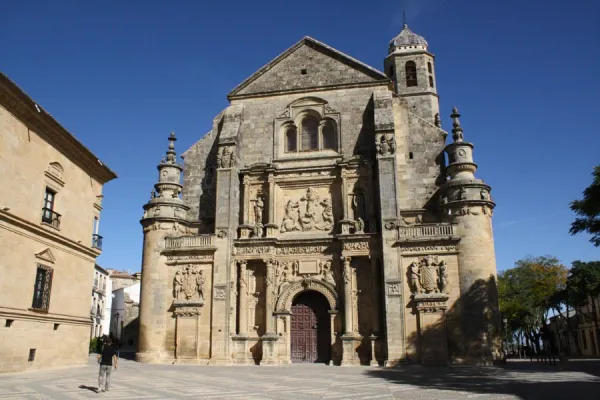
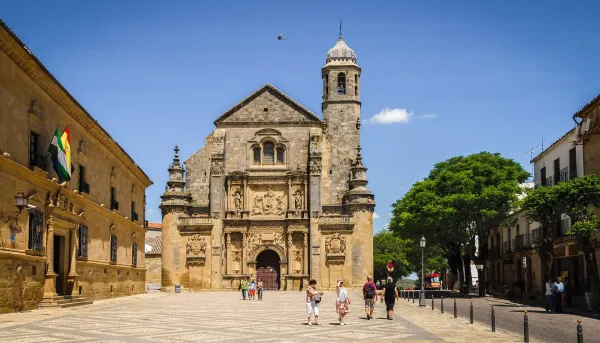
Blinded by his Poniente door, between 1605 and 1615, being at the Episcopal See of Jaén Don Sancho Dávila, his current southern cover is erected, from which the traces of which Alonso de Barba, co-conspirator and main disciple of Andrés de Vandelvira, must take care.
This cover is made up, in its first body, of columns free of Corinth order, opposite to backpilasters, half-point arc with plant key and relief of virtues in the gears.
The second, after the opening, is made up of Ionian column- back-pilars (following the orthodox scheme of classicism), which embrace an idealized theme of serlian or palladian hollow, in which the free image of the headline is installed. On both sides the episcopal weapons of your promoter.
Also, in the first decade of this century, the conditions for making the bell tower - then ruined and inexplicably displaced at present after its unannounced restoration - are signed by the master Pedro de Ortiz, and the work was executed by various masonry teachers, including Juan de Bayona.
The interior of its factory, remodeled on many occasions, currently has a single living room, covered by canyon vault and dome reduced in its presbytery.
It is one of the oldest parishes in the city. It was reconstructed in the last third of the 14th century (after the destruction of But Gil), leaving few remains of the previous 13th century factory, such as the semicircular apse.
He has suffered several interventions, highlighting that of the Renaissance facade of 1605, built by the disciple of Vandelvira Alonso de Barba, under the bishop of Jaén Sancho Dávila (1605- 1615).
It was probably a mosque converted to Christian worship after the Reconquist, being a parish - dependent on the jurisdiction of the Archbishopric of Toledo in the XIIi century - until in the mid-19th century it is added to the church of Santa Maria.
External: The main cover consists of two bodies, the lower one with half-point arc with Corinthian columns on the sides and backpilers; in the shrouds we see the reliefs of two virtues, faith and charity. On the opening is a second floor of Ionian order, whose central hole covers the sedent image of the saint. On both sides there are two great shields of the promoting bishop, all topped up by pyramidal pinacles. This is a cover that repeats Renaissance schemes.
The front cover, with a half-point arch, was blinded when the choir was built - it is straight, of ancient protogotic constructions.
The bell tower, from the same time as the main cover, is simple and consists of a cubic body with four voids for the bell body. It does not currently occupy its original location.
The outside apse features scalated pillars and polylobulated arches, protogotic remains of the former 13th century factory.
Interior: Its interior has been rebuilt several times. It currently has a single living room ship covered by canyon vault with side chapels, most of which are Gothic.
The apse is polygonal with voids.
It has a great historical value, as it was one of the parishes in which the medieval city was divided, in which the Renaissance interest of later centuries is appreciated to transform the external aspect, by building facades on the medieval temples.