

Description
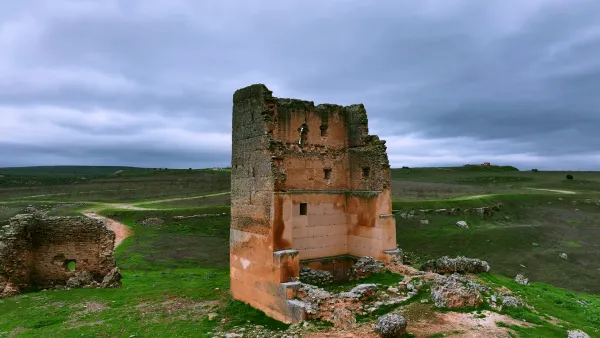
The castle of the Tobaruela is a military-looking and rectangular-floor signage building, articulated around a partially porticated central courtyard. This castle-palace is made up of wall canvases and two towers, a square that could correspond to the Tribute and a beautiful bilobulated tower. The main door of the castle is framed by a monumental cover with four nobility shields. The castle was protected by an anthemide and a dry pit. It is currently privately owned.
The Carvajales' lineage was one of those who benefited from the conflict that erupted in the second half of the 14th century, which would face Peter I and Henry II Tratámara, thanks to the support they provided to the trastamarist side, which would lead him to become one of the most powerful and influential families of Alto Guadalquivir. In this context, there is a rivalry between two important nobility groups, the Carvajales and the Benavides, which led Alonso Sánchez Carvajal, in a struggle with Juan de Benavides, to build in 1475 the castle of the Tobaruela, an action that would cause problems with the monarchy, since it would not comply with the prohibition of the Catholic Kings to build new fortifications, a mandate aimed at ending the nobility conflicts.
The castle of the Tobaruela is a very late residential building in which you can appreciate the most obvious features of the architectural evolution that this type of fortifications suffered throughout the 15th century. They were originally fully military castles with a Tribute Tower with a double function as a defensive and residential element. The process of transformation begins with the articulation of the residential area around a central courtyard and the conversion of the tower into an exclusively defensive element. Finally, the Tribute Tower will reduce its size, even disappearing, using the space it occupies to improve the articulation of the residential area.
It is a rectangular-floor castle with evidence that it was not finished, which incorporates a rectangular tower in the southeast corner, which could be identified with that of the Tribute, and which would have as its purpose the defense of the main access. In the south-west corner, an elegant bilobulated tower was set up on three vaulted floors. It was protected on three of its fronts by an anthemide and a dry pit.
On the canvas is the main door that allows access to the interior of the fortification, with a rectangular cover of armchairs arranged to rope and framed by stylized pinacles, topped with plant motifs. The vanity is made up of a carpanel arch with a molding decoration at the inner angle of the arch. A series of heraldic shields are available on the arch. Below to the left is the shield of Portugal, in reference to Juana of Portugal, the first wife of Alonso Sánchez de Carvajal. To the right the shield of Pacheco, by his second wife, Maria Pacheco. On these we found the shields of Carvajal and Cueva.
Internally the fortification is organized around a porticated courtyard on one of its fronts, which is completed in height with large windows of panel arches held on columns. The rooms and rooms were distributed around the courtyard, especially on the second floor.
During the Middle Ages, the confrontation between Peter I and Henry II Trastámara brought with it the progress and political relevance of various lines such as the Carvajales. Linares is consolidated as a rural core of a certain entity, appearing in the sources as one of the most populated villages of the Baeza Council in the early 15th century. A situation that would serve as an incentive to attract second-row nobles and hydalgos.
At this time the rural fortresses that constituted the characteristic housing of the nobility begin to appear also in the cities, as nobility houses that will incorporate defensive elements. They were solid residences of military appearance to the outside, but refined inside. They could be seen as genuine bulwarks in which to take refuge in the event of the development of urban nobility.
For this period is the Castle of the Tobaruela, a very late military work that reflects the situation of political struggle of the end of the Middle Ages. The Catholic Kings, with the aim of ending the nobility conflicts that had characterized the previous centuries, ordered the destruction of numerous castles, while prohibiting the construction of new ones. Some of the gentlemen, while omitting the legislation, built fortresses, such as the Tobaruela Castle, built in 1475 by Alonso Sánchez Carvajal, in the context of his clashes with Juan de Benavides. In order to avoid the real prohibition, and in this way to avoid requesting the permission of the monarchs, Alonso Sánchez Carvajal justified the construction of this castle before the authorities, arguing that the works carried out pursued the restoration of an old fortress, which has raised the hypothesis that it could be built on an earlier fortification.
Is part of