Saltar al contenido principal

Baeza

MUNICIPIOS
  • Baeza
  • 6b113f25-c234-0491-af2f-c149a865afa8?t=1603923180029
  • a65f89b4-654e-e046-fdbd-d44fa6641988?t=1603922557103
  • 6310a5e2-e849-e7b1-582a-468d48f758f0?t=1586171131274
  • 1f236e61-7713-a025-2f0d-35391af76a7d?t=1603922557227
  • 8a202e8f-385a-5f9e-3afe-569acec987a4?t=1616522299103
  • 795a0c33-4ee3-408e-1c13-b816123adc64?t=1586171132490
  • b6010740-bf62-6b8e-ab23-6d9f76897f5b?t=1586171132143
  • 750eeda9-773d-709d-2383-372d10701650?t=1586171130098
  • a78c862d-3c74-cde9-6ff9-b69630560ce4?t=1586171131756
  • beac10cd-9668-0c22-7db3-9966e5eda5b3?t=1586171132006
  • 479bc6c3-babf-eaef-7fb3-b4ad8b635e5b?t=1616522299289
  • f361a4e0-b515-6e7c-a7dc-ff14c67688ec?t=1616522299347
  • 81e8d636-ef0d-91e5-2750-3f56d6d04808?t=1616522299408
  • b1ddae0a-a5ee-4323-53d3-54bc68526d9a?t=1616522299473
  • 0dee5670-1fe0-cbf4-5867-9147345e2afe?t=1616521131504
  • 81d1e198-9d29-279e-149f-081024b27891?t=1586171130396
  • 39a7fbfd-9aa2-1cac-c7d3-238c006f5a28?t=1616522299547
  • e016a9da-4297-fc04-4d3c-dfa579da9552?t=1586171130697
  • 2b452c6d-15df-a819-aa50-e54921bbd0de?t=1616522299619
  • 805356f8-60e7-d8f0-2e25-1edd5ebffa4d?t=1602694728132
  • 7172efae-cdfc-d5aa-a347-037b6d6b16aa?t=1616522299688
  • 36d285cc-5d64-d9a0-6e84-7ad58f539a76?t=1616522299749
  • bc9f53d4-3a83-f0a9-e1da-c486d747724b?t=1616522299815
  • 0da7acd2-1162-bbf8-8c3d-d3a3d8140eaa?t=1603105398568
  • f1c392af-765a-3f53-d9a0-c0b6b9acfb77?t=1603105767022
  • 2c724b20-61d7-99b1-e423-f4292a646491?t=1603106229722
  • eaa9f592-f374-8747-0f22-1cadb4e98585?t=1603106434496
  • 02cdf257-dfc8-6b82-5816-a0ba6ba51dc1?t=1603106654931
  • 8791fed9-36c1-40e4-b1a6-95e267986d8d?t=1603106857711
  • 62bf1f22-afbd-c0da-1f93-ce52788b8636?t=1603107417445
  • 79f98f41-2429-b937-f94c-827a88cb386c?t=1603107482920
  • 086c140f-fab0-c0f1-595b-9eeda08b0616?t=1616522299958
  • 59d90e88-c35f-3adb-7dbd-d51422bb9b63?t=1644243699085
  • Baeza
  • 6b113f25-c234-0491-af2f-c149a865afa8?t=1603923180029
  • a65f89b4-654e-e046-fdbd-d44fa6641988?t=1603922557103
  • 6310a5e2-e849-e7b1-582a-468d48f758f0?t=1586171131274
  • 1f236e61-7713-a025-2f0d-35391af76a7d?t=1603922557227
  • 8a202e8f-385a-5f9e-3afe-569acec987a4?t=1616522299103
  • 795a0c33-4ee3-408e-1c13-b816123adc64?t=1586171132490
  • b6010740-bf62-6b8e-ab23-6d9f76897f5b?t=1586171132143
  • 750eeda9-773d-709d-2383-372d10701650?t=1586171130098
  • a78c862d-3c74-cde9-6ff9-b69630560ce4?t=1586171131756
  • beac10cd-9668-0c22-7db3-9966e5eda5b3?t=1586171132006
  • 479bc6c3-babf-eaef-7fb3-b4ad8b635e5b?t=1616522299289
  • f361a4e0-b515-6e7c-a7dc-ff14c67688ec?t=1616522299347
  • 81e8d636-ef0d-91e5-2750-3f56d6d04808?t=1616522299408
  • b1ddae0a-a5ee-4323-53d3-54bc68526d9a?t=1616522299473
  • 0dee5670-1fe0-cbf4-5867-9147345e2afe?t=1616521131504
  • 81d1e198-9d29-279e-149f-081024b27891?t=1586171130396
  • 39a7fbfd-9aa2-1cac-c7d3-238c006f5a28?t=1616522299547
  • e016a9da-4297-fc04-4d3c-dfa579da9552?t=1586171130697
  • 2b452c6d-15df-a819-aa50-e54921bbd0de?t=1616522299619
  • 805356f8-60e7-d8f0-2e25-1edd5ebffa4d?t=1602694728132
  • 7172efae-cdfc-d5aa-a347-037b6d6b16aa?t=1616522299688
  • 36d285cc-5d64-d9a0-6e84-7ad58f539a76?t=1616522299749
  • bc9f53d4-3a83-f0a9-e1da-c486d747724b?t=1616522299815
  • 0da7acd2-1162-bbf8-8c3d-d3a3d8140eaa?t=1603105398568
  • f1c392af-765a-3f53-d9a0-c0b6b9acfb77?t=1603105767022
  • 2c724b20-61d7-99b1-e423-f4292a646491?t=1603106229722
  • eaa9f592-f374-8747-0f22-1cadb4e98585?t=1603106434496
  • 02cdf257-dfc8-6b82-5816-a0ba6ba51dc1?t=1603106654931
  • 8791fed9-36c1-40e4-b1a6-95e267986d8d?t=1603106857711
  • 62bf1f22-afbd-c0da-1f93-ce52788b8636?t=1603107417445
  • 79f98f41-2429-b937-f94c-827a88cb386c?t=1603107482920
  • 086c140f-fab0-c0f1-595b-9eeda08b0616?t=1616522299958
  • 59d90e88-c35f-3adb-7dbd-d51422bb9b63?t=1644243699085

Description

Baeza is located in the same geographical centre of the province of Jaén, located in the region of the Loma of which its western capital is considered.

Located near the Guadalquivir River, in a landscape of fertile land of orchards, olive groves and cereal. The absence of non-agricultural land reduces the areas of natural interest to the Guadalquivir River and the wetlands of the Lagoon Grande, of great ecological wealth and the largest in the province.

Baeza is a city where the Renaissance is shown in all its splendor, in both civil and religious monuments: palaces and churches that alternate with white houses, portades, porticos, towers, squares and fountains.

Its period of splendor dates back to the 16th and 17th centuries, although the city has been outstanding since remote times.

Tourist Office

Oficina de Turismo
Plaza del Pópulo, s/n, 23440
953 779 982
otbaeza@andalucia.org

Useful Information

Tourist area: Ubeda / Baeza
Distance to the capital (km): 48
Altitude over sea level (m): 769
Extension (Km2): 194
Number of inhabitants: 16012
Gentilicon: Baezanos
Postal code: 23440

Is part of

AUDIOVISUAL CONTENT

MORE INFORMATION

Culture

To understand today's Baeza, we have to go back to the first inhabitants who settled in the place known as the Alcázar hill, in the Bronze Age, evolving to the Iberian city Viatia or Vivatia, passing to the Roman era, when Biatia was one of the most important cities.

It would be the Muslims who made up the city's murary limits, some of which were remade in the 16th century. After the Christian conquest the epoch of splendor of Baeza begins. The new Christian Baeza begins to grow out of the world, where religious buildings are the most representative.

  • The Cathedral. It is the most representative building in the square. In this enclave there could have been a Roman temple, over which Muslims raise a mosque and, in 1227, under the Marian advocation of the "Nativity", the cathedralicia headquarters is erected. In the 16th century, a reform is carried out, which will be the one that prints the Vandelvirian Renaissance seal to the building. The cover was drawn in 1587 by Juan Bautista Villalpando with "relief of the Nativity of the Virgin." The base of the tower is believed to be the mosque's miner, adding in time of Vandelvira the body of the bells and the deck.
  • Church of Santa Cruz. This work dates from 13th century, of late Romanesque style and preserved after the Christian conquest. The exterior is austere, highlighting its two covers with half-point arquivolts. The interior consists of three ships.
  • Ruins of the convent of San Francisco(extracamides). This work could have been one of the most important of the Andalusian Renaissance, but a number of misfortunes have prevented it, among these, the Lisbon earthquake of 1775 that brought down the vault of the major chapel. In this funeral and conventual complex, Vandelvira developed all its genius. The Latin cross church, which is accessed by a half-point arch that frames the entire cover, still remains with the relief of San Francisco and a tondo with the Virgin, which now give way to a large auditorium.
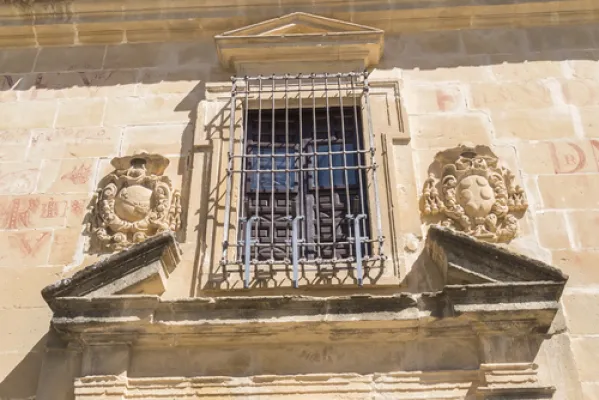
  • Old House of Correction and Prison, current City Hall(extracamides). It was built in 1520 as a prison at the request of Charles I. Since 1867 it has been home to the City Council. It is composed of the prison, with a more sober cover on which Justice and Charity are represented, and the house of the corridor with rich silver decoration. On the upper floor we find tripartite balconies with the shields of Philip II, the corridor and the city. It is topped with cornice decorated with membranes highlighted with figures. The Salon de Plenos has a Renaissance potter (horizontal and intertwined wooden ceiling) from the convent of San Antonio.
  • Church of St. Andrew. Building from the early 16th century, which held the title of a schoolgirl from 1764 to 1852. The silver-style cover, next to the square tower, stands out. The interior is a large main ship made up of arches pointed with side chapels.
  • Jabalfifth Palace.In front of the church of Santa Cruz, the Jabalfifth palace, one of the highest exponents of the isabelin Gothic style, was built in the late 15th century. The isabelin Gothic We find it on the outside, with decoration based on diamond tips, pineapple nails, fronts, florons, ties, pinacles, mocaronas and heraldic shields. The facade it is overcome with five arches of half-point Renaissance period, as well as the courtyard of the late 16th century. Today it is the seat of the Antonio Machado International University.
  • The St. Mary's Square, Baezan monumental heart, concentrates the largest number of monuments: the cathedral, the conistorial houses, the fountain of Saint Mary; the seminary of St. Philip Neri, with its picturesque facade plagued with cheers, current headquarters of the International University of Andalusia or the house-palace of Rubin de Ceballos, behind the cathedral.
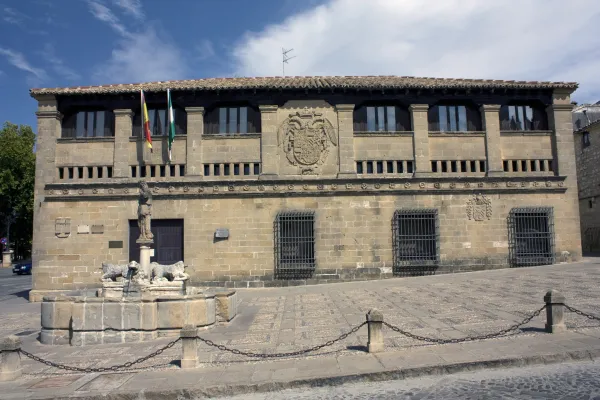
  • The Populo Square, framed by the door of Jaén and the arch of Villalar, is one of the most emblematic squares of the city, where we find the plateresque cover building of the old Escribanías, today the headquarters of the tourist office of the Junta de Andalucía, the old Carnicerías and the source of the Lions in the center.
     

Nature

Baeza is located in a dominant place in the region of the Loma and on the right bank of the Guadalquivir River. The city is located on three hills and the small valley that remain in the middle, in a rather high position over the Guadalquivir valley, a situation conducive to being a very important square in ancient times. It is surrounded by the Guadalquivir rivers to the south and Guadalimar to the north.

A site that as we walk through the walls allows us to contemplate the immense sea of olive trees that is presented to us all around us. From the sights of this walk, you can see the beautiful picture of the Guadalquivir valley, the extensive olive trees, the Cazorla saw, the Segura and Sierra Mágina saw, with the villages of Jimena, Mancha Real, Bedmar and Garciez in the distance.

The predominant vegetation is the olive tree, but next to the river and the lagoon Grande we find what we call the gallery forest: white, mimberas, tarais, black, and other species of bushes. A vegetation that with the change of the seasons draw a color brush in the landscape, especially in the autumn season.

The fauna of the town is the one of the Jienese countryside: hares, rabbits, deer, foxes, parrots, quail... They are also easy to see the storks and a wide variety of prey birds. Without forgetting the fauna that lives next to the river line and in the vicinity of the lagoon Grande.

The absence of non-agricultural land reduces areas of natural interest to the river margins and to the wetlands of the Great Lagoon with a special ecological interest.

  • Laguna Grande: This permanent lagoon that suffers significant level fluctuations, is fed from the Torres River through irrigation channels. Precisely for maintaining water during summers, this wetland is particularly important for waterbirds, it is an ideal place for food and shelter. Around the water, in addition to the vegetation of carrizos, spadañas and juncos stands out the presence of tarajes, alamos, fresnos and zarzas, where there is plenty of the visitor and I shelter the fauna of the place, among which we can mention: common fence, real anade or common porron, highlighting the fly bird, where we can see the nests of this small bird, hanging from the trees of this natural place. The locals of both the Bishop's Bridge and Baeza are willing to visit this beautiful natural site.


Parties and Events

Among the parties with the most roots among the neighbors of Baeza, we highlight:

  • La Candelariaon February 2. On the eve of the feast of the Holy One celebrates the Candelaria, typical of the blessing of the donuts of Saint Blas, protector of the throat, in the parish of El Salvador.
  • Holy Week. Between Andalusian and Spanish, the Holy Week of Baeza, declared of National Tourist Interest, stands out for the artistic richness of its steps. About 20 cofradies process through its streets and squares, in this jewel of the Andalusian Renaissance. Its creation dates back to the 16th century, when the co-fradia of the Vera Cruz, one of the oldest in Andalusia and Spain, emerged. One of the most beautiful moments of Baezan Holy Week, occurs on the morning of Good Friday, with the departure of the fellowship of Our Father Jesus Nazarene and the Cross of St. Helena, better known by the name "El Paso"; when the Nazarene Christ gives the blessing to his mother, through an articulated mechanism, when the images are crossed.
  • May CrossesMay 1. In different plazoletas and neighborhoods of the old town, altars are covered with the only theme of the exaltation of the Holy Cross.
  • Annual city fair. It is celebrated on August 15, the feast of its patron saint, Santa María del Alcázar.
  • Romeria de la Yedra. It is celebrated around the feast of the Nativity of the Virgin (8 September).
  • The Yedra, a pastry of Baeza, located 7 km. to the north of this, and where there is the Marian sanctuary of Our Lady of the Rosel and the Holy Christ of the Yedra. The Romeria itself is celebrated on Saturday day 7, the day when the Virgin travels through the city of Baeza and goes back to her shrine of La Yedra, accompanied by horses, carriages, reels and carrots, all covered with flowers.
  • Corpus Christi. With reminiscent of the 15th and 16th centuries. Procedural custody is certainly the goldsmiths of the city.

The annual calendar of celebrations is completed with the festivities of San Isidro Labrador, the pattern of farmers, Saint Christopher, pattern of the driving industry,Our Lady of Carmen and Council parties of Baeza in honor of San Andrés.


Gastronomy

The gastronomic culture is based on its history and geography. In many of its dishes you can find cultivated influences of Roman, Jewish, Islamic, Moorish and Mudejar cuisine.

The traditional cuisine is merged with the seasons and with the festivities, as well as the basic raw materials of the earth and all irrigated with the liquid gold of the olive fields of Baeza.

Among the indigenous dishes are:

  • The orza loin. It is a typical dish of the slaughter, which is used as a preservative, frying the fresh back on a slow heat in its own butter to which different spices, nails, cinnamon, pepper... are added... and then introduced into the orza. It is also done with the chorizos of the slaughter and thus are preserved all winter.
  • Cod to the baezan. In a saffrito of onion, tomato, peas and roasted peppers made from strips, you will add the already fried cod.
  • Pipirrana. In which peppers, tomatoes, garlic, onions and olive oil are used. A refreshing dish that can't be missed in summer.
  • Andrajos. Red pepper, green pepper, onion, garlic, laurel, olive oil, pepper, white wine, vegetables and hare or rabbit. All flavoured with peppermint. For the dough, flour and water.
  • "Sick-cooked"or" dizzy chickpeas, "a dish that tries to take advantage of the remains of another meal. In a pan with oil we chopped onion and added the chickpeas, which when mixed with the spoon are broken. It is added fried tomato and eggs that are mixed and cut.
  • "Eyes." or "Masoil". It consists of a bread of extra virgin oil, pepper and anise. The name comes from being the eighth part of the mass of a bread.

Warehouse:

  • Virolos, typical pebbles.
  • Butter cakes with nuts.
  • Torrijas, a way to take advantage of the bread left over.
  • Fried milk: It's about bounced and fried milk.
  • Papajotes, It's a frying pan. A mass of fried flour and bounced with sugar and cinnamon.
  • Oil ice cream, with milk, sugar, egg yolks and oil ingredients.


History

Atalaya over the Guadalquivir valley, its alcázar assured the Spanish rear in the constant threat of the Islamic kingdoms located to the west and south of Guadalquivir.

Baeza is now known for its olive production, its abundant monumental legacy (declared World Heritage by Unesco in 2003) and for hosting the International University of Andalusia.

Its main economic activity is agriculture, linked to the olive and the olive industry, although monumental tourism has developed the activity of the hotel.

Its churches, palaces and towers are a monumental set in which the different architectural styles take place, although the Renaissance and the Gothic isabelin are of particular importance. From its rich architectural heritage, it stands out the cathedral (16th century), the church of Santa Cruz (13th century), the convent of San Francisco, the City Hall and the church of San Andrés, all of the 16th century.

In short, the historic centre of Baeza is one of the most important monumental ensembles of the world renaissance.


Culture

To understand today's Baeza, we have to go back to the first inhabitants who settled in the place known as the Alcázar hill, in the Bronze Age, evolving to the Iberian city Viatia or Vivatia, passing to the Roman era, when Biatia was one of the most important cities.

It would be the Muslims who made up the city's murary limits, some of which were remade in the 16th century. After the Christian conquest the epoch of splendor of Baeza begins. The new Christian Baeza begins to grow out of the world, where religious buildings are the most representative.

  • The Cathedral. It is the most representative building in the square. In this enclave there could have been a Roman temple, over which Muslims raise a mosque and, in 1227, under the Marian advocation of the "Nativity", the cathedralicia headquarters is erected. In the 16th century, a reform is carried out, which will be the one that prints the Vandelvirian Renaissance seal to the building. The cover was drawn in 1587 by Juan Bautista Villalpando with "relief of the Nativity of the Virgin." The base of the tower is believed to be the mosque's miner, adding in time of Vandelvira the body of the bells and the deck.
  • Church of Santa Cruz. This work dates from 13th century, of late Romanesque style and preserved after the Christian conquest. The exterior is austere, highlighting its two covers with half-point arquivolts. The interior consists of three ships.
  • Ruins of the convent of San Francisco(extracamides). This work could have been one of the most important of the Andalusian Renaissance, but a number of misfortunes have prevented it, among these, the Lisbon earthquake of 1775 that brought down the vault of the major chapel. In this funeral and conventual complex, Vandelvira developed all its genius. The Latin cross church, which is accessed by a half-point arch that frames the entire cover, still remains with the relief of San Francisco and a tondo with the Virgin, which now give way to a large auditorium.
  • Old House of Correction and Prison, current City Hall(extracamides). It was built in 1520 as a prison at the request of Charles I. Since 1867 it has been home to the City Council. It is composed of the prison, with a more sober cover on which Justice and Charity are represented, and the house of the corridor with rich silver decoration. On the upper floor we find tripartite balconies with the shields of Philip II, the corridor and the city. It is topped with cornice decorated with membranes highlighted with figures. The Salon de Plenos has a Renaissance potter (horizontal and intertwined wooden ceiling) from the convent of San Antonio.
  • Church of St. Andrew. Building from the early 16th century, which held the title of a schoolgirl from 1764 to 1852. The silver-style cover, next to the square tower, stands out. The interior is a large main ship made up of arches pointed with side chapels.
  • Jabalfifth Palace.In front of the church of Santa Cruz, the Jabalfifth palace, one of the highest exponents of the isabelin Gothic style, was built in the late 15th century. The isabelin Gothic We find it on the outside, with decoration based on diamond tips, pineapple nails, fronts, florons, ties, pinacles, mocaronas and heraldic shields. The facade it is overcome with five arches of half-point Renaissance period, as well as the courtyard of the late 16th century. Today it is the seat of the Antonio Machado International University.
  • The St. Mary's Square, Baezan monumental heart, concentrates the largest number of monuments: the cathedral, the conistorial houses, the fountain of Saint Mary; the seminary of St. Philip Neri, with its picturesque facade plagued with cheers, current headquarters of the International University of Andalusia or the house-palace of Rubin de Ceballos, behind the cathedral.
  • The Populo Square, framed by the door of Jaén and the arch of Villalar, is one of the most emblematic squares of the city, where we find the plateresque cover building of the old Escribanías, today the headquarters of the tourist office of the Junta de Andalucía, the old Carnicerías and the source of the Lions in the center.
     

Nature

Baeza is located in a dominant place in the region of the Loma and on the right bank of the Guadalquivir River. The city is located on three hills and the small valley that remain in the middle, in a rather high position over the Guadalquivir valley, a situation conducive to being a very important square in ancient times. It is surrounded by the Guadalquivir rivers to the south and Guadalimar to the north.

A site that as we walk through the walls allows us to contemplate the immense sea of olive trees that is presented to us all around us. From the sights of this walk, you can see the beautiful picture of the Guadalquivir valley, the extensive olive trees, the Cazorla saw, the Segura and Sierra Mágina saw, with the villages of Jimena, Mancha Real, Bedmar and Garciez in the distance.

The predominant vegetation is the olive tree, but next to the river and the lagoon Grande we find what we call the gallery forest: white, mimberas, tarais, black, and other species of bushes. A vegetation that with the change of the seasons draw a color brush in the landscape, especially in the autumn season.

The fauna of the town is the one of the Jienese countryside: hares, rabbits, deer, foxes, parrots, quail... They are also easy to see the storks and a wide variety of prey birds. Without forgetting the fauna that lives next to the river line and in the vicinity of the lagoon Grande.

The absence of non-agricultural land reduces areas of natural interest to the river margins and to the wetlands of the Great Lagoon with a special ecological interest.

  • Laguna Grande: This permanent lagoon that suffers significant level fluctuations, is fed from the Torres River through irrigation channels. Precisely for maintaining water during summers, this wetland is particularly important for waterbirds, it is an ideal place for food and shelter. Around the water, in addition to the vegetation of carrizos, spadañas and juncos stands out the presence of tarajes, alamos, fresnos and zarzas, where there is plenty of the visitor and I shelter the fauna of the place, among which we can mention: common fence, real anade or common porron, highlighting the fly bird, where we can see the nests of this small bird, hanging from the trees of this natural place. The locals of both the Bishop's Bridge and Baeza are willing to visit this beautiful natural site.


Celebrations and Events

Among the parties with the most roots among the neighbors of Baeza, we highlight:

  • La Candelariaon February 2. On the eve of the feast of the Holy One celebrates the Candelaria, typical of the blessing of the donuts of Saint Blas, protector of the throat, in the parish of El Salvador.
  • Holy Week. Between Andalusian and Spanish, the Holy Week of Baeza, declared of National Tourist Interest, stands out for the artistic richness of its steps. About 20 cofradies process through its streets and squares, in this jewel of the Andalusian Renaissance. Its creation dates back to the 16th century, when the co-fradia of the Vera Cruz, one of the oldest in Andalusia and Spain, emerged. One of the most beautiful moments of Baezan Holy Week, occurs on the morning of Good Friday, with the departure of the fellowship of Our Father Jesus Nazarene and the Cross of St. Helena, better known by the name "El Paso"; when the Nazarene Christ gives the blessing to his mother, through an articulated mechanism, when the images are crossed.
  • May CrossesMay 1. In different plazoletas and neighborhoods of the old town, altars are covered with the only theme of the exaltation of the Holy Cross.
  • Annual city fair. It is celebrated on August 15, the feast of its patron saint, Santa María del Alcázar.
  • Romeria de la Yedra. It is celebrated around the feast of the Nativity of the Virgin (8 September).
  • The Yedra, a pastry of Baeza, located 7 km. to the north of this, and where there is the Marian sanctuary of Our Lady of the Rosel and the Holy Christ of the Yedra. The Romeria itself is celebrated on Saturday day 7, the day when the Virgin travels through the city of Baeza and goes back to her shrine of La Yedra, accompanied by horses, carriages, reels and carrots, all covered with flowers.
  • Corpus Christi. With reminiscent of the 15th and 16th centuries. Procedural custody is certainly the goldsmiths of the city.

The annual calendar of celebrations is completed with the festivities of San Isidro Labrador, the pattern of farmers, Saint Christopher, pattern of the driving industry,Our Lady of Carmen and Council parties of Baeza in honor of San Andrés.


Gastronomy

The gastronomic culture is based on its history and geography. In many of its dishes you can find cultivated influences of Roman, Jewish, Islamic, Moorish and Mudejar cuisine.

The traditional cuisine is merged with the seasons and with the festivities, as well as the basic raw materials of the earth and all irrigated with the liquid gold of the olive fields of Baeza.

Among the indigenous dishes are:

  • The orza loin. It is a typical dish of the slaughter, which is used as a preservative, frying the fresh back on a slow heat in its own butter to which different spices, nails, cinnamon, pepper... are added... and then introduced into the orza. It is also done with the chorizos of the slaughter and thus are preserved all winter.
  • Cod to the baezan. In a saffrito of onion, tomato, peas and roasted peppers made from strips, you will add the already fried cod.
  • Pipirrana. In which peppers, tomatoes, garlic, onions and olive oil are used. A refreshing dish that can't be missed in summer.
  • Andrajos. Red pepper, green pepper, onion, garlic, laurel, olive oil, pepper, white wine, vegetables and hare or rabbit. All flavoured with peppermint. For the dough, flour and water.
  • "Sick-cooked"or" dizzy chickpeas, "a dish that tries to take advantage of the remains of another meal. In a pan with oil we chopped onion and added the chickpeas, which when mixed with the spoon are broken. It is added fried tomato and eggs that are mixed and cut.
  • "Eyes." or "Masoil". It consists of a bread of extra virgin oil, pepper and anise. The name comes from being the eighth part of the mass of a bread.

Warehouse:

  • Virolos, typical pebbles.
  • Butter cakes with nuts.
  • Torrijas, a way to take advantage of the bread left over.
  • Fried milk: It's about bounced and fried milk.
  • Papajotes, It's a frying pan. A mass of fried flour and bounced with sugar and cinnamon.
  • Oil ice cream, with milk, sugar, egg yolks and oil ingredients.


History

It's in the Copper age, 3rd millennium BC, when they appear the first villages. Most of them were walled and their economy was based on agriculture and livestock.

In the Iberian period, 7th century BC, the hill of the Alcázar is considered a consolidated town.

During the 2nd and 1st centuries BC, in full Roman Empire, appears in several sources as Vivatia or Biatia. It acquires great importance due to its location, as it is a mandatory step on the commercial route Catulo - Málaga.

The territory of Biatia would be occupied in the second decade of the eighth century by Muslim troops. This time the city is known as Bayyasa.

Christian kings will take the city and lose it again on several occasions. But it will be Fernando III "the Holy One" who finally conquered it in 1227, and considered it as a bridge head in the reconquest of Al-Andalus, for this reason it is given to the city of privileges and a court, the "Fuero de Cuenca."

The presence of the Catholic Church is restored, establishing in Baeza the episcopal seat in the 13th century. From this date on, the most important religious and conventual orders were present in the city.

It will be in the 16th century when Baeza reaches its maximum architectural splendor with the foundation of the University, among other public buildings of interest. The apogee will continue in the 17th century, is the century of the greatest conventional apogee.

The 18th century will be of decline. With the war of Baeza Independence, he suffers considerable human and economic losses. Excessive demands and contributions would also help. The deamortization of Mendizábal, which brought the disappearance of the convents, was very remarkable.

The mainly agricultural economy, increases production and increases the area dedicated to olive trees to the detriment of other arable crops.

In 1966Baeza was declared "Historical-Artistic Set", which was a take-off in tourism services, increased by the Declaration in 2003 by UNESCO, in Baeza as World Heritage.

University tradition is recovering with headquarters Antonio Machado of the International University of Andalusia.
 

Literature

The city has had a great influence on distinguished authors such as Antonio Machado and Federico García Lorca, who had a momentous meeting here.

Not forgetting the important presence of San Juan de la Cruz in Baeza and the family ties linking Jorge Manrique to this town.

Other information

Other monuments that form part of their heritage are:

  • Old college.
  • Old Seminary of San Felipe Neri.
  • Casa Estudio de Manuel Garrido.
  • Museum of Baeza.
  • Casa-studio Diego Lozano, Father Sifon.
  • Antonio Moreno Museum.
  • Museum of the Olivo Culture.
  • Old Carniceries.
  • Civil Audience and Public Writings 16th Century.
  • Gaspar Becerra Exhibition Room.
  • Church of El Salvador
  • Church of St. Paul
  • Forgiveness door and streets adjacent to the Cathedral.
     

In this municipality

30

Accommodations

22

Restaurants

26

Services

9

Events

We recommend