
16
Jan
Feast of San Antón
16 January 2026
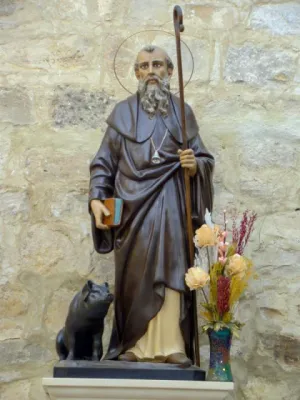


Bishop and martyr, who died in the year 316. Accounts of his life and martyrdom date back no further than the 9th century, though they are not entirely without foundation, and the liturgy has echoed them. Ragusa, Taranto and other cities claim to hold relics of the saint, who was one of the most popular figures of the Middle Ages. According to legend, he was a physician in Sebaste, a profession in which he became known for the miracles that accompanied his cures. When the episcopal see of that city fell vacant, he was raised to that office. However, shortly afterwards he withdrew into solitude in a cave, where he lived as an austere penitent, until the servants of Agrícola, prefect of Cappadocia, acting in the name of Emperor Licinius, discovered him, his dwelling surrounded by numerous wild beasts. Imprisoned, Licinius made great efforts to win him over to paganism. All in vain; he was beheaded along with seven women. In many places, his feast day is marked by the blessing of two candles, placed in the shape of a cross, held over the heads of the faithful and touched to the throat, since he is invoked against throat ailments — because, on his way to prison, a mother brought him her son, who was choking to death on a fishbone, and San Blas cured him. Bread and salt are also blessed for the healing of illnesses in people and animals, as is oil, into which the candle wick is dipped. Wool carders regard him as their patron, because before he was beheaded, his flesh was torn with an iron comb. In Russia he is the patron of livestock, since large numbers of wild beasts would go into the desert to his cave so that he might bless them. He is depicted holding two crossed candles in one hand, with an iron comb, with the child from whose throat he removed the bone, with a pig (which a wolf had snatched from a woman, and which was returned to her by the Saint's order), or, finally, in the cave surrounded by beasts of the forest. The Eastern Church honours him on 11 February; the Latin Church on 3 February.
The Order of San Blas was a military order from Armenia, founded in the 12th century, both to promote the worship and religious life of the faith and to fight the Mohammedans through its members. It ceased to exist when the Turks conquered Armenia. The knights of this order wore a blue costume with a golden cross, at the centre of which was the image of San Blas.
According to popular tradition, the Feast of San Blas in Rus has always been the town's biggest festival, being held in honour of its Patron Saint: the «Patron of the Charcoal Burners». Such was the devotion to their patron saint that men would leave their work in the mountains to come and spend this festive day with their families.
This was the festival of fireworks and Cocido con Relleno. Decades ago, when there was little money because wages were very low, men would save throughout the year, secretly setting aside a small fund ("matute") hidden from their wives, in order to buy fireworks to set off on the day of San Blas, in his honour: it was quite a sight to see San Blas carried in procession through the streets of Rus amid the smell of gunpowder.
When fireworks became more sophisticated (quite a few years ago now), it was rather spectacular to see, in the final firework wheel, an image of San Blas appear. The town hall square was packed with people, and everyone was amazed, shouting ¡¡¡Viva San Blas!!! and applauding wildly.
The Diocese periodically reassigns parish priests among our towns, and on one such occasion when it was Rus's turn to have a new priest, there was great surprise in the village when the newcomer, a few years later, declared that San Blas was not the Patron Saint, but the Co-Patron. The true Patron Saint was Santiago. And that San Blas was not a charcoal burner either, but a physician. That he was made a saint for saving a child who was choking on a fishbone, by feeding him a piece of bread ring. This is how the famous rosquillas de San Blas began to be made in Rus as a tradition.
As every year, on 3 February Rus dresses up in celebration in honour of its Co-Patron Saint San Blas. This eagerly awaited festival for the people of Rus begins on 2 February with the Hoguera de la Candelaria bonfire, held in the town hall square. In this bonfire, bundles of "ramón" (olive branches) are burned, cut and brought to the village by the Brothers of San Blas.
On 3 February, the main day begins at eight in the morning with the flower-decked Diana. This involves the Municipal Music Band, accompanied by the Brothers of San Blas, setting off fireworks through the streets of our town while shouting VIVA SAN BLAS.
At 11:30 am, the religious festival in honour of our Co-Patron Saint begins, at the end of which the members of the brotherhood hand out the rosquillas.
After the rosquillas have been handed out, San Blas is carried in procession through the streets of our town, accompanied by all the people of Rus. In some years, the Civil Guard band from the Academy in Baeza has also taken part.
Once the procession ends, it's time for the "Ligá", going from bar to bar drinking beer and wine with the corresponding tapas. Afterwards, some finish up at local restaurants, while others follow tradition by eating the typical Relleno at home.
The afternoon continues with coffee and more time spent celebrating in the town's bars, waiting for the fireworks display.
A few years ago, on 4 February (SAN BLASILLO DAY), a day of recovery and rest, a few last fireworks could still be heard, signalling that the end of the festivities began at five in the afternoon with the "Rateros" (small firecrackers thrown along the ground), with the brothers gathering once more to throw them and dodge them to avoid getting burned, ending with a Grand Traca (string of firecrackers) marking the end of the Feast of San Blas until the following year.
16
Jan
16 January 2026
18
Sep
18 September 2026

21
Sep
21 September 2026


