
Useful Information
Municipalities through which it runs Úbeda - Baeza - Beas de Segura - Jaén - Andújar - Villanueva del Arzobispo

With Saint John of the Cross, you begin an intimate journey through the places in Jaén where the mystic found refuge, inspiration, and silence. Here you discover the legacy of a poet who transformed spiritual experience into one of the pinnacles of world literature.
Your journey begins in Villanueva del Arzobispo, where Saint John arrived in 1578, ill and weakened after his captivity. In the Convent of Calvary, you will find the space where he served as prior and where, amidst confessions and spiritual direction, he began to outline the grand schemes of his thought. You will stroll through the Plaza Mayor and around the Sanctuary of Fuensanta, where he visited the new Carmelite convent.
The route continues towards Baeza, a university city and Renaissance center. Here he founded the Discalced Carmelite College, served as its first rector, and you feel the serenity of a place that fostered his formative work and contemplative life. Further on, you arrive at La Peñuela, in La Carolina, where he lived his last months as a simple subject following internal disputes within the Order. From there, he was transferred to Úbeda, where he died at the age of 49. In this city, you can visit the Museum of Saint John of the Cross, the only one in the world dedicated to him. The itinerary is completed with other essential sites: the Monastery of the Discalced Carmelites and the Center for the Interpretation of Mysticism in Beas de Segura, and the autograph manuscripts preserved in Andújar and Jaén, true literary treasures.
On this route, you'll discover Jaén through the depth, beauty, and silence that shaped the life and work of Saint John of the Cross. A journey where landscape, spirituality, and literature converge.
Is part of

In Úbeda, you enter the final chapter of the mystic's life. Here you will discover the places where he spent his last days, where he wrote, where he was cared for, and where his legacy became forever linked to the city.
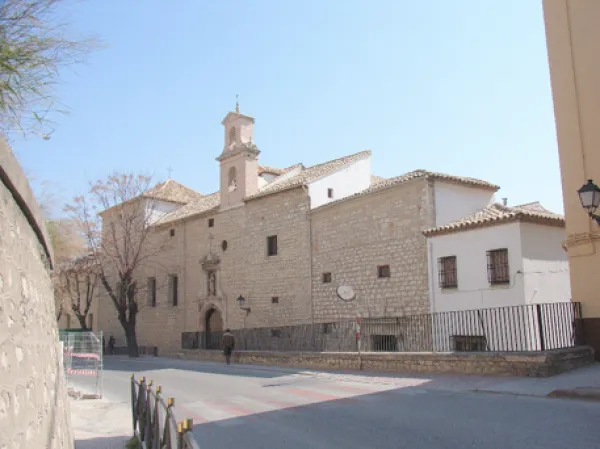
Convent of San Miguel / Former Convent of the Discalced CarmelitesHe spent his final days here after being transferred from La Peñuela. Here he was cared for by the friars and here he died on December 14, 1591. Although the original building no longer exists, the space preserves the memory of that serene and luminous end.
Museum of Saint John of the CrossIt is the only museum in the world dedicated entirely to him. Here you can explore his life, his work, and his spirituality through manuscripts, objects, recreations, and historical pieces that allow you to understand the depth of his thought.
Church and Convent of San Miguel (current location of the museum) The complex houses the museum and keeps the saint's presence alive.
Historic Surroundings of Úbeda This Renaissance city, a World Heritage Site, offers a perfect setting to understand the poet's spiritual dimension. Its quiet streets, squares, and churches invite you to walk slowly, as if following the echo of his verses.

When you arrive in Baeza, you are immersed in one of the most luminous chapters of his life. Here you discover the city where the mystic served as a formator, rector, and spiritual guide, in a university environment that fostered his thought and work.
Convent-College of Our Lady of Mount Carmel – San Basilio This is the heart of the route in Baeza. Here, in the former Convent of Our Lady of Mount Carmel, Saint John of the Cross founded the first University Residence of the Discalced Carmelite Order, intended to train young men with a vocation and academic pursuits.
Vicar's House An enclave linked to the Carmelite presence in Baeza. Although it is not preserved as a space open to the public, it forms part of the historical itinerary that helps you understand the context in which Saint John carried out his formative work.
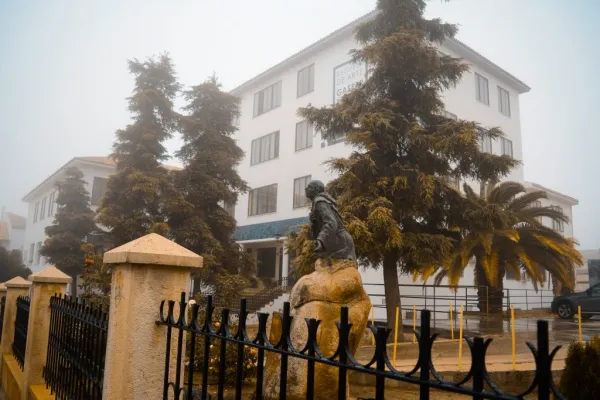
Monastery of San José del Salvador Your journey begins here. Saint John of the Cross arrived in Beas as Prior of the Convent of Calvary, sent by Mother Ana de Jesús, who wished to have the spiritual guidance of the Discalced Carmelites closer at hand. In this monastery—one of the most important Carmelite convents for women—the Saint heard confessions, offered spiritual guidance, and wrote, finding an environment conducive to organizing his mystical thought.
Interpretation Center of the Town of Beas, the 16th Century, and Mysticism Located next to the Sanctuary of Our Lady of Peace, this space allows you to understand the historical and spiritual context of the era. Here you can explore the history of Beas, its castle-fortress, the presence of the Order of Santiago, and, above all, the mystical universe shared by Saint Teresa of Ávila and Saint John of the Cross.
Way of St. John of the Cross A pilgrimage route that begins in Beas and ends in Caravaca de la Cruz. It traverses the landscapes the Saint visited as vicar and confessor, a 151 km itinerary that unites spirituality, nature, and memory.
Hospice of the Discalced Carmelites Built in 1659, after the Saint's stay, but intimately linked to his legacy. Located next to the main church and very close to the Monastery of San José, it is now part of private property on San Juan de la Cruz Street, historically known as Hospice Alley.

Length of the route: 0m.
Estimated duration: 1h.
Type of route: On foot.
Places that make up the route:
Length of the route: 0m.
Estimated duration: 1h.
Type of route: On foot.
Places that make up the route:
Length of the route: 29.63km.
Route: SANJUANISTA VILLANUEVA DEL ARCHOBISPO A BEAS POR CALVARIO Y PRIMITIVE

