Useful Information
Municipalities through which it runs Arjona - Jaén

Arjona is the birthplace of a storyteller who transformed Jaén into a land of legends.
Following the path of Juan Eslava Galán means discovering Jaén through the eyes of one of its greatest storytellers. Born in Arjona, the writer has made the province a recurring setting for his novels, where history, mystery, and landscape intertwine seamlessly.
In Arjona, his hometown, you'll wander through squares, churches, and hidden corners that inspired many of his works. From the ancient Alcázar to the Sanctuary of the Sacred Relics, each stop reveals fragments of a past that Eslava Galán brings to life with humor, rigor, and fascination.
His books—from *In Search of the Unicorn* to *The Templar Tombstone*—take you on a journey through Martos, Baeza, Jaén, Alcaudete, Baños de la Encina, and Úbeda, places that come alive with Templar enigmas, medieval adventures, and local legends.
This route is, in essence, a bridge between literature and the land, allowing you to enjoy the province with a curious and engaging perspective.
Is part of

Plaza de Santa María: A natural viewpoint overlooking the Jaén countryside, where the ancient Alcázar of Aryuna still reveals its imposing outer wall. It is the perfect starting point for the tour: spacious, bright, and steeped in history. Eslava Galán describes it with the precision of someone who knows every stone, and the traveler can contemplate it with the same fascination.
Sanctuary of the Sacred Relics: A 17th-century Neoclassical temple that incorporates the ashlars of the old Mocha Tower. Its monumental staircase and Baroque crypt surprise visitors, who discover here a solemn space full of symbolism.
Church of Santa María del Alcázar: Majestic and austere, it rises above the former Great Mosque. Hidden on one of its facades is the famous Templar Baphomet, an enigmatic face carved in stone that seems to observe the traveler and plays a key role in The Templar Tombstone.
Templar Baphomet: A sculptural detail that sparks the imagination: forked beard, double profiles, Templar mystery. A must-see for lovers of legends.
Juan Eslava Galán Museum of Arts and Customs: Located in the former Hospital of San Miguel, this museum not only exhibits ethnographic pieces but also preserves part of the writer's personal world, including the table where he wrote In Search of the Unicorn. An intimate place, perfect for understanding his creative process.
Almohad Cistern:The oldest building in Arjona, hidden beneath the old mosque. Its vaults and alabaster pedestals transport the traveler to the medieval era, evoking the daily life of ancient Aryuna.
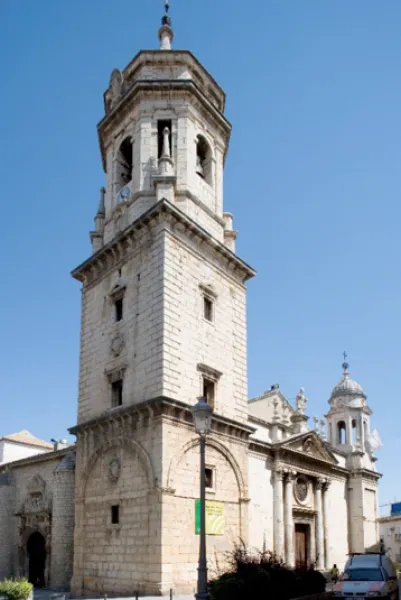
Church of San Juan Bautista: Built on the site of an ancient Roman temple and later a synagogue, this church is a crossroads of cultures. Its Plateresque façade and octagonal tower are architectural gems that surprise visitors.
Crypt of the Baron of Velasco:A Neo-Byzantine space of golden tesserae, marble sculptures, and an ingenious system of rails to access the niches. A place so unique it seems straight out of a mystery novel.
Arjona Town Hall: A 19th-century Andalusian house that Eslava Galán describes in detail: a bright courtyard, columns, tiled wainscoting, and marble staircases. Visitors can recognize in this building the atmosphere that the author recreates in his works.
The Templar Tombstone: The element that gives the novel its title appears in an unexpected place, revealed in the final section of the book. The route allows visitors to discover this exact spot, adding excitement to the journey.
Juan Eslava's Literary Corner: In the Municipal Library, this space brings together all his works, many signed, along with his work table and typewriter. An intimate corner for those who wish to connect with the writer beyond his books.

Basilica of San Ildefonso:Site of the miracle of the Descent of the Virgin in 1430. A key location in the devotion of Jaén and in the author's historical narrative.
Church of La Magdalena: Former main mosque. The neighborhood, the fountain, and the lizard are recurring literary devices in his work.
Institute of Jaén Studies (IEG): Home to the author's personal archive: more than 8,000 documents, books, and files.
Castle of Santa Catalina: Emblem of Jaén. Medieval fortress and privileged viewpoint that appears in his historical essays.
The Lizard of La Malena: The most famous legend of Jaén. A literary and cultural symbol frequently used by Eslava Galán.
Arab Baths Cultural Center – Villardompardo Palace: 11th-century Arab baths, the largest open to the public in Spain. A recurring historical setting in his popular works.
Arrabalejo Tavern: Mentioned in In Search of the Unicorn. A place steeped in popular tradition and culinary memory.
Arch of San Lorenzo: A 13th-century Gothic-Mudéjar vestige. A space steeped in history that inspires the author.
Palace of the Constable Iranzo:Direct setting in *In Search of the Unicorn*. It preserves a magnificent Mudéjar hall.
San Francisco Square:An emblematic place in the city. The Templar chapel of the old convent was located beneath it.
“El Gorrión” Tavern:Founded in 1888. It appears in his works and preserves the famous “mummified ham”.
Maestra Street:Historic thoroughfare of the old town. Setting in *In Search of the Unicorn*.
Bernabé Soriano Street (La Carrera):Site of ancient horse races mentioned in his Planeta Prize-winning novel.
Puente Tablas:Iberian oppidum of great archaeological value. Eslava Galán incorporates it into his historical narrative.
Santa María Square – Jaén Cathedral:The Cathedral is masterfully described in The Templars and the Table of Solomon.