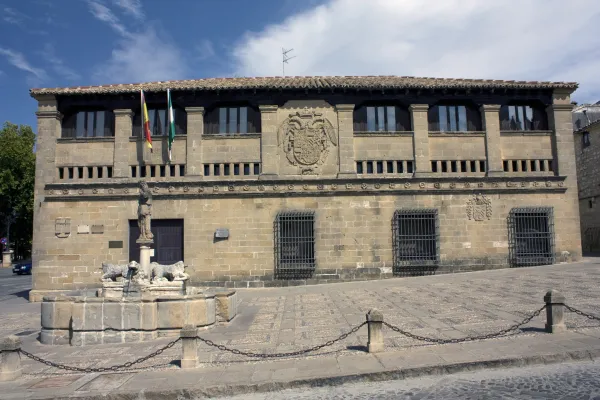


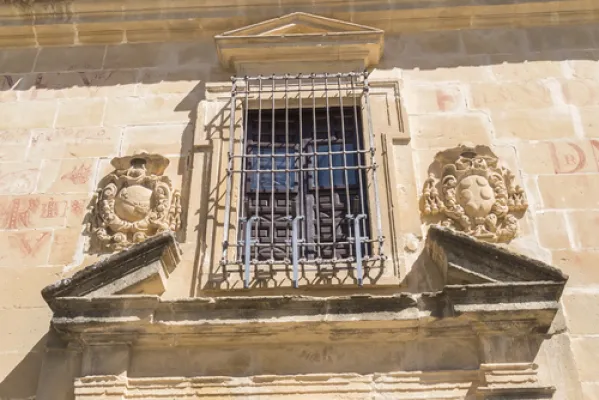
Description
Good for Cultural Interest. Monument. Declared in 03 / 06 / 1931. In the factory accounts of the church of San Andrés, there is Andrés de Vandelvira responsible for the main chapel.
According to F. Escolano Gómez, on May 14, 1565, Pedro Hernández de Baeza, prior to the parish church of San Andrés, is responsible for the charge and discharge of the factory from the years 1562 to 1564; in the discharge of the year 1564, he is paid to Andrés de Vandelvira 3,740 maravedís "(...) by the traça of the major chapel that he made (...);" it is also noted that the factory continued between the years 1565 to 1570 and that in 1572 Alonso (the work of the work of the work of the Barba...). "Other notes in this regard are in the years 1575, 1576 and 1577, the latter being at the head of the master's office the Juanes de Izpino or Azpino. In the accounts of the years 1604-1610 there is a record of a..." second work of the chapel... "It is difficult to specify at present the vestiges of the Vandelvirians preserved in this major chapel, as it suffered an important intervention in the 17th century, in addition to numerous subsequent restorations.
In any case, his participation in the constructive process of this monumental Gothic church is documented, the beginning of which is to be placed under the mandate of the prelate Don Alonso Suárez de la Fuente el Sauce (1500.1520), whose shields champion on the delicate plateresque cover open on the East side. There is a splendid tower of bells, with beautiful plateresque crest, raised in the time of Bishop Gabriel Esteban Merino (1523-1535). It is also the West cover, carved by the command of Bishop Don Diego Tavera (1555-1560). It does not keep the temple inside the original wooden roof, of which only one part remains at the level of the choir. The importance of this church for the city of Baeza is due, apart from the artistic, to the veneration of the local Patrons, St. Andrew the Apostle and Our Lady of the Alcazar.
OTHER ARTISTICAL MANIFESTIONS NOT ARCHITECHANIC.
The main chapel is headed by a beautiful altarpiece, which in the opinion of Professor Luz de Ulierte is "(...) one of the best carved, chromed and golden poly of the whole diocese, both its architecture and its sculptures (...)." Estilistically it is inserted into the circle of Sebastian de Solís and Gil Fernández, although made by the brothers Blas and Juan de León, between 1629 and 1633. The iconographic program is made up of the twelve Apostles, Christ Crucified with the Virgin and Saint John. In the shrimp, the Virgin of the Alcazar, patron of the city, is a Gothic size, although reformed in the 18th century. At the foot of the temple are the chorus and a canvas of the Divine Pastor in the baptismal chapel, pieces of the 18th century. Dieciochesca is also a beautiful Immaculate Conception. In the sacristy there are nine tables from an altarpiece of the late Collegiata, attributed to the painter Francisco Sánchez in the last decades of the 15th century. They represent the Birth, the Adoration of the Magi, the Circision, the Presentation of Jesus in the temple, the last Supper, the Performance, Calvary, the Ascension of Jesus and the Assumption of the Virgin.
Is part of