

Description
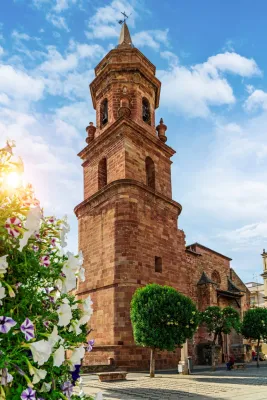
Almond tower, built with stone and brick rows, with a lookout on its top, framed between cornlines and with half-point windows on all its fronts.
Under the shield is a beautiful watch, carved in stone and of elegant bill, which probably gave name to the new construction. It is a clock that at the present time has no function, because of it only its cultivated sphere persists. Clock that would be replaced, surely in the 19th century, by the one we see below the looking body.
Everything seems to indicate, according to the capitular records of the 17th century, that the Clock Tower was an element attached to the royal prison with which it was communicated. On September 12, 1653, he reported that a prisoner had fled through the tower because of the watchmaker's neglect, which is why he would be punished and replaced. Surveillance tower from where the streets and people of Andújar are seen and from where the work rate of their neighbours was marked. At the present time, the Clock Tower is certainly one of the most representative elements of the monumental city of Andújar and part of the morphology of the square of Santa Maria.
On the west front and at half height we find the imperial shield of Charles V and a watch carved in stone. In the first ornamental element, a bicephalous eagle carries the imperial crown and the gold Toison borders the shield. In the right canton the lineage of the Trastámara and the Habsburg and in the sinister of the House of Avís, which correspond to Charles V and his wife Isabel of Portugal, respectively. His presence is due to the coincidence of the execution of the work with the reign of Charles V, for it was customary at the time to leave witness to the reigning monarch in the new constructions. An imperial shield that reminds the Andujareans of their fidelity to the monarch in the years of the war of the Communities, as part of the Junta de las Ramblas. It was not in that same view his mayor, Francisco de Vergara, who "had sympathy for the Communists, and knew the city of the management he brought with them, was so outraged, that in the middle of Cabildo he took away the rod of justice." From the loyalty and obedience of the city the emperor was very pleased and proof of this was the letter he sent on July 20, 1520, from the city of Ipres, in which he thanked the city's attitude towards his person at those difficult times.
The only documentary source that exists today on this construction is on its west front and says: "The great knight Francisco / Alarcón twenty-four of Granada and his major mayor Sancho Díaz / Baeza, who is the king of this city, is now the only one who has been the author of this city. Mayordomo Alonso Yáñez."
At its base is the Municipal Tourism Office, from where you can access the Panoramic Mirador.
Is part of