

The Sierra Mágina Natural Park rises like a large mountainous island in the middle of Jaén's sea of olive groves. From afar, the rugged limestone terrain stands out against the gentle countryside; up close, a territory full of nuances is revealed, where every slope, every ravine, and every spring tells a story. Dominating the horizon is Pico Mágina, at 2,167 meters, the highest peak in the province and a landmark for those who enjoy hiking, running, or flying over the summits.
Within its nearly 20,000 hectares, ecosystems of exceptional uniqueness in southern Spain are concentrated. At the foot of the mountains, olive groves, orchards, and fruit trees coexist with small rural villages; At intermediate elevations, mixed forests of holm oak, gall oak, and maple extend, accompanied by junipers, savin junipers, turpentine trees, and hawthorns. Higher up, the mountain becomes rugged and luminous: creeping junipers, hawthorns, and black pine withstand the wind, snow, and ice in places like the Gargantón Pine Forest. In these higher elevations appear some of the area's botanical treasures, unique endemic species such as Jurinea fontqueri, Lithodora nitida, and Vicia glauca, which make Sierra Mágina a natural laboratory for botanists and lovers of mountain flora.
Water is another of the great threads that weave the landscape. The deeply karstified limestone sculpts karst pavements, sinkholes, and caves, but also feeds springs, fountains, and rivers that accompany locals and visitors alike. Places like the olive grove on the Cuadros River, the Zurreón Waterfall, which can freeze over in winter, or the ravines that descend towards the Guadalquivir Valley are ideal spots to enjoy refreshing trails, natural swimming areas, and unexpected viewpoints.
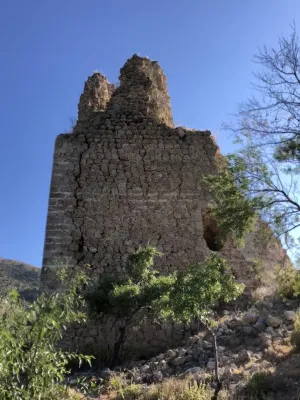
But Sierra Mágina is not just nature; it is a landscape deeply lived and shaped. For centuries it was a border between the Muslim and Christian kingdoms, something that can still be seen today in castles, towers, and remains of walls scattered throughout the region, from Jódar to Bedmar, from Bélmez de la Moraleda to Cambil.
The olive grove economy, protected by the Sierra Mágina Designation of Origin; The terraced orchards of Pegalajar, the extensive livestock farming of mountain sheep (also known as "ojinegra") and Andalusian white goats, and the old industries of esparto grass, soap, and perfume have left a deep mark on the territory.
In the heart of the Sierra Mágina, each municipality adds its own unique touch to a shared landscape of mountains, water, and an endless sky. In Cambil and Torres, water is the main protagonist, shaping lush forests and crystalline waterfalls; while the steep slopes of Albanchez de Mágina and the legendary atmosphere of Belmez de la Moraleda lend character and mystery. Pegalajar preserves a valuable traditional irrigation system and historic orchards declared cultural heritage sites, in contrast to Jódar and Cabra del Santo Cristo, where esparto grass crafts are an essential part of their identity. Bedmar opens as a gateway to unique enclaves such as the Cuadros River and the diverse landscapes of Huelma, Jimena—home to the Canava Pine Forest—and the austere Campillo de Arenas gorge. From La Guardia de Jaén, sweeping provincial panoramas unfold, while the rocky outcrops of Carcheles and Mancha Real, the prelude to the ascent of Peña del Águila (Eagle's Peak), are home to birds of prey and other wildlife. Noalejo emerges as a mid- and high-mountain oasis on the border with Granada, and Larva offers endless horizons in a serene, steppe-like landscape, strategically situated between two natural parks. Together, they form a unique mosaic of landscapes that defines the soul of the region.
A natural, cultural, and ethnographic treasure, Sierra Mágina presents itself as a destination where visitors can hike among endemic species, run through history, and soar above one of the highest mountains in Andalusia.