
Saltar al contenido principal

Vilches

MUNICIPIOS
  • e2fdf917-2e2c-2a08-49fc-21c32566e218?t=1687277240494
  • c4eb1866-6864-211d-8b8d-5d6240b72c0e?t=1687277240860
  • e203e5aa-0c7b-55bc-bb18-7f2ad2a50893?t=1687277240664
  • 36f5d348-3269-39d2-d70f-6d5b005c43c2?t=1687277240761
  • 61e83072-e72e-55d4-da7b-2cbab669b212?t=1585852470283
  • b8aaede2-095b-503f-349d-1f204fe0ddee?t=1687277240934
  • de02a0ed-f04e-7e2f-c703-d8c7d6baea37?t=1687277240590
  • e2fdf917-2e2c-2a08-49fc-21c32566e218?t=1687277240494
  • c4eb1866-6864-211d-8b8d-5d6240b72c0e?t=1687277240860
  • e203e5aa-0c7b-55bc-bb18-7f2ad2a50893?t=1687277240664
  • 36f5d348-3269-39d2-d70f-6d5b005c43c2?t=1687277240761
  • 61e83072-e72e-55d4-da7b-2cbab669b212?t=1585852470283
  • b8aaede2-095b-503f-349d-1f204fe0ddee?t=1687277240934
  • de02a0ed-f04e-7e2f-c703-d8c7d6baea37?t=1687277240590

Description

Vilches is a municipality located in the north of Jaén, in the district of El Condado, located in the foothills of Sierra Morena. The pedanias of Guadalén and Miraelrio are also part of it.

Its municipal term is crossed by the Guadalén, Guarrizas and Guadalimar rivers, which pour their waters in the reservoirs of Guadalén, La Fernandina and Giribola, respectively.

Its varied landscape has great tourist potential, highlighting its areas of environmental interest, reservoirs, oak dehesas, extensive olive trees, farmland, not forgetting its cynetic and fish resources.

The historical-artistic heritage is relevant. The church of San Miguel, the hermitage of the Virgin of the Castle, the remains of the castles of Vilches and Giribola, belonging to the Route of the Castles and the Battle of Jaén, and archaeological sites such as Giribola, of Iberian times, are highlighted.

Useful Information

Tourist area: Sierra Morena / Sierras de Andújar and Despeñacolos
Distance to the capital (km): 80
Altitude over sea level (m): 543
Extension (Km2): 273
Number of inhabitants: 5086
Gentillo: Vilcheños
Postal code: 23220

Is part of

AUDIOVISUAL CONTENT

MORE INFORMATION

Culture

Its artistic heritage includes:

  • Church of San Miguel Archangel, This church dates back to the last third of the 16th century. The main cover is simple and with a half-point arch. It appears decorated with a stone shield made of quarry, typical of the Renaissance and Spanish mannerism. On a side it has a cover with a tile image of the Virgin of the Castle. The tower is of rectangular floor, which is unusual, and with relief decoration of the bell tower, similar to work in brick. The interior is one-ship and at the bottom is a half-barrel vault with the arms shields of Bishop Calderón. The majestic baroque altarpiece of the 18th century, the work of sculptor Diego de Briones, the chapel in which the so-called "trophies" of the battle of the Navas de Tolosa are kept (1212) and, in another chapel, a canvas of the Final Judgment are kept.
  • Ermita- shrine of the Virgin of the CastleHe rose in the 18th century on the ancient church of Santiago, at the top of the hill of the castle. It houses the image of the patron of Vilches, who every August 14, on the occasion of the holidays in his honor, is brought down in procession to the parish of San Miguel.
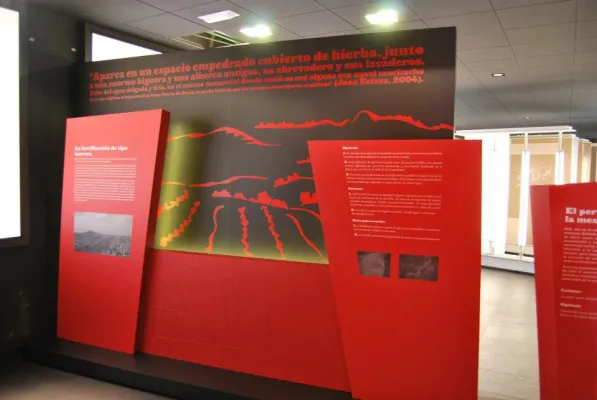
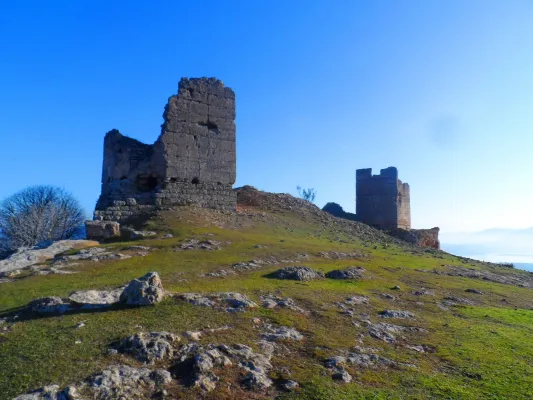
  • Vilches Castlelocated on a high hill to which it gives name and from where you can enjoy a wonderful view, is the castle of Vilches. A fortress castle that played a very important role as a point of defense of the high Guadalquivir, served as a refuge for the inhabitants of the environment in the face of the advance of Christian troops during the Reconquest and starred in famous war episodes, in the Middle Ages, between Arabs and Christians. Although we know that the hill has been populated since the time of the Iberians, the origins of the castle are uncertain. There are only a few remains of the fortress: a esquinero turret, known as "Cube de la Villa," part of another turret and a passage with a slightly pointed vault of armchair. With the passage of the years and the consolidation of Christian culture, much of the towers and parts of the walls of the castles were used to build small churches and hermitage. In the courtyard of arms the church of Santiago was built, on which the hermitage of the Virgin of the Castle was later built. It was declared Good of Cultural Interest in 1985.
  • Archaeological site of Giribola. It is an archaeological site of great importance located in the confluence of the Guadalimar and Guadalén rivers, from where you can enjoy excellent panoramic surroundings. From what has been known so far, it is known that it was home to an Iberian city, which some scholars associate with Orisia, which was destroyed in the Second Punio War, a prehistoric sanctuary, a Paleocrist or Visigode cenobium and a Almohad castle built after the battle of the Tolosa Navas.

Nature

TheNorthfrom the term Vilches extends through Sierra Morena, with altitudes reaching 800 m. The vegetation in this higher part is very varied and is associated with the Mediterranean forest: encinars, alcornocals, complaints. There are also shrubs and areas of wood pine plantations.

More to Southin the foothills of Sierra Morena, with altitudes between 400 and 500 m., the adhesitated surfaces and pastures predominate. With a soft orography of constant undulations, where the olive grove predominates and we also find low mountain with acuchals and madroños.

Here live numerous animal species, such as birds, mammals and arthropods, easily observable in their natural habitat.

Thewet areass are around the reservoirs(Guadalén, Girirbola and Fernandina), in theriver banksGuadalén, Guadalimar and Guarrizas. The banks of the rivers and streams welcome mimberas, tarays, adelfas and other tree species such as the white chopo or the black Alamo.

The reptiles abound, highlighting the populations of theleprous galapagoin the rivers Guadalén and Guarrizas, as well as theViper de Latastein the Sierra. They will also be easily observable fishing and real eagles, common and black vultures, royal owls, lynches, gines, badges, etc.

Parties and Events

Vilches is a municipality of deep-rooted traditions, with popular celebrations, both religious and profane, that take place throughout the year and with activities for all ages.

  • San Antónwhich is held on 17 January. The streets are filled with bonfires of olive branches, which come from the pruning of these trees, to honor the pattern of the animals.
  • San Sebastián, Vilches pattern, which is held on January 20. That day the saint leaves his hermitage to process the streets.
  • Carnival parties, in which the neighbors participate, in which they dress up and sing mockery cokes (the City Council awards the best). They take place in the Caves del Zahaní district.
  • Holy Week. A week marked by religious acts and processions from Palm Sunday to Resurrection Sunday.
  • Festival of Corpus Christi. After Mass, in the church of St. Michael, the Lord will take a tour of the people accompanied by children of first communion. It is tradition to paint the streets using multi-color sawdust to reproduce allegorical drawings to the day of Corpus.
  • Saint GregoryOn May 9, in the neighborhood of the Mesones, a mass is held in the church of St. Gregory. At the end of the day, the rosses of blessed bread are distributed and the image of the saint is moved to the church of San Miguel.
  • Patrons in honor of the Virgin of the Castleon the 14th of August the transfer of the patron from her hermitage to the parish is carried out, remaining there until 8 September. The next day, on the 15th, the Holy Mass is celebrated in his honor and the floral offering. The festivities will last five days, in which there will be sports events, enclosures, capeas, gastronomic samples and popular verbenas.
  • The Vilches bell-bearers, they are a gang of Vilcheños who, when Christmas comes, go through the streets, singing their stanza. They sing ancient and villain senses. It is a tradition in which Arab reminiscent is observed, both in its melodies and in its stanza. The song is initiated by a soloist and the chorus chorus. The accompaniment is very unique: guitar, bandurry, laud, bell, triangle, Spartan alpargata, plow, wooden drawer, almirez and saucers.

Gastronomy

Vilches is a municipality very fond of its traditions and this is also reflected in its gastronomy. Meat obtained from hunting is often used to make its dishes.

We highlight among the best known:

  • The harls, a hare stew, flour, tomato, onion, olive oil and pepper.
  • The countrysideA stew with hare and potatoes.
  • The brain, on this dish is cod, with onion, tomato and olive oil, which takes the lead.
  • The crumbswhich consists of bread, garlic, olive oil, all accompanied by some products from the slaughter of the pig.

From the pastry shop we want to highlight:

  • PapajotesIt's traditional sweet. This dessert is consumed at breakfast or at snack, and is one of the most widespread sweets in the province.
  • Sweet peas for the Day of All Saints.
  • Tickles, drunks and flowersHoly Week.
  • Bake and bread with matalauva in San Gregorio.

History

In the municipal term of Vilches, about a hundred archaeological sites have been invented. From the Copper age the field of Santagon. The occupation of this settlement had to end at the beginning of the Bronze Age, when the consolidation of metallurgical activity and the fertility of the surrounding lands involved the emergence of small villages in the area, some of them fortified, such as the Cañada de Malaguo, Giribola or Cerro Santo. This settlement has the novelty of having a large defensive tower.

In the Iberian stage, GiridanceThe metallurgical centers were controlled from here. The town has an urban layout defined by streets, houses and public areas, delimited by a large wall. From this Iberian period, many settlements and small fortifications have been invented, including the first occupation of the castle hill.

In the Roman times Vilches is identified as BaesucciAccording to a stone located on the hill of the castle. The Emperor Vespasian granted him the title of municipality. In Santagon, remains of ancient villas with mosaics have been found in the noble areas.

Also the people Visigode He settled in Vilches. A visigode architrabe has been found and is preserved in the Jaén Provincial Museum.

It's in the Islamic period when the current Vilches site is consolidated, being occupied from 711. It was part of al- Andalus for five centuries, from the first years of the 8th to the 13th century. This long period makes Vilches a typical Muslim cityfrom which we can guess vestiges today. As the 12th century progressed, the castle of Vilches became very vulnerable by the proximity to Despeñacolos, where the Spanish-Latvian troops practiced acts of harassment over the possessions of al- Andalus.

In 1212, the Christian kings of Castile, Aragon and Navarra, beat the Muslims in the the battle of the ships of Tolosa. Three days later, the castle is conquered and the population exterminated, which will force this area to be repopulated with inhabitants from beyond Sierra Morena. The Christians will stay in the Vilches castle And the Muslims will return to Giribola.

It will be King Fernando III who gives up the territory of Vilches to the Council of Baeza, until Felipe IVin 1627, release him and grant him the The title of Villa.

The number of Vilches with railway station, already in 1900.

In this municipality

6

Accommodations

5

Restaurants

2

Services

5

Events

We recommend