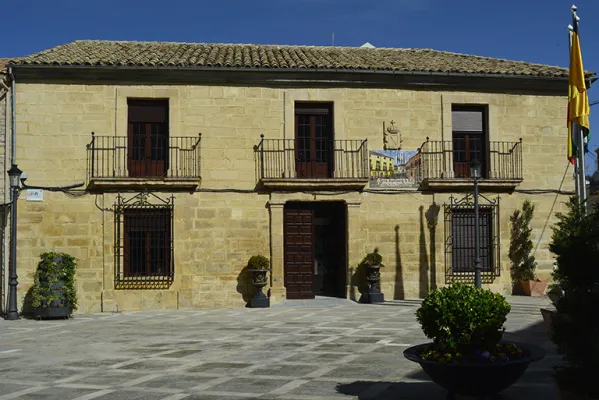
Tourist Office



Municipality located to the north of the region of La Loma, between extensive and fertile olive fields. Its term is essentially agricultural, the olive tree being the main crop. It should be noted that, in recent years, 85% of land of the farm have irrigation.
The Rus economy is based on olive cultivation, Almazara industry and textile industry, very rooted in the town. The proximity and good road communication with Ubeda and Linares means that trade and care activities are derived to these municipalities.
In its municipal term is the Local Autonomous entity of El Marmol.
From its historical heritage we highlight: The Parish Church of Our Lady of the Assumption, the Arab Torreon of Rus and the Palecanal Oratory of Valdecanas.
Is part of


Rus, located in the region of La Loma and south of the Guadalimar River, with an average altitude of 590 m and an extension of 47 km2 He is a clear representative of this Jienese region.
The landscape that is presented to us when we are located in the lands of Rus is really spectacular, a real olive sea, the most representative image of La Loma jienense. The promontories are low and the earrings are soft. Some small areas are reserved for the cultivation of cereals. In the areas near the Guadalimar the vegetation changes by what we know as the riverbank forest: willows, alms and low bushes.
Because of its privileged location, Rus has interesting natural environments that are worth discovering. The framework around it is truly striking: to the north Sierra MorenaSouth Sierra Magina and to the east the Serra de Cazorla, Segura and Las Villas.
Among the areas of most natural interest in its term are:
To the many species that live in the olive tree, some as emblematic as the abubilla, brown chotocabra, coal, pale aguilucho, ash aguilucho, we have to add mammals such as the fox, the rabbit, the gin or the deer. Without forgetting the birds that feed on the olive tree in their long migratory movements through the peninsula, a nutritious food that will help them to restore strength.
Many parties are held, but there are two traditions that stand out above the others.: San Blas and the Fiesta de Mozos.
Other:
According to some sources, Rus is the former Ruradensis Republic of 202, the time of the Roman Emperor Marco Aurelio, although there may have been an Iberian core before.
In addition to the two oratorios or cenobia, the Valdecanals and the Cave of the Veguilla, ceramic remains have been found extended by the term, which makes us imagine that there was a core population.
Although it does not appear in the chronicles, it is assumed that the town passed to the hands of Fernando III, at the same time as the rest of the region, around 1226. At that time he became a member of the Order of Calatrava and the jurisdiction of Baeza until 1628, when by the privilege of Philip IV he was separated and converted into a village of realingo.
Rus is known to have participated in the Battle of the Salty in 1340.
Property with bars, balconies and shields from the 18th and 19th centuries are preserved.
In 1886 he incorporated into his municipality the anejo of El Mármol, former lordship of the secretary of Philip II, Juan Vázquez de Salazar.
El Mármol is an entity of a territorial area below the municipality of Rus.
He was a lordship from 1577, until the Cortes of Cadiz suppressed them. It is set up as an independent city council in the 19th century, but the accumulation of debt causes its inhabitants to ask the Provincial Council for its annexation to Rus, which happened in 1886.
It has a rich historical heritage made up of:
4
4
1
4