Saltar al contenido principal

Peal de Becerro

MUNICIPIOS
  • peal de becerro
  • 36ed687c-6781-2c15-a6ca-96c10df24791?t=1621272389278
  • a1255b7a-25c1-49d8-c70f-54d9311fb045?t=1621272389327
  • 0c495f3f-a175-bd80-6af1-b5a640307452?t=1595435156186
  • f46b1747-cb7f-6d40-a908-654d4eeffccd?t=1621272389373
  • 687d48bc-006b-017f-12ea-4600ed60245b?t=1621272389419
  • a4e805f6-b189-49a7-3cfd-d274f4eef1ca?t=1621272389595
  • e876c399-4357-b1e3-3d9d-421dba5e1d2d?t=1595435254911
  • peal de becerro
  • 36ed687c-6781-2c15-a6ca-96c10df24791?t=1621272389278
  • a1255b7a-25c1-49d8-c70f-54d9311fb045?t=1621272389327
  • 0c495f3f-a175-bd80-6af1-b5a640307452?t=1595435156186
  • f46b1747-cb7f-6d40-a908-654d4eeffccd?t=1621272389373
  • 687d48bc-006b-017f-12ea-4600ed60245b?t=1621272389419
  • a4e805f6-b189-49a7-3cfd-d274f4eef1ca?t=1621272389595
  • e876c399-4357-b1e3-3d9d-421dba5e1d2d?t=1595435254911

Description

Municipality located to the east of the provincein the Sierra de Cazorla region.

It has an enclave in the middle of the mountain area. The main territory of the municipal term is to the west of the region on land of olive countryside. The original administrative division thus allowed this municipality to have forest resources, pastures in communal mountain areas.

It is part of the Guadalquivir watershed, a river that crosses the municipal territory, as well as its tributary Guadiana Minor, Guadaltiín and Toya.

In its landscape, the large olive groves and cereal fields. In addition of the main population centre, Peal de Becerro, the villages of Toya, Peal Furnaces and the enclave of The Almicaran, integrated within the mountain area of the Sierra de Cazorla.

In Toya exists a burial chamber of Iberian origin, declared a National Historical Monument in 1918. Inside it was found "La Bicha de Toya" which is a sculpture and is currently in the National Archaeological Museum of Madrid.

The local economy is based on olive cultivation, processed metal, construction, olive industry and meat products.

Within Historical Heritage We highlight: Toya Chamber, the Clock Tower, the Mocha Tower, the Toya Castle and the Peal Furnace Aqueduct.

Useful Information

Tourist area: Serras de Cazorla, Segura and the Villas
Distance to the capital (km): 87
Altitude over sea level (m): 550
Extension (km ²): 147
Number of inhabitants: 5,277
Gentillo: Pealeños
Postal code: 23460

Is part of

AUDIOVISUAL CONTENT

MORE INFORMATION

Culture

  • The Toya House. Discovered in the early 20th century, it is one of the most important funeral monuments of Iberian culture on the Peninsula, not only because of its conservation status, but also because of the monument itself. Some consider it the first great architectural work of the Iberian Peninsula. This is a underground burial chamber built with large "in situ" carved stones, placed one on the other without any type of argamase. The interior impacts, because it is a three-ship enclosure, the sides in turn, divided into two, made of carved chairs to fit perfectly on each other. Banks, bakers and a table appear. The roof is also closed with stone slabs. The construction work of the camera is very interesting for its high level of execution. The "Toya's jousting." It is characteristic of an Iberian prince and his family, of it we highlight: the wheels of a warrior car, dishes, vessels, remains of a sword, an iron helmet, beads of silver necklace, glass of marine blue and yellow....Declared Historical Artistic Monument in 1918.
  • The Clock Tower:In the heart of the urban core are two towers that formed part of an ancient medieval fortress, One of them, The Clock Tower raised at the end of the 14th century, sits on a stone socket, is quadrangular, of silery not always regular. It is internally distributed on four levels, maintains the almenate and also on two sides of its matacan-function balconies, in the third, matacan menulas, and in the latter a watch that gives it name has been placed.Declared Good of Cultural Interest in 1985.
  • The Mocha Tower: It is about the second tower of the fortress Medieval, it is of masonry concerted in some of its parts has corners reinforced to rope and sawn and topped with skimmed canes. It must have been built between the 13th and 14th centuries, it was restored at the end of the last century.It has been declared Good. of Cultural Interest in 1985. Among the towers is a wide space, in which an Auditorium has been established, for the celebration of cultural and playful activities in the open air.
  • The Castle of Toya: In Toya, near the Iberian tomb, an impressive tower of the Toya castle is maintained. It has a square floor, it is demochada and in its interior are preserved half-barrel vaults that covered the rooms and on its outside the arrangement of the masonry goes to soga and tizon, also showing structure of calicanto. It has been declared Good of Cultural Interest since 1949.
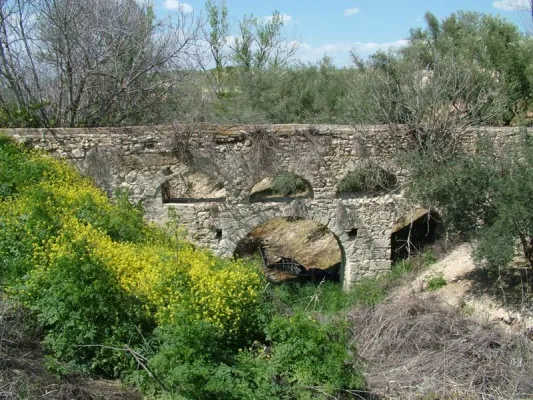
  • Aqueduct of Peal Furnaces: In this pedany, there is an old and damaged aqueduct, considered as of Roman construction. It defies the passage of time and erosion caused by the river that crosses it below.

Nature

Peal de Becerro with a surface of 147 km2, belongs to the region of Sierra de Cazorla. Posee two pedanities, Toya and Peal Furnacesand an enclave, The Almicaran, integrated in the Sierra de Cazorla, 55 km. of the municipality.

It is part of the Guadalquivir watershed, river that crosses the municipality, as well as its tributary the Guadiana Menor, the Guadaltiín and other minor water streams.

The land of olive countryside and in a more secondary way, east of the region, a mountain areaincluded in the Natural Park of the Sierras de Cazorla, Segura and Las Villas.

The agricultural land are divided between arable crops (wheat, barley) and olive in similar extensions.

The enclave of The Almicaran, part limit with the province of Granada. In these saws there is a large variety of tree species. Up to 900 m of altitude are the pine forests carrasco, accompanied by Madroños and lentils. Up in altitude, we found oats, complaints and Pine rodenum.

In more humid areas we can find millennia tejos and copies of steels, both very few in Andalusia. On the margins of the rivers appear strawberries, willows, choposas well as and eneas where water birds and small mammals are covered.

The Natural Park has one of the richest flowers in the entire Mediterranean basin.

With the declaration of the National Cazorla and Segura Coto in 1960, some new species were introduced, such as: the muflon, boar or gamo. There are currently 51 species of mammals in the Park. The remaining include: Monkey goat, deer, gamo, fox, garduña and badger. In the fish fauna, the common trout, rainbow trout and barb. Several types of reptiles and amphibians.

Among the most interesting areas of the municipality we will mention:

  • Loma de los Castellones. From this abrupt enclave we can see the impressive rocky cliffs and stone blocks that rise in their surroundings. It is located south of the town in the natural park of the Sierras de Cazorla, Segura and Las Villas, 19 km. of the municipality.
  • Pico Crico. Impressive peak of 1,847 m., from which we can enjoy spectacular views of the Natural Park.
  • Gualay screws. It is a beautiful place where you can see the coastal vegetation surrounding the Arroyo Tornillos de Gualay.

Parties and Events

  • Saint Anton, 17 January: in honor of the holy protector of the animals. The tradition of burning fires is preserved, the night before.
  • La Candelaria February 2: The current custom is to bring the children who were born and baptized the year before the Church for presentation. The Pealeans carry offerings that are the typical roses and the popcorn of bread that are blessed and accompanied by the Virgin of the Incarnation. In the procession the image and the throne instead of being adorned with flowers and cirios are adorned with the rosches of the candlestick.
  • Celebrations of Our Lady of the Incarnation: the parties in honor of their patron are celebrated twice in the year. In the days close to March 25 and between August 17 and 21, dates on which the Peal de Becerro fair is held with a multitude of both playful and festive events, among which the loft of loops stands out.
  • Romeria dedicated to San Marcos in Toya: the last Sunday of April is celebrated in honor of San Marcos. In its course the image is moved to the river Toya, where it is wet as a symbol of purification of the fields and livestock, so that the year is fruitful.

Gastronomy

  • Gachamas: Cook flour and potatoes together, then turn a lot in the pan to get a golden cake, eat with chorizo, pancake, fried peppers and even some pieces of melon.
  • Talarines. Tomato, garlic, onion, a dry red pepper and minor game meat, rabbit or hare.
  • Beet: Made with olive oil, flour, potatoes, green pepper, tomato, crushed garlic and sweet pepper.
  • Rin-Ran:Mashed potatoes with choriceros peppers, sanded with olive oil, vinegar, salt, garlic and cumin. This dish is decorated with hard egg, cod strips and onion or onions.

In the pastry shop:

  • Cattle cake: The size of a cookie and made with a flour and water paste that is amassed with oil and canals that once fermented is cooked in the oven.
  • The "twists," punched for Christmas, white bath rosches for important parties, oil rosches for the Candelaria....

History

From Bronze Age settlements have been documented in the municipality of Peal de Becerro, with an intense population in the Toya and Guadiana Minor Rivers courses.

The connection of the province of Jaén with Iberian archaeology is important, but the municipality of Peal de Becerro is certainly an exceptional place. Since the 5th century of C., Tugia was a important centre in route control that through the Guadiana Menor put the Alta Andalucía in contact with the coast of the Levina. Between the 5th and 2nd century of C.the city was linked to development of the Iberian aristocracy as shown by many other remains found in the area, the location of an incineration necropolis presided by an extraordinary burial chamber, the most monumental and best preserved that has provided the Iberian Archaeology, the House of Toya.

From the Roman and Visigoda stage have been found various elementslike a funerary stele with a touch relief, a gravel stele, a quail, a visigode column and in the Cerro de la Horca a visigode necropolis with eight tombs.

In medieval times Peal is not mentioned so in that period it must have been a small population dependent on the fortified centre of Toya. Your castle, according to the chronicles by Fernando III. A few years later the king bestows on the archbishop of Toledo, Quesada and Toya, who incorporated the advance of Cazorla, passing by in 1,310 the jurisdiction of the Ubeda.

After the Spanish conquest Peal de Becerro became an independent population. The Spanish strengthened their defenses and They raised the towers. which we now know as the Clock and Mocha. It has belonged to the advance of Cazorla until its dissolution by the Cortes de Cadiz in 1812.

Then by Royal Order of King Fernando VII was declared villa in 1822.

In this municipality

4

Accommodations

1

Restaurants

2

Services

5

Events

We recommend